🎹 Piano Chord Calculator
Select any root note, chord type & inversion to instantly find all the notes in any piano chord
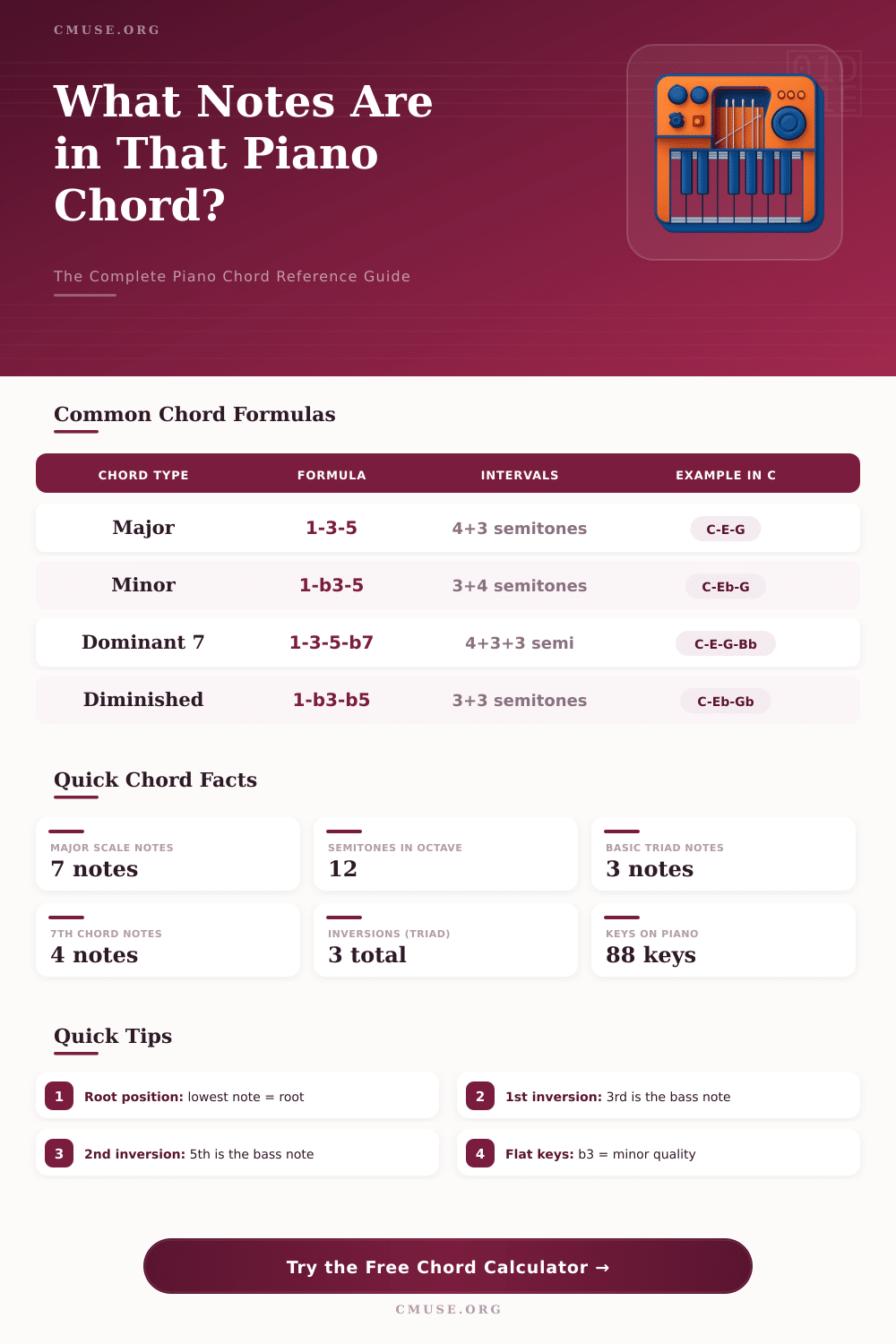
| Root | Major | Minor | Dom 7 | Major 7 |
|---|---|---|---|---|
| C | C - E - G | C - Eb - G | C - E - G - Bb | C - E - G - B |
| D | D - F# - A | D - F - A | D - F# - A - C | D - F# - A - C# |
| E | E - G# - B | E - G - B | E - G# - B - D | E - G# - B - D# |
| F | F - A - C | F - Ab - C | F - A - C - Eb | F - A - C - E |
| G | G - B - D | G - Bb - D | G - B - D - F | G - B - D - F# |
| A | A - C# - E | A - C - E | A - C# - E - G | A - C# - E - G# |
| B | B - D# - F# | B - D - F# | B - D# - F# - A | B - D# - F# - A# |
| Inversion | Bass Note | Note Order | Example (C Major) |
|---|---|---|---|
| Root Position | Root (1st) | 1 - 3 - 5 | C - E - G |
| 1st Inversion | 3rd | 3 - 5 - 1 | E - G - C |
| 2nd Inversion | 5th | 5 - 1 - 3 | G - C - E |
| 3rd Inversion | 7th | 7 - 1 - 3 - 5 | B - C - E - G |
| Semitones | Interval Name | Abbreviation | In C Scale |
|---|---|---|---|
| 0 | Unison / Root | P1 | C |
| 1 | Minor 2nd | m2 | Db |
| 2 | Major 2nd | M2 | D |
| 3 | Minor 3rd | m3 | Eb |
| 4 | Major 3rd | M3 | E |
| 5 | Perfect 4th | P4 | F |
| 6 | Tritone / Dim 5th | A4/d5 | F#/Gb |
| 7 | Perfect 5th | P5 | G |
| 8 | Minor 6th | m6 | Ab |
| 9 | Major 6th | M6 | A |
| 10 | Minor 7th | m7 | Bb |
| 11 | Major 7th | M7 | B |
| 12 | Octave | P8 | C |
Piano Chord simply keep the song together. When you understand how they work, then reading music note by note becomes much more simple, and you can create your own music. In many pop songs the singer carries the melody while the piano plays harmony in the bottom part.
The best start is with three-note Piano Chord. Here is just a nice name for a three-note Piano Chord. They appear everywhere in music because you build them by a simple rule: root, third and fifth.
Start with Three-Note Piano Chords
Mainly major and minor three-note chords, you will hear them in almost every song that you know.
Here is where it gets interesting. To build a Piano Chord you need to understand the scale it comes from. Take C major, this is C, E and G, taken directly from the C major scale.
But here is the secret: a Piano Chord really consists only of those three note names. No rule says how many tiems you play every note or where on the keyboard you place them. You can play E, G, C or C, E, G, C or even stack C twice with E and G together.
Every such arrangement gives you a different feel of the same basic Piano Chord.
The easiest way is to use both hands together. The left hand keeps the root note from the chord family. At the same time the write hand plays the whole Piano Chord.
From here everything becomes more colorful with extended chords. Add the seventh step of the scale, and suddenly you have something like Cmaj7 or Cm7. Going further, chords like C7, C9 and C11 include the seventh, ninth and eleventh interval from the root.
Each of them adds its own texture.
Understanding scales and intervals really is where the magic is. Learn a scale, and you right away know what notes belong to that key. When you get there, intervals show exactly where all chords live.
Starting with C major is easy, because you use only the white keys on the piano: C, D, E, F, G and B. The chord patterns in a key follow a fixed pattern, so if you learn it in one key, switching to another becomes much less scary.
The three chords that matter most of the time sit on the first, fourth and fifth step of the scale, and all of them are major. Trying progressions through different keys really speeds things up. As you spread those notes across the keyboard, that is called voicing.
Doubling notes fills the sound and makes it richer. When you play with someone on acoustic guitar, you can go freely: move the bass around, play high melody notes up, and then simply addfull chords here and there for texture, instead of always.