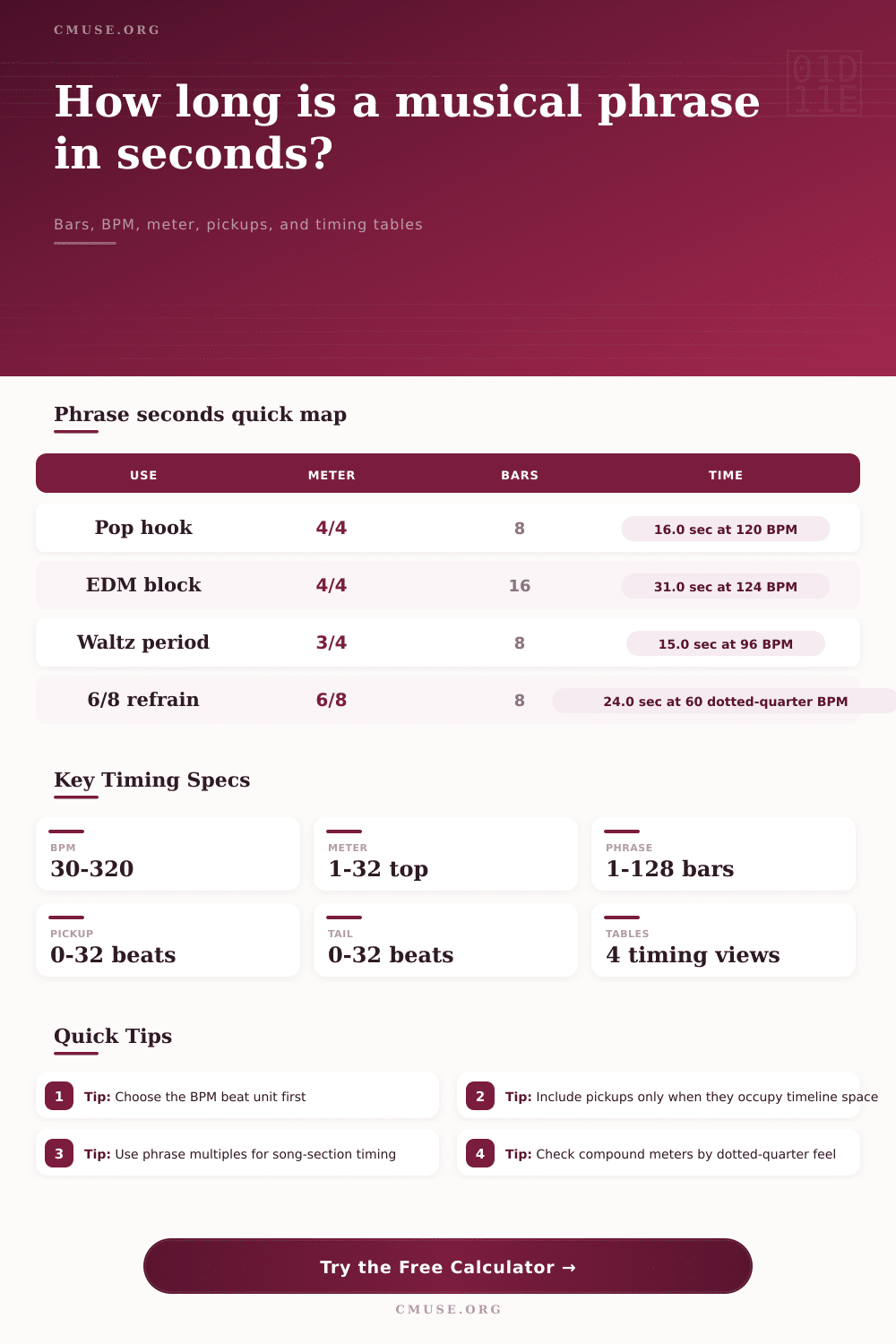
Phrase Length in Seconds Calculator
Convert a phrase from bars, BPM, and time signature into exact seconds, total beats, bar-line targets, SMPTE-friendly time, and comparison timings for common phrase sizes.
Phrase model: Full bars are timed from the meter and BPM beat unit. Optional pickup, release tail, count-in, and repeat passes can be included when they occupy real timeline time before export, rehearsal, or cue-sheet timing.
Calculation Breakdown
Notated phrase size before repeats or count-in space.
Total counted beats inside the main phrase.
Quarter-note equivalents used for tempo conversion.
Where the following phrase starts in the arrangement.
| Phrase Size | Core Seconds | With Add-Ons | Bar Target | Use Case |
|---|
The size table keeps the same tempo, meter, pickup, tail, and count-in settings while changing only the phrase bar count.
| Tempo | One Bar | Current Phrase | Repeated Total | Feel Note |
|---|
The tempo table compares nearby BPM values so you can see how small tempo changes affect phrase seconds.
| Timeline Part | Beats | Seconds | Starts | Ends |
|---|
The timeline table separates count-in, pickup, main phrase, tail, and repeat passes for cue sheets and DAW markers.
| Subdivision | Duration | Units In Phrase | Units In Total | Editing Use |
|---|
Subdivision counts help place lyric syllables, MIDI edits, risers, tremolo gates, and click-track accents inside the phrase.
What you might discover is that your vocal melody are too long for the chorus. Why? It has a catchy hook, but it drags on. Why? Because you haven’t measured out how much time you has in that section.
How long is a phrase in seconds? You aren’t just counting bars; you are learning actual time of your arrangement in real-world terms. The calculator do all the math. It turns abstract musical concepts into concrete units of seconds and frames.
Why Time Matters More Than Bars
Musicians is accustomed to thinking in bars. They can does eight bars of verse and sixteen bars of chorus with no problem. A DAW however doesn’t think in bars at all. Instead it thinks based off seconds and samples. When you’re fitting a lyrical idea into a radio edit or syncing music to video, clock time becomes more important different than the number of bars.
At 120 beats per minute an eight bar phrase will last for precisely sixteen seconds. Drop that tempo to 60 beats per minute, and those same eight bars extends into thirty-two seconds. The structure hasn’t changed at all; only the duration of the music. Duration is governed by tempo not bar count.
It also converts the tricky stuff for you. These are the compound meters. Counting in pulses of dotted-quarters? That’s what I do when I’m writing in six-eight time. The calculator allow you to find this as the beat unit. So the seconds is aligned with how you hear it in the groove. Plug in a raw number without indicating the beat unit and you may find the timing feel wrong…by a factor of three. It is a small detail but an important one if you care about accurate conversion.
You want the numbers to represent how you feel it pulsing inside you, it is not simply some abstract math. Outside of the phrase there’s nothing clean about real-world arrangements. There’s the tail where you need the reverb to breathe out before the cut-in to the next section. There’s the pickup note beginning a phrase not at the downbeat. There’s also the count-in setting the tempo.
A couple of bars of count-in doesn’t sound like much. On a quick tempo it mean four seconds of drum fills or silence. That eats away at your available timeline. The table below (on the page) show how the additional add-ons alter overall duration. In other words, it compels you to consider the spaces between notes. And those spaces are every bit as important than the notes themselves.
This is the life of film and television composers. A scene might only give you ten seconds for a transition cue. Write out a typical eight bar phrase at a moderately slow pace and you may well blow through your window. The calculator allows you to work backward from either phrase length or the tempo. You can set the number of repeats to see how a loop will behave over time.
The guesswork become precision. Instead of wondering if something will fit, you begin knowing how it will fit. The give and take in that equation is the relationship between when the music want to be played and what is physically possible on the medium. Do you love the long, slow section of a waltz? If this is a song where we need to keep moving forward, then you’ve got to cut some fat off the tune.
To make those choices comfortabley, you have to know when the right second count come along. You can shorten a pickup or tighten up a tail without losing the feel. It’s all about control. Knowing precisely how long each phrase should of last takes away the fight against the grid. Instead, you begin using it to your benefit.
You’re never not on the clock. And you don’t ever have to let it rush you, you simply have to learn to read it.