Phrase Length Calculator
Plan musical phrases by bars, meter, BPM, phrase groups, hypermeter, seconds, beat totals, cue points, and arrangement grid positions.
Calculation Breakdown
| Marker | Bar | Time | Beat Count | Use |
|---|
| Group | Bars | Start Time | End Time | Hypermeter |
|---|
| Bars | Beats | Duration | Common Role |
|---|
| Form | Typical Bars | Phrase Logic | Grid Note |
|---|---|---|---|
| Question and answer | 4 + 4 | Two balanced halves form an 8-bar period. | Mark bars 1 and 5. |
| Pop verse | 8 or 16 | Often built from two 4-bar ideas or two 8-bar periods. | Use 4-bar hypermeter. |
| EDM drop block | 16 or 32 | Loops, fills, and transitions commonly land every 8 or 16 bars. | Place cue markers early. |
| AABA standard | 32 | Four 8-bar phrases create A, A, B, and A sections. | Name each phrase group. |
| Film cue phrase | Time driven | Bars are often chosen to land the end on a visual hit. | Check seconds and frames. |
| Group Size | Meaning | Useful For | Watch Point |
|---|---|---|---|
| 2 bars | Short call-response units | Riffs, tags, turnarounds | Can feel busy at slow BPM. |
| 4 bars | Most common phrase pulse | Pop, rock, hip-hop, dance | Great marker spacing. |
| 8 bars | Full period or section half | Verses, choruses, AABA | Works well for vocals. |
| 16 bars | Long arrangement block | Builds, drops, extended cues | Add midpoint markers. |
How do you respond to timing in music? It’s generally not by accident but instead created using mathematical structures within the music itself. Guessing at tempo changes and bar counts will make for some untidy edits. What you need is a easy method of converting musical concepts into time values. To help with this, here’s a simple calculator to turn your chosen beat and bar count into seconds.
Beats are grouped by phrase lengths that the brain can anticipate. The dominant time signature in Western Music is 4/4, or four beats per measure. Multiple phrases of four bars tends to group together. A verse feels full at eight bars; a chorus can develop over sixteen. This is not set in stone, but it is the foundation that most rock, pop, and electronic music use.
How to Count Music Time
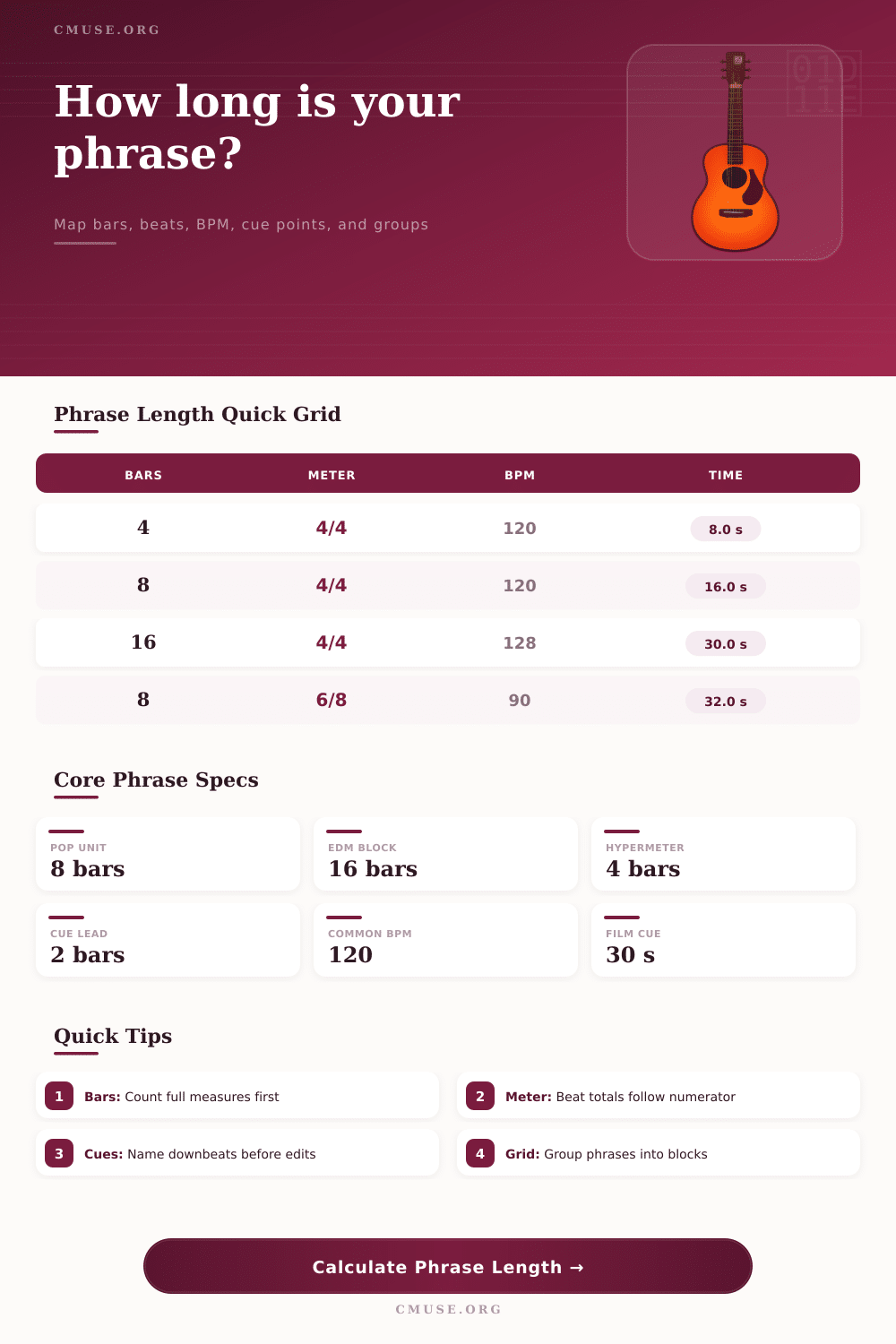
The other challenge to tackle is both tempo and meter. A lot of producers considers that if a track is 100 beats per minute it’s going to take the same length of time no matter what time signature it’s in. But they’re not right! Each pulse of a measure has a different length in 6/8 than say 4/4. Since there are six pulses (beats) within a measure in 6/8 time, each pulse are an eighth note. Adjusting the timing by not accounting for denominator of the time signature will lead to phrases of the wrong length. You can set the numerator and denominator independently. This allows tool to accurately calculate durations based off the actual rhythmic value of every bar.
At another level, bars is grouped into higher-level phrases known as hypermeter. Typically this is a set of eight or four bars. Even if you don’t count each beat, you feel where the larger section breathes. In electronic music, there’s seldom a drop on an arbitrary bar. There’ll be sixteen or thirty two bars before it arrives at a structural intersection. By knowing where these are, you can automate your filters and place your transitions. Bring in new instruments at points where listener expects something different.
The other element of synchronising music to visual material is timing. Film composers live by the second, not just the bar. Three seconds too many and a cue cuts badly. Three seconds short and there’s a gap. To translate from bars to seconds means understanding the number of beats in each bar and the BPM (beats per minute). The calculator does this for you, converting it all into linear timeline. In other words, it tells you when a phrase will finish relative to what you see on screen. It brings together technical and intuitive aspects.
When composing more complex works with several section, arrangement grids can assist. You can define your cue points and phrase groups, then view the structure of the track before you notate it. It avoids errors such as having a chorus that is only two bars long in an otherwise sixteen-bar section. The asymmetrical nature are jarring. Even with experimental melodies, having phrases that match brings order to the music.
It’s easy to forget that you don’t have to be a math wiz to nail it down; just treat the grid with some respect. The table notes will check your work and help keep phrase lengths closer than what is expected. From scoring a film to looping a sample for Hip-Hop, the bar-time relationship holds steady. Understanding this relationship lets you manipulate pace while grounding all the emotional moments in a rhythmic framework that underpins everything it touches. You should of used it to make sure your rhythm sounds naturaly good.