Phase Rotation Calculator
Convert delay, distance offset, polarity inversion, and first-order all-pass settings into phase degrees, samples, wavelength, and alignment notes.
Phase Rotation Results
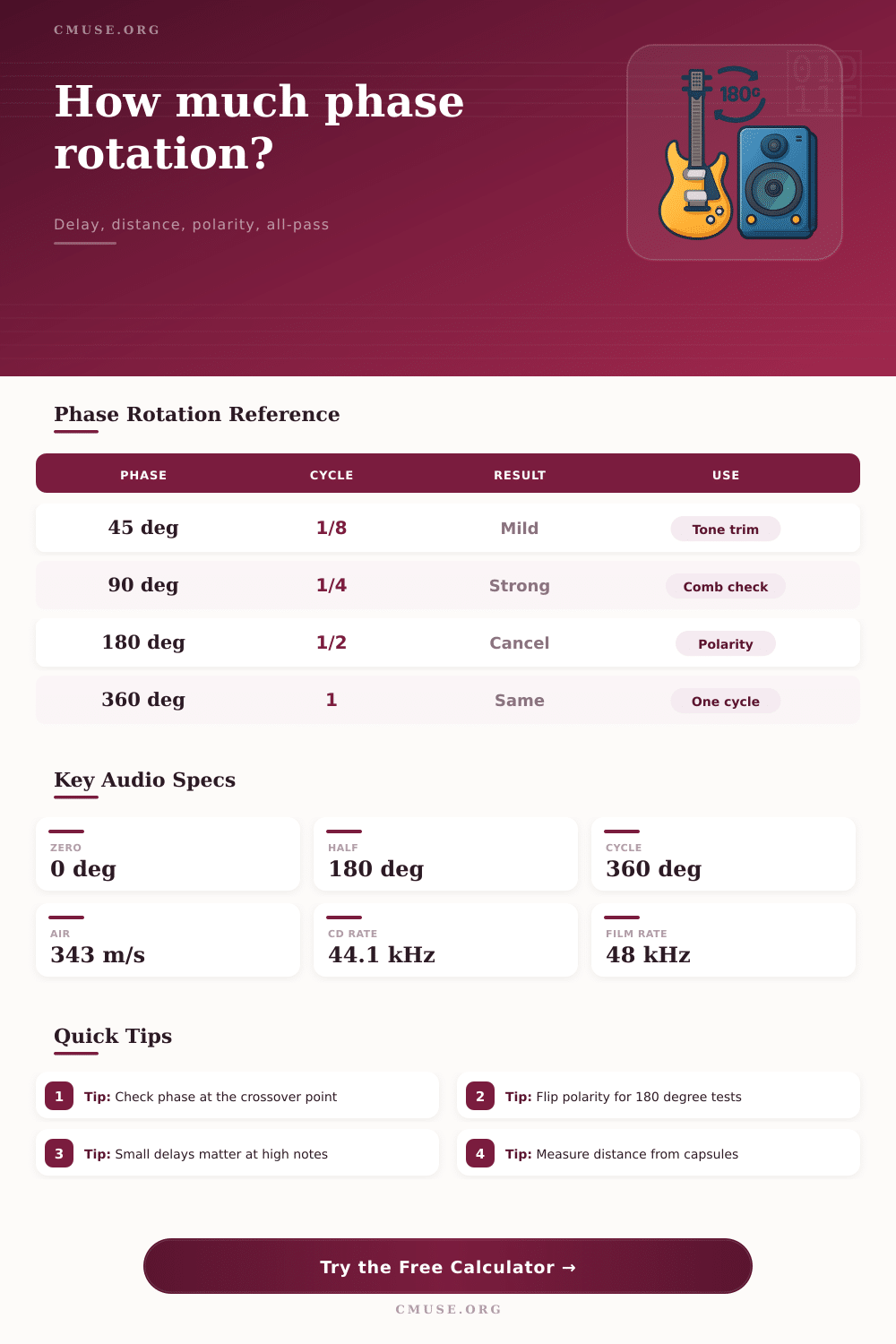
| Rotation | Cycle fraction | Delay at 1 kHz | Audio meaning |
|---|---|---|---|
| 45° | 1/8 cycle | 0.125 ms | Small tone change, usually not full cancellation |
| 90° | 1/4 cycle | 0.250 ms | Strong comb-filter shift on repeated sources |
| 180° | 1/2 cycle | 0.500 ms | Maximum narrow-band cancellation if levels match |
| 360° | 1 cycle | 1.000 ms | Same phase angle, delayed by one full period |
| Audio scenario | Typical frequency | What to enter | Primary check |
|---|---|---|---|
| Subwoofer to satellite | 70 to 120 Hz | Crossover frequency plus path offset | Keep summed response near 0° or 360° |
| Snare top to bottom | 180 to 250 Hz | Capsule spacing plus polarity invert | Compare 180° flip against low-mid punch |
| Kick in to kick out | 55 to 90 Hz | Distance between capsule positions | Watch for half-cycle low-end loss |
| Guitar cabinet mic pair | 700 to 2000 Hz | Small distance and delay moves | High mids rotate quickly with tiny offsets |
| Room mic blend | 100 to 500 Hz | Arrival delay in milliseconds | Choose musical offset or time-align deliberately |
| Frequency | Wavelength in air | Half wave | Quarter wave |
|---|---|---|---|
| 80 Hz | 14.1 ft / 4.29 m | 7.0 ft / 2.15 m | 3.5 ft / 1.07 m |
| 250 Hz | 4.5 ft / 1.37 m | 2.3 ft / 0.69 m | 1.1 ft / 0.34 m |
| 1 kHz | 1.13 ft / 0.34 m | 6.8 in / 17.2 cm | 3.4 in / 8.6 cm |
| 4 kHz | 3.4 in / 8.6 cm | 1.7 in / 4.3 cm | 0.8 in / 2.1 cm |
| All-pass input | At center frequency | Below center | Above center |
|---|---|---|---|
| First-order phase curve | -90° | Approaches 0° | Approaches -180° |
| fc = 80 Hz, f = 80 Hz | -90° | -53° at 40 Hz | -127° at 160 Hz |
| fc = 120 Hz, f = 80 Hz | -67° | Gentler shift | More rotation near fc |
| Polarity plus all-pass | Adds 180° | Wrap display decides sign | Use ears and measurement together |
Phase cancellation occur when two microphone recieve the same sound source but from different distances. The reason phase cancellation occurs is because sound travel in waves. When sound from one microphone reaches a preamp at the same time as sound from a second microphone reaches a preamp, the sound waves align at the preamp.
However, if the peak of the sound wave from one microphone coincide with the trough of the sound wave from the second microphone, the sound waves will cancel each other out. This creates a thin and hollowly sound from the speakers, and sound’s low frequency cancel completly. This is known as a phase trap within the audio mix and cant be fixed with equalization.
Phase Cancellation: What It Is and How to Avoid It
Phase isnt a binary switch to either cancel sound or allow sound to enter the microphones. Phase is a sliding scale. A person may use a polarity flip switch to even out sound from two microphones, but a polarity flip switch is only a 180-degree phase rotation.
With the sliding scale of the phase of sound waves, moving the microphone even slightly can change the sound from perfect phase to a mild tone shift or to a deep comb filter cause by phase cancellation. The phase shifts of sound are frequency dependent. This means moving the microphone a distance that create phase cancellation at 200 Hz will not necessarily create phase cancellation at 1000 Hz.
Due to this frequency dependent phase shift, a person might hear the high frequencies of a snare drum kit hit clear but the low-mid frequencies dissapears due to phase cancellation. In order to successfully engineer a sound mixing session with phase control, a person must account for every millisecond of delay in each signal chain. All signal chains has an acoustic path for sound to travel through the air to the microphone and an electrical path for digital plugins or long cables to create electrical delay.
A phase calculator can help calculating these delays. The calculator requires the person to input distance and frequencies of the sound source. Based off the distance and frequencies, the calculator will calculate the degree shift in phase for each microphone.
Each degree shift in phase will have an effect on the sound image create by each microphone. A 90-degree shift in phase will smear the sound image created by each microphone. A 180-degree shift in phase is a dangerous shift in phase setting because 180 degrees is the point where sound waves fight for survival.
The temperature in the recording or listening space will have an effect on the phase of sound waves. Sound move faster in warm air than it does in cold air. This change in the speed of sound change the wavelength of the sound.
In a professional mixing studio, this change in the wavelength of sound can change the alignment of sound between speakers. This change in sound alignment is important for the configuration of subwoofers and satellite speaker in a speaker system. For best sound, the subwoofer should be further from the listener then the satellite speakers.
This will ensure that the crossover point between the subwoofer and satellite speakers is not smear out in the listening area. For the speakers to provide the best sound for a listener, the summation of the sound from each speaker should be close to zero degrees or 360 degrees. An all-pass filter can be used to rotate the phase of sound through an audio signal.
A delay effect will shift each frequency of an audio signal by the same amount of time, but an all-pass filter will rotate each frequency of sound differently. This allow engineers to use an all-pass filter to find a specific frequency within a sound source and rotate that frequency by a specific number of degrees while leaving the rest of the sound unaffected. An all-pass filter allow for targeted phase rotation in a mix while the polarity switch is a blunt instrument.
When measuring the distance between the sound source and the microphone, a person must measure from the microphone capsule and not from the microphone grille. A small distance such as half inch of foam between the snare drum and the microphone can change the sound from a punchy sound to a thin sound. Changes in phase occur quickly in the kilohertz range of sound.
This is because the high frequencies that are used in most sound sources have shorter wavelength. Due to the shorter wavelengths of high frequencies, even the smallest movement of a microphone can cause rotation of the phase of sound through multiple full cycle. Phase is a matter of geometry and time.
When aligning a room microphone or when time-stamping a DJ monitors speaker to a musical beat, the engineer want the sound to peak at the same time and move the air in the same way. By measuring the phase of sound from each microphone, sound engineers can prevent the thin and hollow sound from being create and ensure that the low frequency of sound return to the original sound signal. They should of checked the phase first.