Phantom Power Current Calculator
Estimate microphone phantom current, per-leg P48 feed drop, delivered mic voltage, supply draw, rack capacity, and channel headroom before patching condenser microphones, active DIs, or split input systems.
Load a common studio, stage, broadcast, or location scenario. Each preset fills the phantom standard, current draw, mic count, cable resistance, supply rating, buffer, and minimum voltage target.
Phantom Power Breakdown
Per-Leg Current
Ileg = Imic / 2Balanced phantom current splits through the pin 2 and pin 3 feed resistors when the load is symmetrical.
Mic Voltage
Vmic = Vs - Ileg × (Rfeed + Rcable)The microphone sees less than the source voltage because the feed resistor drops voltage under load.
Supply Load
Itotal = Imic × mics × paths + idleThe rack or stagebox supply must cover every active phantom-powered input path at the same time.
Feed Heat
Presistor = Ileg² × RfeedEach phantom feed resistor dissipates power according to current squared, so high-current loads matter.
P48 nominal source voltage
P48 feed resistor per leg
common P48 input current limit
recommended supply planning buffer
| Mode | Nominal Source | Feed Resistors | Current Planning Note |
|---|---|---|---|
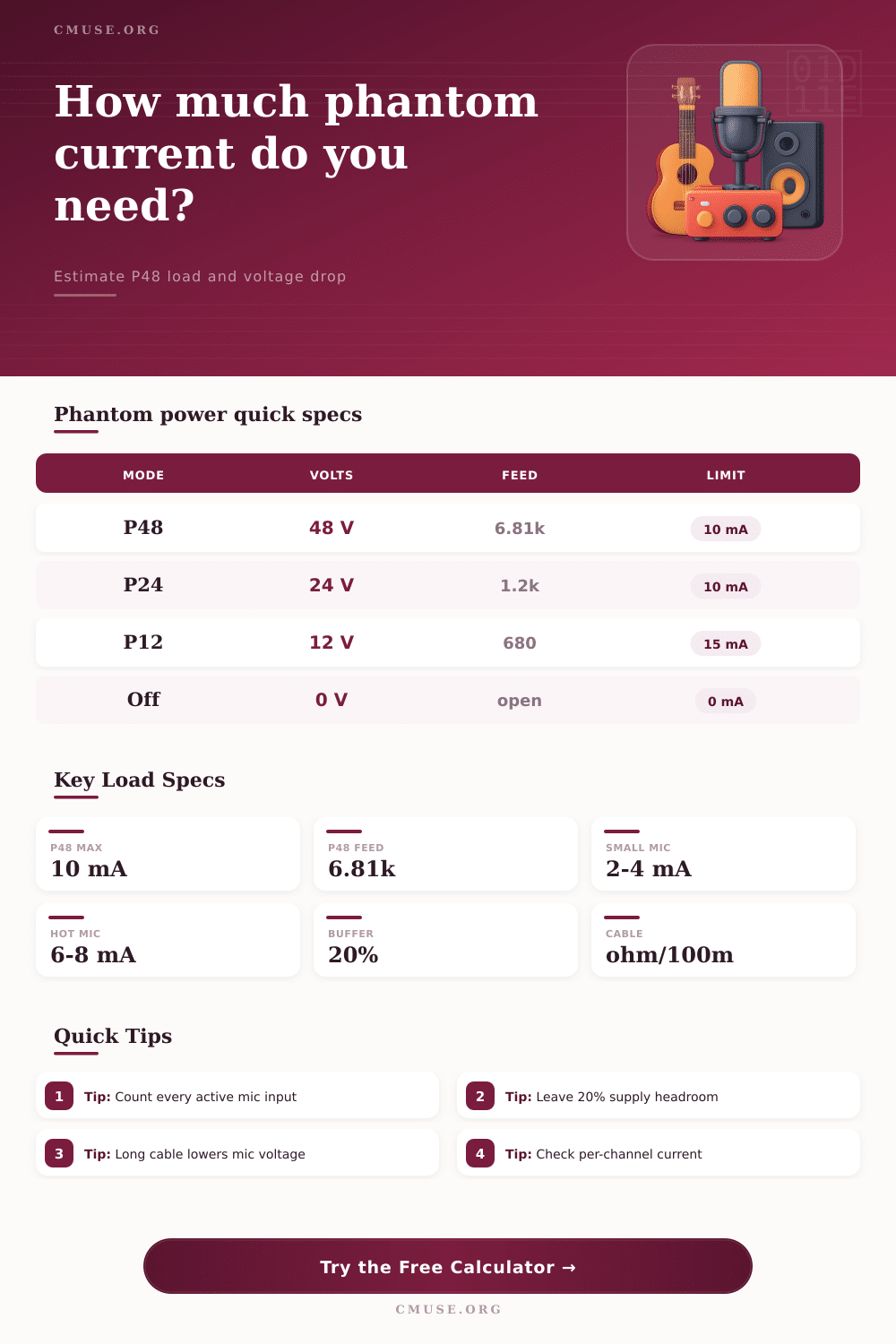
| P48 | 48 V DC | 6.81k ohms from rail to each signal leg | Most modern studio condensers and active DIs are designed for this mode. |
| P24 | 24 V DC | 1.2k ohms from rail to each signal leg | Lower source voltage, lower feed resistance, and similar current planning range. |
| P12 | 12 V DC | 680 ohms from rail to each signal leg | Used by older or specialized gear; verify the microphone supports it. |
| Custom | User-entered rail | User-entered resistor value | Useful for measured supplies, bench tests, or nonstandard field hardware. |
| Device Type | Typical Draw | Planning Current | Voltage Watch Point |
|---|---|---|---|
| Small diaphragm condenser pair | 2 to 4 mA each | 4 mA if the exact sheet is unknown | Usually comfortable on P48 with normal cable runs. |
| Large diaphragm condenser | 3 to 6 mA each | 6 mA for conservative rack planning | Voltage at the mic falls as current rises through 6.81k feeds. |
| Active DI or inline buffer | 2 to 8 mA each | Use the device data sheet value | Multiple active boxes can exceed a small interface supply quickly. |
| Boundary or gooseneck microphone | 1 to 5 mA each | Count every open conference input | Large panels are supply-current problems more than cable problems. |
| Measurement microphone preamp | 4 to 10 mA each | Check capsule preamp specification | High-current models can approach a channel limit. |
| System Size | Example Supply Rating | Load Scenario | Capacity Check |
|---|---|---|---|
| Two-input interface | 20 mA total phantom budget | Two 4 mA condensers with 20 percent buffer | About 9.6 mA planned load, usually safe. |
| Compact mixer | 80 mA total phantom budget | Eight 6 mA condensers with 20 percent buffer | About 57.6 mA planned load, moderate spare current. |
| Digital stagebox | 160 mA total phantom budget | Sixteen 5 mA inputs with 20 percent buffer | About 96 mA planned load, good rack margin. |
| Broadcast panel | 120 mA total phantom budget | Twelve 3 mA goosenecks with 25 percent buffer | About 45 mA planned load, usually supply-safe. |
| Large split rig | 300 mA total phantom budget | Thirty 6 mA active paths with 20 percent buffer | About 216 mA planned load, verify split phantom policy. |
| Cable Run | Conductor Resistance | Extra Drop At 4 mA Mic | Planning Note |
|---|---|---|---|
| 10 m studio patch | 2.1 ohms per 100 m | About 0.004 V per leg | Negligible beside the phantom feed resistor drop. |
| 50 m stage line | 2.1 ohms per 100 m | About 0.021 V per leg | Still small, but include it for long festival snakes. |
| 100 m light cable | 6.5 ohms per 100 m | About 0.013 V per mA per leg | Current draw and connector health matter more than length alone. |
| Transformer split path | varies by wiring | depends on active source side | Only one phantom source should normally power the microphone. |
| Project | Typical Inputs | Current Target | Recommended Check |
|---|---|---|---|
| Stereo acoustic recording | 2 condensers on P48 | 6 to 12 mA total | Confirm channel limit and normal 48 V source voltage. |
| Drum overhead and spot package | 6 to 10 condenser inputs | 30 to 60 mA total | Check the interface or stagebox supply rating, not only the channel count. |
| Theater lavalier rack | 12 to 32 powered adapters | 36 to 160 mA total | Use real transmitter adapter current and a large supply buffer. |
| Broadcast discussion panel | 4 to 12 gooseneck microphones | 12 to 60 mA total | Allow for every open panel channel, even when muted in the mix. |
| Live split stage | Several phantom-capable consoles | one source per mic preferred | Define which desk supplies phantom before energizing the split. |
When you plug in a condenser mic and then unplug it from your interface, does it take the USB connection down too? Don’t worry, it’s just an accounting problem. No, there isn’t a ghost in the machine… There’s just a supply of phantom power that has been exceeded.
While most engineers view phantom power as a on/off switch, it’s realy a shared pool of electricity with real-world limitations. This will help you plan ahead to avoid frying a preamp or tripping a breaker. It’s a safety budget, not guesswork.
Why Phantom Power Can Run Out
The interior of every rack mount device use the same set of power rails for all inputs. By choosing P48 mode, you’re asking a tiny switch-mode supply to send 48 volts down these rails and through high value resistors (6.81k ohms). These resistor limit fault current and serve as protection against shorts on the balanced lines.
For every milliamp of current demanded by the mic, there is a corresponding drop in voltage across the resistors. Draw too many milliamps, and the voltage drops lower then the operating threshold of the microphone capsule. This doesn’t cause the sound to cut out immediately. Instead, it simply becomes quieter/noisier as the internal preamp struggle to keep up.
That’s only part of it: you’ve got to count the inputs, but you also must count what they’re actualy sucking down. While some diaphragm vocal mics may sip at just 2 milliamps, a high-output measurement capsule may gulp at 10 milliamps. The problem is this: that budget interface are only rated at 80 milliamps total. Plug in five of those heavy-draw mic, and you’ve got a problem.
The calculator does the math for you, it adds up all those individual draws and compares it to how much your supply can put out. Because power supplies heats up when loaded near their limit and tend to degrade over time, it applies a safety buffer.
The other factor is that there’s more resistance due to the length of the cable. While typical mic cable isn’t high resistance, any appreciable run can add up, particularly in larger venues and onstage. The resistor calculator includes the effect of resistance per 100 meters of conductors. Though much less important as a voltage drop factor, it come into play in those cases where you’re already realy testing the limits of your power source. Even though available current may be just inside the spec, a cable running 100 meters may drop the output too far below minimum operating voltage for a sensitive mic.
Prevention is the best cure: Plan ahead. Don’t just patch it all up, turn it on and pray that it works. Count how many mics you are going to use. Then, use the datasheet to guess how much power they will draw. See if that total is over the limit of your chosen stagebox or interface. What do you find? Either way, you have options.
You can either swap out some battery/powered DIs or other passive units for active ones, reducing the amount of phantom-powered channels running at once. Or you could upgrade to a larger, beefier stagebox with a better power source. Better to know about this conflict beforehand than during a performance when the sound start cutting out.
Don’t think of reducing phantom power just because you can. Consider instead that being unseen is only as good as it lasts. Don’t treat phantom power like an endless supply of utility. Don’t assume the best thing you can do is reset the whole recording chain in hopes it works next time. Honor the limits, keep the head room and leave yourself some wiggle room for the inevitable load that arrives on opening night. You should of planned better.