Percent ALcons Calculator
Estimate consonant loss, STI equivalent, critical distance, and limiting listener distance from RT60, room volume, source directivity, and listener range.
Speech Intelligibility Result
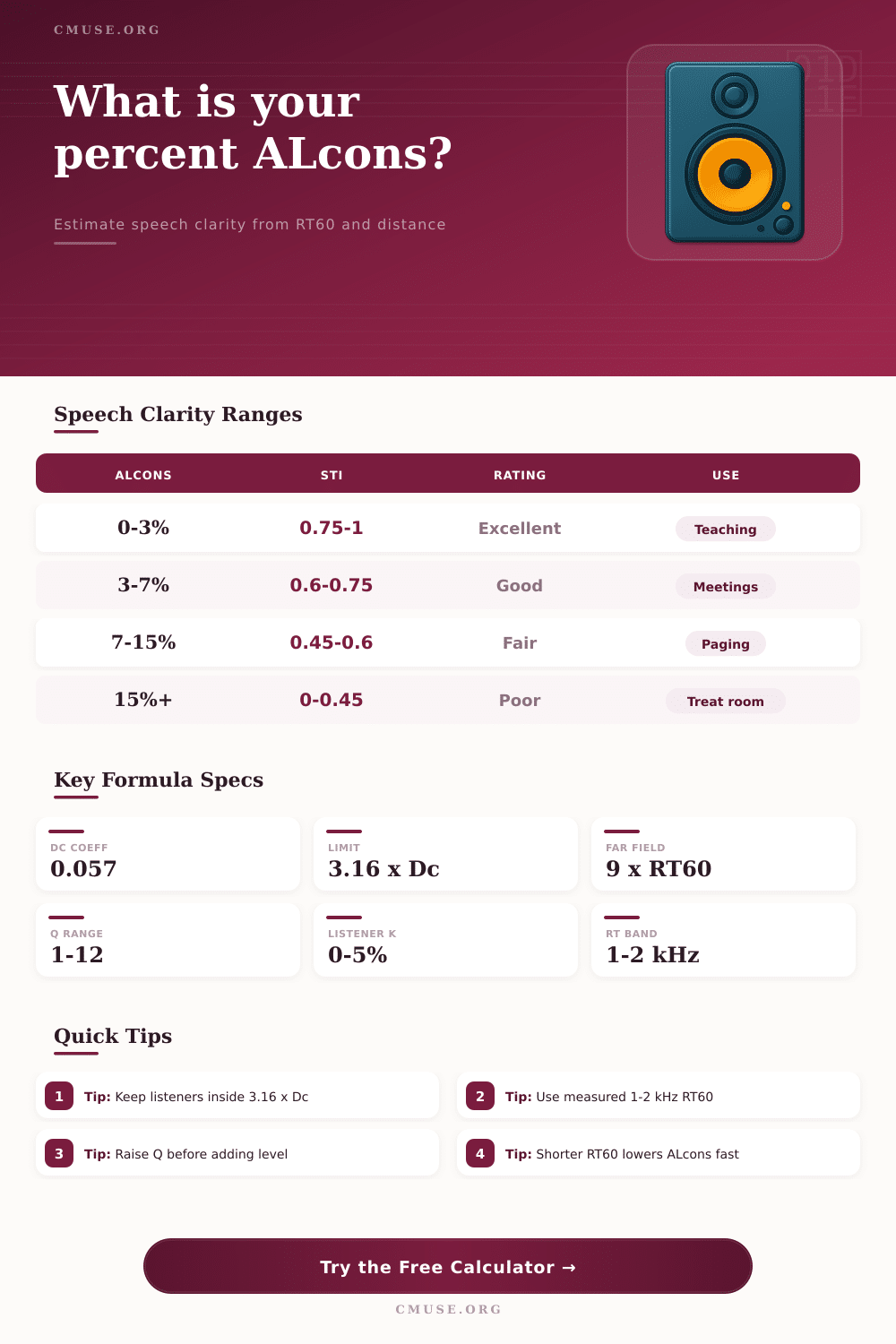
| %ALcons | Approx. STI | Speech Rating | Practical Reading |
|---|---|---|---|
| 0-3% | 0.75-1.00 | Excellent | Strong clarity for teaching, lecture capture, voice alarm, and detailed spoken content. |
| 3-7% | 0.60-0.75 | Good | Usually clear for meetings, spoken-word playback, guided tours, and normal announcements. |
| 7-15% | 0.45-0.60 | Fair | Acceptable for simple paging, but consonants may blur with fast speech or noise. |
| 15-33% | 0.30-0.45 | Poor | Listeners work hard; shorten distance, lower RT60, improve directivity, or add delay zones. |
| 33%+ | 0.00-0.30 | Unacceptable | Speech is likely unreliable without major acoustic or sound-system changes. |
| Space | Typical Volume | RT60 Range | Expected Challenge |
|---|---|---|---|
| Voice booth | 10-30 m³ / 350-1,060 ft³ | 0.15-0.35 s | Very short RT; distance is usually the smallest risk. |
| Classroom | 180-350 m³ / 6,350-12,360 ft³ | 0.45-0.80 s | Back seats need enough direct sound and low noise. |
| Lecture hall | 800-2,500 m³ / 28,250-88,300 ft³ | 0.70-1.30 s | Balcony and rear seats often sit near or beyond the limiting distance. |
| Worship room | 1,500-8,000 m³ / 53,000-282,500 ft³ | 1.20-3.00 s | Music-friendly reverberation can mask consonants unless directivity is controlled. |
| Gym or arena | 4,000-20,000 m³ / 141,000-706,300 ft³ | 1.80-4.00 s | High RT and long throws can push ALcons into poor territory quickly. |
| Source Type | Q Value | Directivity Index | Best Use in ALcons Work |
|---|---|---|---|
| Unaided talker or omni source | 1 | 0 dB | Short listening distance in treated rooms. |
| Wall-backed talker or broad speaker | 2 | 3 dB | Small rooms where reflections are moderate. |
| Typical forward loudspeaker | 4 | 6 dB | Conference, classroom, and small performance speech. |
| Controlled PA cabinet | 6-8 | 8-9 dB | Longer rooms where direct-to-reverberant ratio matters. |
| Narrow horn or column beam | 12+ | 11 dB+ | Reflective venues, balconies, and high-ceiling speech systems. |
| Preset | Dimensions | RT60 | Listener Distance |
|---|---|---|---|
| Podcast table | 5.5 x 4.5 x 2.7 m / 18 x 15 x 9 ft | 0.35 s | 1.4 m / 4.6 ft |
| Classroom front | 9 x 7 x 3 m / 30 x 23 x 10 ft | 0.65 s | 7 m / 23 ft |
| Lecture hall | 28 x 18 x 7 m / 92 x 59 x 23 ft | 1.10 s | 22 m / 72 ft |
| Gym announcement | 38 x 24 x 10 m / 125 x 79 x 33 ft | 2.40 s | 30 m / 98 ft |
Percent articulation loss of consonants, or ALcons for short, is a measurement that calculates the percentage of consonant detail that listeners lose in a given space. This percentage is calculated by entering information regarding the volume of the space, the RT60 of the space, the distance from the speaker to the listener, the directivity of the loudspeaker, the number of loudspeaker that are being used, and the listener factor. Each of these factors interact with each other to create the final percentage for the ALcons calculation.
Each factor influences how the others, which help to create the percentage. For example, long reverb times in small spaces is often acceptable if the listener is close to the loudspeaker. However, long reverb times within large spaces will lead to more higher percentages of lost consonants by listeners.
ALcons: How We Measure Lost Consonant Sounds
Thus, the factors of the volume of the space and the RT60 of the space is required for calculation. Additionally, the far-field limit of loudspeakers is another calculation that the calculator uses. When the distance between the loudspeaker and the listener is three times than the critical distance, the distance formula changes for the calculation.
Instead, the calculation changes to the reverb-based ceiling to ensure that the percentage calculated is accuratey. ALcons is a number that indicates the cleanness of speech for the listener. If the percentage is below three, speech will remain crisp, even at fast rates.
If the percentage is between three and seven, individuals will be able to follow the conversation without difficulty. However, percentages above fifteen indicate that the consonants in speech will blur, making paging system less reliable. Additionally, the percent articulation loss of consonants can be converted to a speech transmission index, which others often use to rate the same space.
Reference tables can be used to contextualize the percent articulation loss of consonants calculations. These reference tables indicates the behavior of different types of rooms, and different factors related to the directivity of loudspeakers. For instance, a loudspeaker system with a column array and a Q of eight will behave differently in a space than an omnidirectional ceiling speaker system of the same size.
Additionally, changing the directivity of loudspeakers from a Q of four to a Q of eight will reduce the percent articulation loss of consonants. Thus, the directivity of loudspeakers are an important factor in the calculation of percent articulation loss of consonants. Real rooms often dont meet the conditions that are specified in the formula.
For instance, the presence of people, furnitures, and various reflective surfaces will alter the decay time within a space. The calculation use the 1-2 kHz range of sound because this range of frequencies carries the majority of the consonant information for speech. However, it is possible for the room to sound poorly in terms of speech clarity despite good measurements for the 1-2 kHz range if there is low frequency buildup within the space.
Additionally, it is also important to include a noise margin in relation to speech; speech will not be intelligible if there is background noise in the space. Background noise will make it difficult for individuals to hear the speaker, regardless of how good the rooms size may be for speech. The percent articulation loss of consonants percentage can be used to make changes to a space.
For instance, if the percentage is too high, it may be beneficial to move the listener closer to the loudspeaker. Alternatively, decreasing the decay time or increasing the directivity of the loudspeaker may lead to a lower percentage. Additionally, aiming the loudspeaker more towards the listener may also help to reduce the percent articulation loss of consonants.
Finally, the percentage may indicate that alterations is needed in the space, such as adding absorption to the space or using a delay-fill loudspeaker to ensure that speech can reach those at the back of the space. Overall, the percent articulation loss of consonants calculation allows for individuals to make these alterations instead of focusing on the coefficients necessary to calculate such a percentage.