Peak Power to RMS Calculator
Convert peak watts, peak voltage, or peak current into RMS values for audio signals, bench tests, and waveform checks using the correct crest factor.
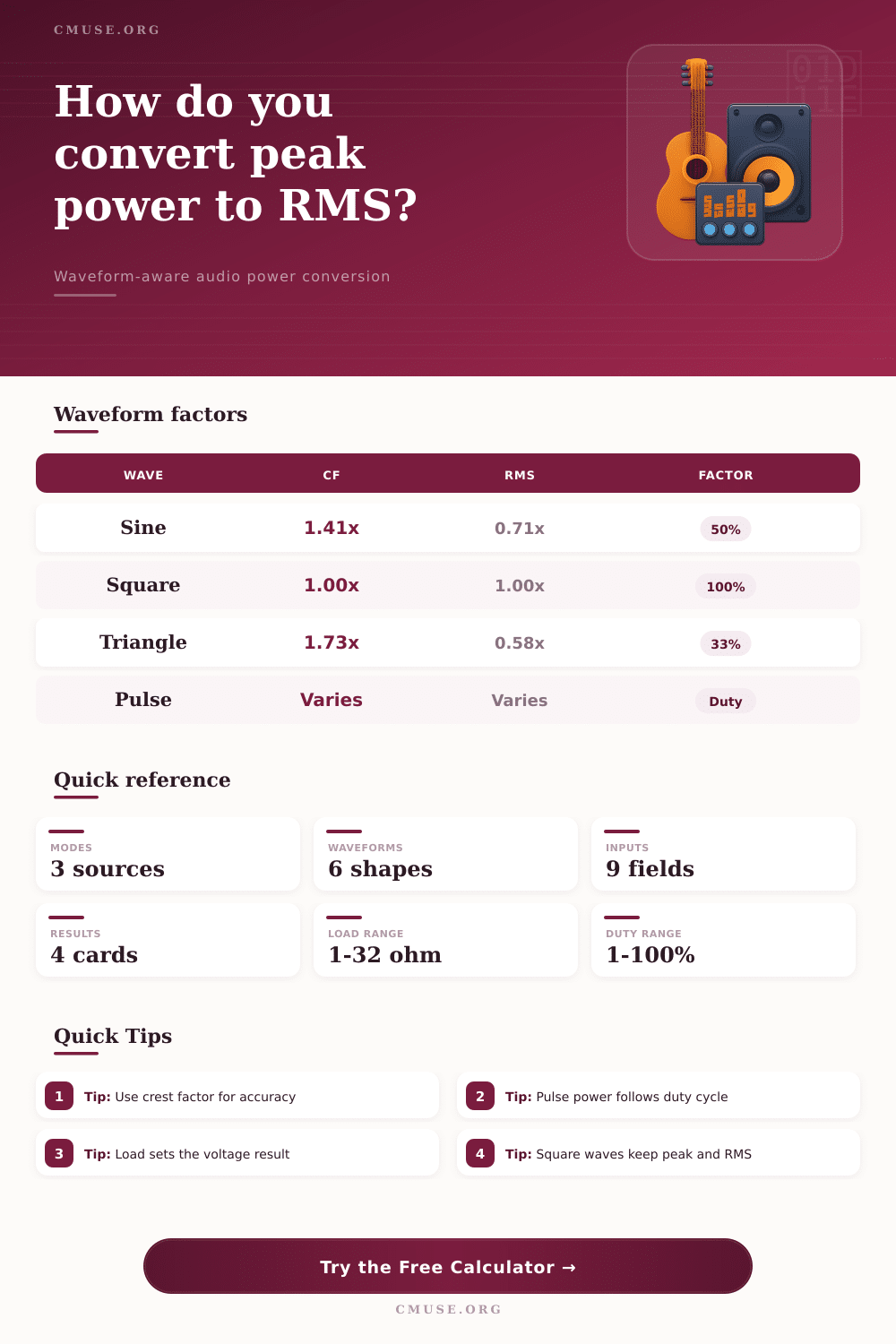
| Waveform | Crest factor | RMS factor | Power factor |
|---|---|---|---|
| Sine wave | 1.414x | 0.707x | 50.0% |
| Square wave | 1.000x | 1.000x | 100.0% |
| Triangle wave | 1.732x | 0.577x | 33.3% |
| Sawtooth wave | 1.732x | 0.577x | 33.3% |
| Input source | Quick formula | Load needed | Best for |
|---|---|---|---|
| Peak power | P rms = P pk / CF^2 | No | Power estimates |
| Peak voltage | V rms = V pk / CF | Yes | Amplifier checks |
| Peak current | I rms = I pk / CF | Yes | Load testing |
| Pulse train | CF = 1 / sqrt(D) | No | Burst signals |
| Scenario | Peak value | RMS value | Note |
|---|---|---|---|
| 1 kHz sine | 100 W | 50 W | Classic half power |
| Square test | 48 W | 48 W | Peak equals RMS |
| 12 dB crest music | 250 W | 15.8 W | High headroom |
| 25% pulse | 200 W | 50 W | Duty drives RMS |
| Load | Peak to RMS example | Use case | Reminder |
|---|---|---|---|
| 4 ohm | 28 V pk = 7 W rms | Small amp test | Watch current draw |
| 6 ohm | 30 V pk = 8.3 W rms | Mid load check | Verify rating |
| 8 ohm | 28 V pk = 4.9 W rms | Speaker bench | Common reference |
| 16 ohm | 28 V pk = 2.5 W rms | Light load | Higher voltage only |
Tip: Use crest factor first when the waveform is not a pure sine, because peak power alone can overstate the RMS load.
Tip: For speaker and amplifier work, check the load impedance before trusting voltage or current values from a peak reading.
Peak power and RMS power is two different ways to measure the power of an audio amplifier. Peak power is a measurement of the highest momentary spike in an audio signal. Peak power is the maximum amount of power that an amplifier can provide for a very short period of time.
RMS power, on the other hand, is a measurement of the average power of an audio signal over a period of time. RMS power are an important measurement because it represents the continuous power that an audio amplifier can provide without overheating teh device. If you use the peak power rating to determine the power that an audio amplifier will provide, you might make mistakes due to the fact that the peak power ratings are usually much higher than the continuous power that the amplifier can provide.
Peak Power vs RMS Power in Audio Amplifiers
The relationship between peak power and RMS power are based off the type of waveform that is used. A sine wave is one of the most common types of waveform used to test audio amplifiers. For a sine wave, the RMS power is half of the peak power; therefore, if an audio amplifier can provide 100 watts of peak power with a sine wave, the RMS power will be 50 watts.
A square wave is another type of waveform. For a square wave, the RMS power and the peak power is equal. A triangle wave is another type of waveform with a different crest factor than a sine wave or a square wave; for a triangle wave, the RMS power is one-third of the peak power of the triangle wave.
Load impedance is one more factor to consider in the relationship between peak and RMS power. Impedance is the resistance of the speaker to the current from the audio amplifier. Impedance is measured in units of ohm.
Most speaker have an 8-ohm load. If the load is 4 ohms, the current will be higher due to the change in resistance of the load. RMS power must also be calculated with the load impedance of the speaker.
Music is much more complex than a sine wave. For music signal, the crest factor is high. The crest factor is the difference between the peak level of the signal and the average level of the signal.
Music has a high crest factor because of the very high peaks of the musical signal. The RMS power of music will be much lower than the peak power of music. For example, music with a 250-watt peak power may only have 16 watts of RMS power.
It is important to understand that RMS power is lower than peak power for music; otherwise, people may think the audio amplifier is more powerfuler than it truly is when playing music. Heat is another important issue to consider for audio amplifier. The RMS power of an audio amplifier will determine how much heat the amplifier creates.
Higher levels of RMS power mean that the amplifier will overheat. The RMS power rating of an audio amplifier should be used to determine how much heat the device will create and to prevent overheating of the device. The peak power of an audio amplifier can damage the device due to the excess current being provided to the speaker.
RMS power will not damage an audio amplifier or speaker. When choosing audio amplifiers, you should of prioritized the RMS power ratings to ensure that the audio equipment can handle the heat created during extended use of the audio equipment. The RMS power of an audio amplifier can be calculated using the peak voltage of the audio signal and the load impedance of the speakers.
Given the peak voltage and the impedance of the speaker, mathematical calculation can determine the RMS power of the audio system. The type of waveform used for the audio signal is another important factor in calculating RMS power. If the audio signal is a square wave, the peak power and the RMS power will be the same value.
If the signal is a sine wave or a triangle wave, however, the peak power and RMS power value will not be the same. Using the peak voltage, the load impedance, and the type of waveform of the audio signal can reveal a reliable RMS power of the audio system.