Passive Radiator Subwoofer Calculator
Calculate passive radiator moving mass, added weight, box tuning, net volume, equivalent port size, and excursion headroom for PR subwoofer enclosures.
🔊 Passive Radiator Presets
⚙ Enclosure And Driver Inputs
🎚 Passive Radiator Inputs
📊 Passive Radiator Spec Comparison
📝 Tuning And Volume Reference
| Use Case | Typical Fb | Box Volume Range | Result Character |
|---|---|---|---|
| Compact desktop sub | 40 to 55 Hz | 0.20 to 0.55 ft³ / 6 to 16 L | Tight upper bass with limited deep output. |
| Small music sub | 32 to 42 Hz | 0.45 to 0.95 ft³ / 13 to 27 L | Balanced extension for nearfield and stereo rooms. |
| Hi-fi 10 or 12 inch | 26 to 34 Hz | 0.90 to 1.80 ft³ / 25 to 51 L | Good music depth with moderate cone control demands. |
| Home theater deep tune | 18 to 26 Hz | 1.50 to 4.00 ft³ / 42 to 113 L | More low bass, more passive radiator travel required. |
| Large high-output sub | 16 to 24 Hz | 2.50 to 6.50 ft³ / 71 to 184 L | Needs large PR area, long stroke, and careful mass limits. |
📏 Passive Radiator Displacement Ratios
| PR Vd / Driver Vd | Margin Rating | Best Fit | Design Note |
|---|---|---|---|
| Below 1.5x | Low | Light listening only | Radiator may bottom near tuning before the driver reaches its clean limit. |
| 1.5x to 2.0x | Basic | Moderate music boxes | Often workable, but limiters or high-pass filtering are wise. |
| 2.0x to 3.0x | Strong | Most subwoofer builds | A common target range for practical PR subwoofer headroom. |
| 3.0x to 4.0x | High | Deep home theater | Useful when tuning low or using powerful long-throw drivers. |
| Above 4.0x | Very high | Large dual-opposed systems | Generous excursion capacity, but check physical fit and total mass. |
⚖ Moving Mass Adjustment Table
| Calculated Added Mass | Meaning | Likely Action | Risk To Check |
|---|---|---|---|
| Negative value | Factory Mmp is already too heavy | Use a larger box, higher Fb, or lighter PR | Actual tuning lands below target if mass cannot be removed. |
| 0 to 50 g | Small adjustment | Add washers or manufacturer plates | Secure the hardware so it cannot rattle loose. |
| 50 to 200 g | Moderate adjustment | Use centered threaded mass kit | Recheck clearance behind the radiator at full travel. |
| 200 to 500 g | Heavy adjustment | Verify suspension and bolt limit | High stress can sag soft suspensions over time. |
| Above limit | Radiator is undersized or too light | Add PR count, area, or choose heavier unit | Do not exceed the stated moving-mass hardware rating. |
📦 Common PR Subwoofer Starting Points
| Project | Active Driver | Passive Radiator Layout | Common Target |
|---|---|---|---|
| Mini desktop cube | 6.5 inch, 4 mm Xmax | One 6.5 inch PR | 0.30 ft³ / 48 Hz for compact punch. |
| Bookshelf sub | 8 inch, 6 mm Xmax | Two 6.5 inch PRs | 0.60 ft³ / 34 Hz for music extension. |
| Studio monitor sub | 10 inch, 7 to 9 mm Xmax | One or two 10 inch PRs | 0.85 to 1.10 ft³ / 28 to 34 Hz. |
| Home theater sub | 12 inch, 12 mm Xmax | Two 12 inch PRs | 1.75 ft³ / 24 Hz with strong displacement margin. |
| Large room sub | 15 inch, 14 mm Xmax | Two 15 inch PRs | 2.70 ft³ / 22 Hz or larger for deep output. |
A passive radiator is a component that is used in a subwoofer box in place of a port. This component allow for low tuning frequencies to be achieved in small enclosures for the subwoofer. Unlike a port, which require a physical hole and a tube to the subwoofer, a passive radiator dont require a hole or a tube to perform its function.
The passive radiator use a weighted diaphragm to move the air within the subwoofer. Additionally, the passive radiator act as a speaker driver but does not have the necessary component to produce movement within the subwoofer box, such as a motor, coil, or magnet. Instead, the passive radiator relies upon the movement of the active speaker driver to move, and the air pressure within the subwoofer enclosure control the movement of that speaker.
Passive Radiators in Subwoofer Boxes
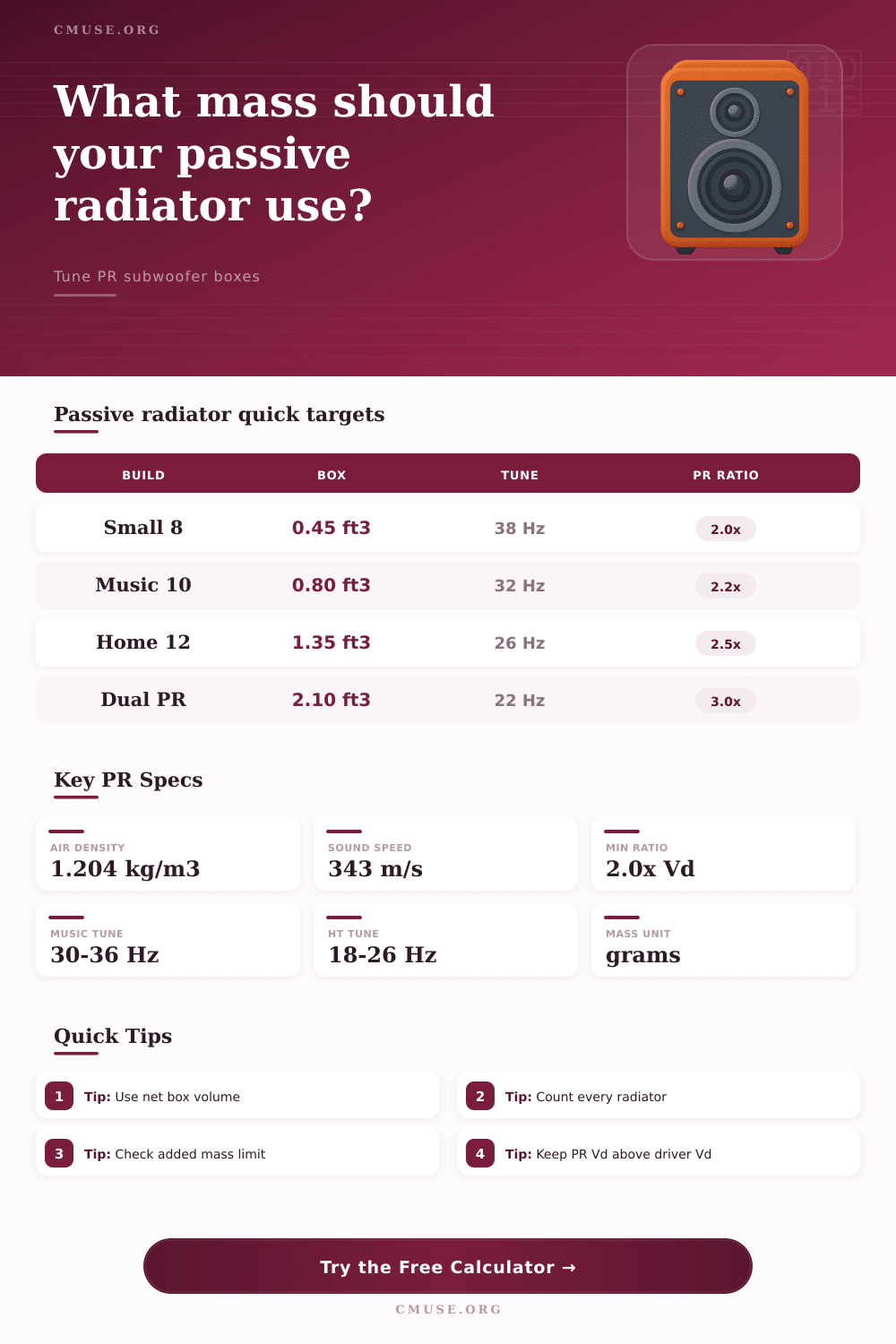
The tuning frequency for a passive radiator box is based off the volume of air within the box and the total moving mass of the passive radiator. If the moving mass of the passive radiator is too low, then the tuning frequency will be too high for the passive radiator enclosure. A high tuning frequency result in a loss of deep bass from the subwoofer.
However, if the moving mass of the passive radiator is too high, the tuning frequency will be too low for the passive radiator. A low tuning frequency with a passive radiator result in slow bass from the subwoofer. To find the correct tuning frequency, the designer should balance the weight of the passive radiator with the volume of air within the passive radiator box.
One of the measurements that must be made for a passive radiator is the net volume of the box. You can find the net volume of the box by subtracting the volume of the active driver from the total volume of the subwoofer box. Additionally, you must also subtract the volume of any bracing within the subwoofer box from the total volume of the subwoofer enclosure.
This value is important in determining the total volume of air that move against the passive radiator. If the volume of the brace is not accounted for in the measurement of the total box volume, then the volume of air within the box will be incorrect. An incorrect measurement for the volume of air within the enclosure will result in an incorrect tuning frequency for the passive radiator.
Another factor that a person must consider when building a passive radiator enclosure is the displacement ratio, or Vd. The displacement ratio for a passive radiator box is the total volume of air that the passive radiator can move compared to the volume of air that the active speaker driver move. Because the passive radiator performs the same function as a port, the passive radiator must be able to move significantly more air than the active driver in the subwoofer.
If the passive radiator is too small for the subwoofer enclosure, it will reach its limit or “bottom out” in the box before the active driver in the subwoofer do. In addition to the other factors that must be considered when building a passive radiator system, adding additional mass to the passive radiator can also adjust the tuning frequency of that system. The factory weight of the passive radiator may not allow for the correct tuning frequency for the subwoofer box.
By adding additional weight to the passive radiator, you can increase the moving mass of the passive radiator to allow for the desired tuning frequency. However, you must take care when adding additional mass to the passive radiator. Each passive radiator have a maximum weight limit.
If too much weight is added to a passive radiator, the suspension for the passive radiator may sag, or the glue that attaches the passive radiator to the subwoofer box may fail. If the calculations for the subwoofer indicate the need for a significant amount of added moving mass for the passive radiator, a second passive radiator should be used rather than adding additional weight to the first passive radiator. Another way of arranging the passive radiators is in a dual opposed arrangement.
In a dual opposed arrangement, two passive radiators are placed on the opposite sides of the subwoofer box. If only a single passive radiator is used, the movement of the passive radiator will cause the subwoofer box to rock back and forth. This rocking of the box will cause unwanted vibrations in the subwoofer box.
By using two passive radiators in a dual opposed arrangement, the two forces created by the passive radiators will cancel each other out. These opposing forces will prevent the subwoofer box from rocking back and forth due to the movement of the passive radiator. Additionally, the dual opposed arrangement will double the area of the passive radiator that moves the air within the subwoofer box.
By increasing the area that move the air in the subwoofer, it will be easier to achieve low tuning frequencies without overexerting the suspension of the passive radiators. Overall, to build a successful passive radiator system, a person must ensure that the volume of air within the box, the moving mass of the passive radiator, and the movement of the air within the subwoofer are all balance with one another. By building this system, the passive radiator will function as a mechanical filter that will allow low frequencies of sound to pass through the passive radiator.
By verifying that there is sufficient headroom and moving mass for the passive radiator, the passive radiator will allow the subwoofer to create low frequencies of sound within a small enclosure. You should of checked the dimensions carefully so the furnitures fits correctly. It isnt easy to get the tuning right but its worth it for the bass.