Pascal to dB Calculator
Convert acoustic pressure into sound pressure level using the standard 20 µPa air reference, with RMS, peak, calibration, and distance correction options.
🎵 Specific Audio Presets
Enter the measured acoustic pressure and choose how it was captured. The calculator converts the input to RMS pascals first, then applies SPL, pressure ratio, approximate intensity, and free-field distance math.
🎚 Pressure Inputs
Calculation Breakdown
📊 SPL Spec Grid
🔎 Pascal to dB Reference Table
| RMS Pressure | Equivalent Pressure | dB SPL | Typical Audio Context |
|---|---|---|---|
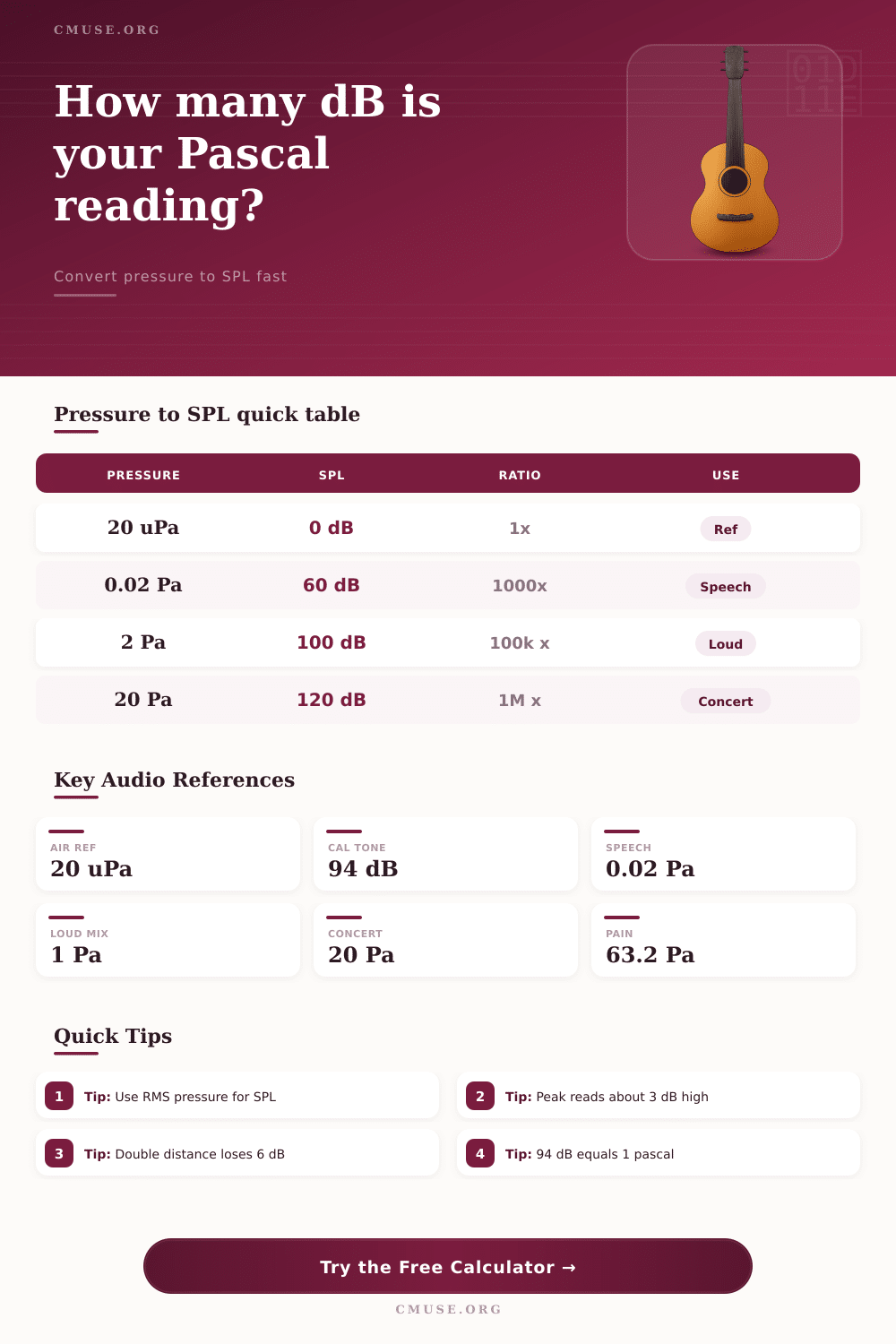
| 0.000020 Pa | 20 µPa | 0 dB | Standard threshold reference in air |
| 0.000200 Pa | 200 µPa | 20 dB | Very quiet recording space |
| 0.002000 Pa | 2 mPa | 40 dB | Quiet control room background |
| 0.020000 Pa | 20 mPa | 60 dB | Normal speech near one meter |
| 0.200000 Pa | 200 mPa | 80 dB | Loud piano or vocal rehearsal |
| 1.000000 Pa | 1000 mPa | 93.98 dB | Common 1 Pa acoustic calibrator point |
| 2.000000 Pa | 2 Pa | 100 dB | Club monitor or loud front fill |
| 20.000000 Pa | 20 Pa | 120 dB | Very loud concert PA zone |
⚙ Unit Conversion Table
| Input Unit | Pascal Factor | Example | Audio Note |
|---|---|---|---|
| Pascal (Pa) | 1 | 1 Pa = 93.98 dB SPL | Best unit for most acoustic formulas |
| Millipascal (mPa) | 0.001 | 20 mPa = 60 dB SPL | Useful for speech and room noise levels |
| Micropascal (µPa) | 0.000001 | 20 µPa = 0 dB SPL | Standard SPL reference scale in air |
| Microbar (µbar) | 0.1 | 10 µbar = 1 Pa | Older acoustic measurement unit |
| PSI | 6894.757 | 0.000145 psi = 1 Pa | Rare for audio, but useful in conversions |
📏 RMS, Peak, and Distance Table
| Setting | Calculator Action | dB Effect | When to Use |
|---|---|---|---|
| RMS pressure | Uses the value directly | 0 dB | Sound level meters and SPL specs |
| Peak pressure | Divides pressure by square root of 2 | -3.01 dB | Oscilloscope or waveform peak readings |
| Peak-to-peak pressure | Divides pressure by 2 times square root of 2 | -9.03 dB | Peak-to-peak waveform measurements |
| Distance doubled | Applies 20 log10(old / new) | -6.02 dB | Free-field source estimates |
| Distance halved | Applies 20 log10(old / new) | +6.02 dB | Close-mic or listener position checks |
🎙 Common Audio Scenario Table
| Scenario | Pressure | SPL Result | Calculation Use |
|---|---|---|---|
| Studio noise floor target | 0.000632 Pa | 30 dB SPL | Check isolation and HVAC background readings |
| Podcast speech at mic position | 0.0632 Pa | 70 dB SPL | Compare voice level before preamp gain choices |
| Vocal booth loud singer | 0.632 Pa | 90 dB SPL | Estimate capsule level and pad needs |
| Drum kit overhead zone | 6.32 Pa | 110 dB SPL | Check mic headroom and hearing safety notes |
| Front-of-house loud point | 20 Pa | 120 dB SPL | Compare measured pressure against system limits |
Sound moves in air as a series of pressure change that the ears or microphones can detect as loudness. Those pressure changes can be converted into decibels to allow for the comparison of one sound level to another. Converting the pressure change to decibels is helpful because it allows for the comparison of sound levels that has different measurement units.
The two values must be measured in terms of the relationship between the sound pressure and the decibel measurement. The source of the pressure reading will indicate how the sound decibel are calculated. For instance, if a sound level meter is used, the reading will feature an RMS value that you can directly translate into sound pressure level decibels.
How to Measure Sound in Decibels
For devices like an oscilloscope, however, the reading might be the peak value of the sound wave. In this case, the value will need to be divide by the square root of two to calculate the sound pressure level in decibels. For peak to peak sound wave measurements, another adjustment will be necessary to account for the difference between peak to peak and RMS sound measurements.
Using the wrong basis for the measurement will result in the sound level being represented as three or nine decibels off from the actual sound level. Such an error may place individuals in a potentially dangerous sound environments or expose them to a safe environment. The reference value will also have to be chosen for the sound measurement.
In air, the reference pressure will be twenty micropascals, but in water, it will be one micropascal. Because the reference sounds are different in each medium, the sound decibel scale will shift according to the medium being measured. For instance, a sound pressure reading of one pascal will equal approximately ninety-four decibels in air using a reference pressure of twenty micropascal.
However, the same sound pressure value will fall at a different point on the sound decibel scale for water. Although the calculator will make the arithmetic for you once you choose the medium, you will have to make the selection yourself as the individual who know the medium of the sound being measured. Distance from the sound source will impact the sound level in decibels.
The farther the listener is from the sound source in a free field, the more the sound pressure will diminish with the square of the distance between the sound source and the listener. Thus, if the distance between the listener and the sound source is doubled, for example, the sound level will drop by six decibel. Conversely, if the distance between the listener and the sound source is halved, the sound level will rise by six decibels.
Because most listening spaces are not free fields, the sound will not follow this rule. However, the relationship between distance and sound levels may still be of use to you in determining the sound level at various distance from the sound source. Sound measurements may also have to be calibrated to account for environmental conditions.
Because sound meters drift over time and in different environments, it is necessary to account for a known calibration offset before calculating the sound level in decibels. In many instances, these offset will be left out of the calculation. However, leaving the calibration offset out of the calculation is one of the most common reasons that the calculated sound level does not match the specifications of the sound meter.
The intensity of the sound can also be calculated from the sound pressure measurements. You can calculate the intensity of the sound by dividing the square of the sound pressure by the characteristic impedance of air. The intensity level follows a ten-log formula and will be roughly ten decibels lower than the sound pressure level of the same sound.
It is important to have both the sound pressure and sound intensity levels visible in your measurement so that you can easy switch from sound pressure measurement to sound intensity (power) measurements. Some common audio situation will allow you to see the importance of these measurements. For instance, a calibrator tone that outputs a sound pressure level of one pascal will read ninety-four decibels on a correctly referenced sound meter.
Normal speech will be around sixty decibels, and sound levels in the middle of a loud concert can exceed one hundred twenty decibels. These different audio situations will have different requirements for microphone padding and hearing protection. While sound levels in decibels may seem like a fact of life, the sound level in decibels for a given sound source is just a snapshot of that sound.
The temperature, humidity, and barometric pressure of the environment where the sound is measured will impact the speed of sound in that environment. The speed of sound will impact the relationship between the sound pressure level and the sound intensity level. These factor will typically remain within the normal ranges for indoor environment.
The sound level measurement location relative to the sound source or reflecting surfaces will matter more to you than the precision of the sound level in decibels calculation. While the calculator will remove the difficulty of the arithmetic involved, you will have to make the decisions regarding the reference medium, distance, and offset to ensure that the sound level in decibels is of any use to you. Thus, a sound level in decibels by itself has no meaning without understanding in what context the sound level was measure.