Partial Pitch Calculator
Calculate brass harmonic partial pitches from a fundamental note, A4 tuning, temperature, transposition, slot correction, and selected partial number.
Load a named harmonic-series situation, then adjust the instrument, fundamental, partial, temperature, and tuning offsets. Results compare the real harmonic partial with the nearest equal-tempered pitch.
Calculation Breakdown
Frequency ratio
Octaves above fundamental
Nearest-note cents
Slot character
Written or reference pitch
Wavelength
Temperature basis
Best use
| Partial | Natural Interval | Equal-Tempered Name | Cents Tendency | Brass Use |
|---|---|---|---|---|
| 1st | Fundamental | Unison | 0 cents | Pedal reference and tube-length basis. |
| 2nd | Octave | +12 semitones | 0 cents | First reliable open brass slot. |
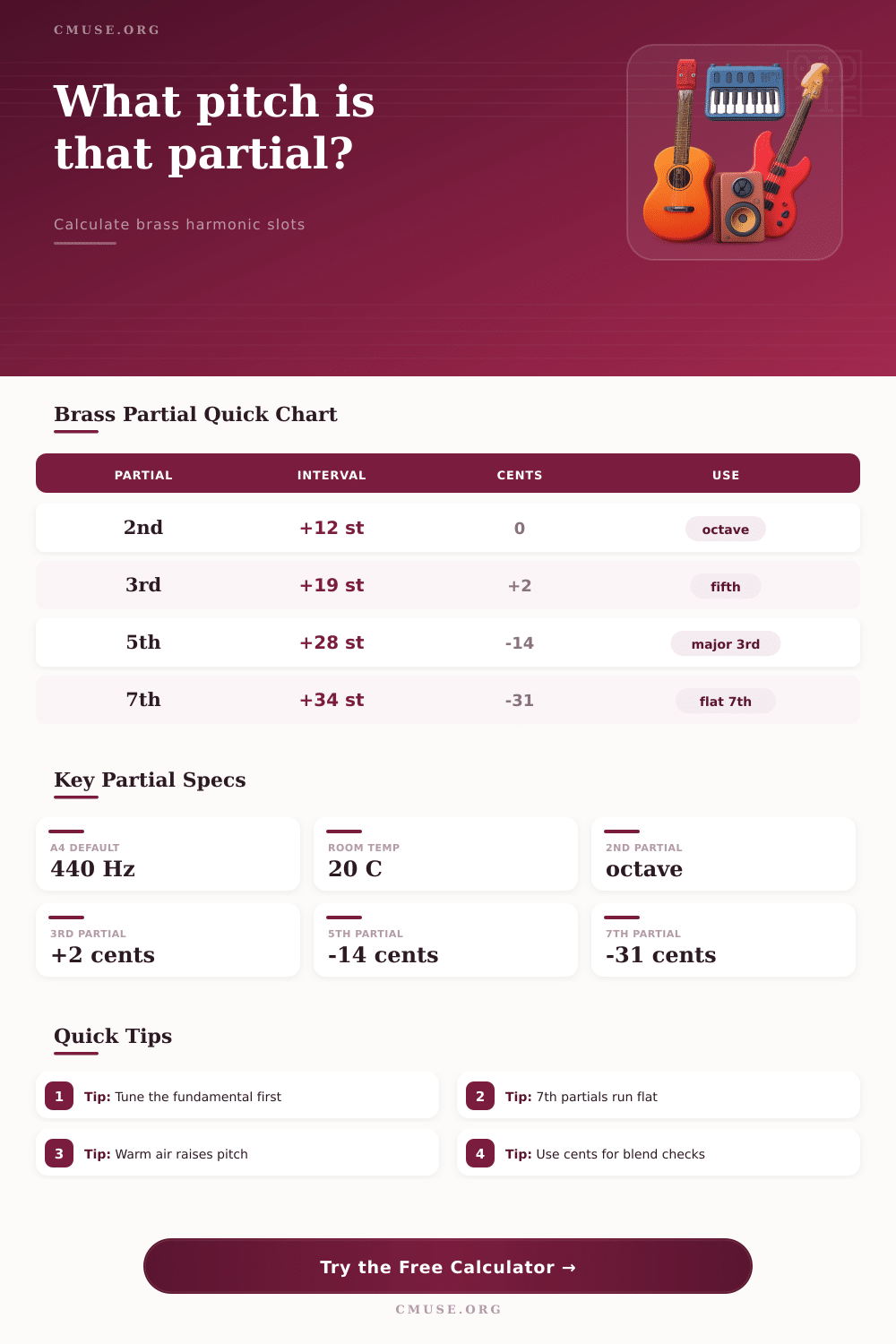
| 3rd | Octave plus fifth | +19 semitones | About +2 cents | Strong, centered, and easy to tune. |
| 4th | Two octaves | +24 semitones | 0 cents | Stable upper octave reference. |
| 5th | Two octaves plus third | +28 semitones | About -14 cents | Natural major third, often needs awareness. |
| 6th | Two octaves plus fifth | +31 semitones | About +2 cents | Bright fifth with strong projection. |
| 7th | Flat harmonic seventh | Near +34 semitones | About -31 cents | Color tone, not a normal equal-tempered seventh. |
| 8th | Three octaves | +36 semitones | 0 cents | High octave and slot-map anchor. |
| Instrument | Open Fundamental | Useful Partials | Typical Concern | Practical Check |
|---|---|---|---|---|
| Bb trumpet | Bb1 physical bugle | 2nd through 12th | High partials sit close together. | Compare 5th and 7th partials against tuner cents. |
| F horn | F1 open horn length | 3rd through 16th | Upper harmonic spacing is narrow. | Use partial number carefully when reading natural horn parts. |
| Trombone | Bb1 first position | 2nd through 8th | Slide position can mask partial tendency. | Separate harmonic cents from slide correction. |
| Euphonium | Bb1 open bugle | 2nd through 10th | Valve combinations add extra tuning drift. | Enter lip or slide correction after valve checks. |
| BBb tuba | Bb0 open bugle | 2nd through 8th | Pedal and false tones need context. | Use the 2nd partial as a reliable anchor. |
| Alphorn | Long natural fundamental | 4th through 16th | 11th and 13th colors are not piano notes. | Read cents offsets before arranging close harmony. |
| Fundamental | Partial | Natural Frequency Ratio | Nearest Pitch | Expected Tendency |
|---|---|---|---|---|
| Bb1 | 2nd | 2:1 | Bb2 | Centered octave with no harmonic cents error. |
| Bb1 | 3rd | 3:1 | F3 | About 2 cents sharp of equal temperament. |
| Bb1 | 5th | 5:1 | D4 | Natural major third sits about 14 cents flat. |
| F1 | 7th | 7:1 | Eb4 area | Harmonic seventh is much flatter than piano Eb. |
| Bb0 | 8th | 8:1 | Bb3 | Clean octave stack, useful for tuba checks. |
| F1 | 11th | 11:1 | B4 area | Raised fourth color, not a normal tempered pitch. |
| Air Temperature | Sound Speed | Fixed Tube Effect | Pitch Direction | Use Note |
|---|---|---|---|---|
| 10 C / 50 F | 337.4 m/s | Lower than room reference | Flat | Cold outdoor tuning may need push-in or warmer air. |
| 15 C / 59 F | 340.4 m/s | Slightly lower | Modestly flat | Common cool rehearsal room condition. |
| 20 C / 68 F | 343.4 m/s | Reference basis | Neutral | Good default for partial charts and tube math. |
| 25 C / 77 F | 346.5 m/s | Slightly higher | Modestly sharp | Warm stage air raises all partials together. |
| 30 C / 86 F | 349.5 m/s | Higher than room reference | Sharp | Leave tuning slide travel for hot conditions. |
Pull out a brass instrument and blow a note. It sounds right. At least you think it does. You check your tuner: four cents sharp. So you tweak your embouchure to correct it, but now your tone has gone stuffy or went flat, in a whole other direction.
No, this isn’t just a matter of bad technique. It’s equal temperament versus physics. Run the calculator above and it’ll show you how frequency of a harmonic partial compares to the piano key that is supposed to match it. Turns out they hardly ever quite line up.
Why Brass Instruments Sound Out of Tune
Brass instruments are essentially tubular resonators that rely on the harmonic series for their sound. This means that when you blow into it, you don’t create just a single note, but also a whole series of overtones or partials. Each partial is based off an integer multiple of fundamental frequency. So if there’s a fundamental at 220Hz, there will be a partial at 440Hz (a perfect octave). There will also be another at 660Hz (a fifth above the octave). They are all pure intervals which neatly match the natural sound of instrument itself.
But whenever we try to fit these pure numbers into standard piano or synthesizer tuning, things start to become mucky. This is where the calculator does all the hard work. It then compares the nearest tempered note to the partial you have selected. The example above show the fifth partial. In the harmonic series, this major third is about fourteen cents flat compared to a piano.
The problem arise when you tune that D sharp to be perfect for a keyboard. What you’re really doing is going against grain of how your instrument naturaly sounds. You’ll sound like a hero to the piano player. However, you’ll be out of tune with everyone else in brass section and out of tune with yourself.
Many players miss this because we follow direction of the tuner’s needle. We don’t realize that they is measuring us according to a different set of rules. It’s fair to say that this has more to do with air temperature. When it is warm the air move faster and the pitch of every partial in tube rises uniformly. That means that if you are rehearsing outside on a cold day, you will need an entirely different embouchure approach than a hot stage bathed in bright light.
You can use tool to adjust for ambient temperature. However, unless you take this variable into account, you will still find your slots drifting even if you feel you’re playing in tune. Pulling your tuning slide out to compensate for cold room may result in you being flat again when instrument heats up to the warmth of your breath. Temperature changes fight against musical intent in a never-ending struggle.
Then there are the troublesome partials. One such color tone is the seventh harmonic, which occurs approximately thirty-one cents lower then the equal-tempered minor seventh. You can’t play it in tune with a piano without bending it significantly, and even then, it sounds unique. It also indicates that you need to be aware of these cent offsets when composing close harmony for brass instrument.
As you go higher up the register, trumpet players is aware that the upper partials cluster more closely together. This gives them fewer options for intonation. The bottom line with brass playing is that it’s all about breaking rules when needed. It’s tuned by ear not by machine.
The machine give you data on which notes do not work well together or why a note feels unstable. Use this to see if you have a tendency to slide too much into one particular slot. Then, put down the phone and listen. Your ear makes the decision of where to stay, but the numbers indicates where the pitch wants to go.