🔊 Parallel Speaker Wattage Calculator
Calculate total RMS power, combined impedance & amplifier requirements for parallel speaker configurations
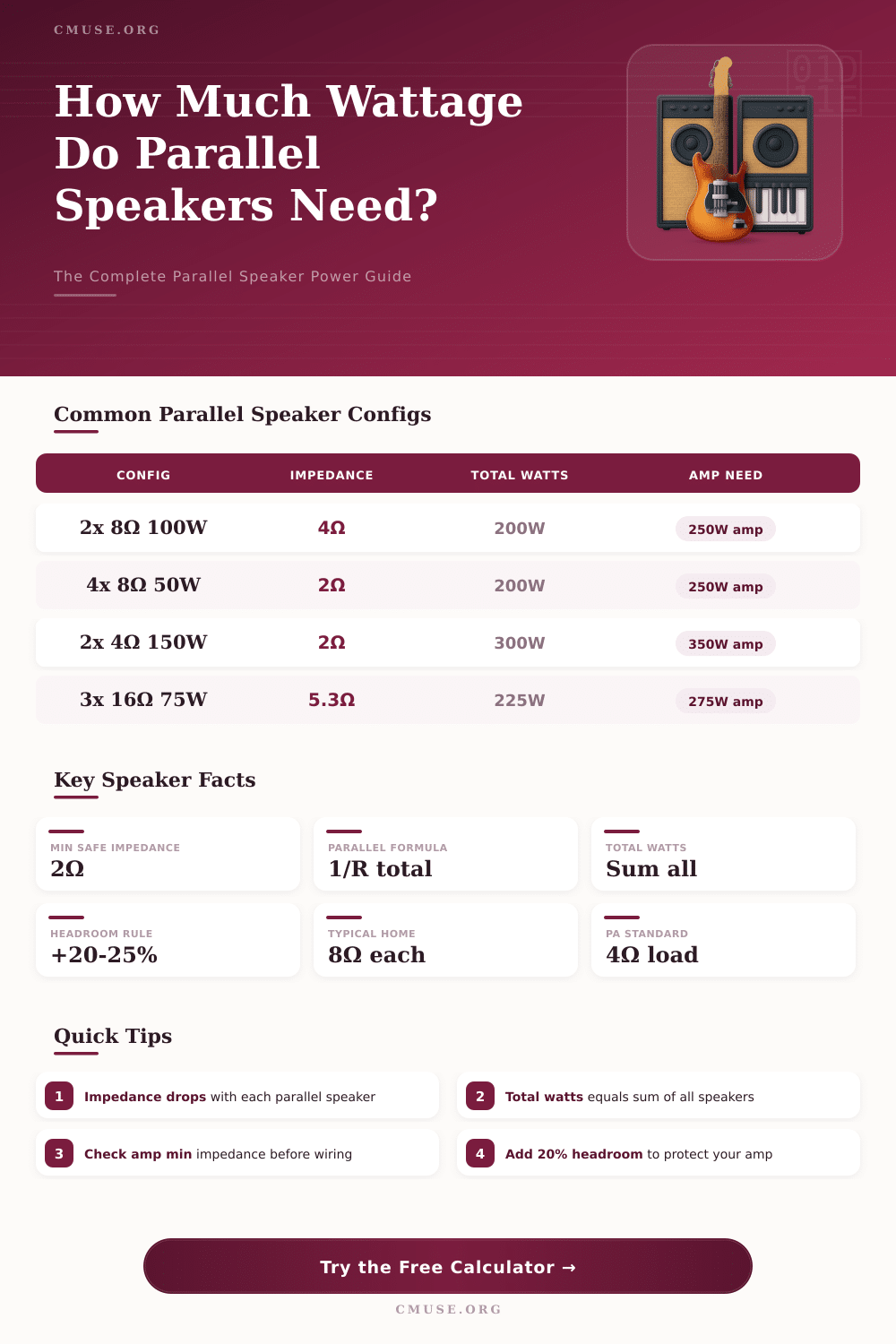
| Speaker Count | Each Speaker Ω | Parallel Impedance | Safety Status | Use Case |
|---|---|---|---|---|
| 2 | 16Ω | 8Ω | Safe | Hi-fi stereo pair |
| 2 | 8Ω | 4Ω | Safe | Standard stereo / home theater |
| 2 | 4Ω | 2Ω | Caution | Car audio, pro amps only |
| 3 | 8Ω | 2.67Ω | Caution | Ceiling speaker arrays |
| 4 | 8Ω | 2Ω | Caution | Guitar cabs, PA arrays |
| 4 | 16Ω | 4Ω | Safe | 4x12 guitar cabinet |
| 4 | 4Ω | 1Ω | Danger | Not recommended |
| 6 | 8Ω | 1.33Ω | Danger | Not recommended |
| Speaker Type | Typical Impedance | RMS Wattage Range | Peak Wattage | Common Config |
|---|---|---|---|---|
| Bookshelf / Hi-Fi | 4Ω – 8Ω | 20 – 150W | Up to 300W | Stereo pair |
| Floorstanding | 4Ω – 8Ω | 100 – 300W | Up to 600W | Stereo pair |
| Guitar Cabinet (12") | 8Ω / 16Ω | 30 – 75W each | Up to 150W | 2x12 / 4x12 |
| PA / Live Sound | 4Ω – 8Ω | 150 – 500W | Up to 1000W | Line array |
| Studio Monitor | 4Ω – 8Ω | 50 – 200W | Up to 400W | Stereo / surround |
| Subwoofer | 2Ω – 4Ω | 200 – 1000W | Up to 2000W | Mono / dual sub |
| Ceiling / In-Wall | 8Ω | 20 – 80W | Up to 160W | Multi-zone array |
| Car Audio | 2Ω – 4Ω | 50 – 300W | Up to 600W | 2 or 4 speaker |
| Total Speaker Watts | Combined Impedance | Min Amp Power | Recommended Amp (20% headroom) |
|---|---|---|---|
| 100W RMS | 8Ω | 100W | 120W |
| 200W RMS | 4Ω | 200W | 240W |
| 400W RMS | 4Ω | 400W | 480W |
| 600W RMS | 2Ω | 600W | 720W |
| 1000W RMS | 4Ω | 1000W | 1200W |
| 2000W RMS | 2Ω | 2000W | 2400W |
The watt power of speaker points, how much electrical energy it fits to process and convert to sound. A bigger number of watts shows that the speaker can take more energy without damaging. Although one commonly links watt ratings with the loudness, they relate also to the activity, to the force, to the cleaning of sound and to the ongoing reliability.
Watt is a unit for energy that one counts by means of volts multiplied by amps. At speakers the watt power explains how much energy the amplifier can send and how the speaker fits to receive before starting to twist or suffer ongoing wound. Really it deals about that how much energy the speaker can receive from amplifier without bending the sound or destroying themselves because of too much heat or because of movement that passes its physical limits.
What Speaker Watts Mean
The details about energy for speakers and amplifiers cover different parts. The watt rating of amplifier relates to its output. The watt rating of the speaker relates to its input.
That difference is really important. At speaker exist ratings for maximum and for standard energy, while at amplifier one talks about output in watts. There do not exist really set standards for guessing the watt power of speaker, what can cause confuison.
The watt power never relates to the sound quality. It simply shows how much energy one can deliver to the speakers in certain sensitivity. A well built 25 watt amplifier can beat a bad done 50 watt amplifier according to sound quality and according to control.
One should mind not only the watt ratings, but also the overall build quality, the delivery of electricity and the harmony with the speakers.
Sensitivity and impedance also matter. Sensitivity points, as far as loudly sound the speaker from one watt at one metre. If the sensitivity is higher, fewer energy is needed.
Impedance is the electrical resistance, that the amplifier sees, and typical values are 4, 6 and 8 ohms. For home usage the good sound quality of speaker and amplifier matters more then the power rating. In speakers one should search impedance and sensitivity, not the power rating.
The main rule is that the energy that the head of amplifier makes does not pass the watt rating of the speakers. If a speaker is rated at 300 watts of steady energy and 350 watts enter it for some minutes, probably the voice coil will burn and will cause damage of the driver. Speakers usually have a range, inside which they are built to work, for instance from 10 until 100 watts.
For most musical uses and for consumer speakers 50 until 150 real watts will do well. Bigger watt power cuts the distortion at low levels. Having backup watt power really is useful.
The stated watt power alone does not well measure thesound output of system, because the efficiency of speaker and the distortion levels at certain grade has big influence.