Parallel Pickup Resistance Calculator
Calculate combined guitar pickup DC resistance, per-pickup share, loaded output resistance, and approximate resonant behavior for two, three, or four pickups wired in parallel.
Choose a wiring preset to load realistic pickup DCR, pot value, tone circuit, cable capacitance, amp input, and pickup inductance. Then adjust the fields to match your meter readings and actual harness.
Calculation Breakdown
1. Parallel DCR
Rparallel = 1 / (1/R1 + 1/R2 + ...)Only active pickups above 0 kΩ are included. This is the main meter-style resistance result.
2. Harness Load
Rload = 1 / (1/Rvol + 1/Rtone + 1/Ramp)The volume pot, partial tone branch, and amp input are treated as parallel loads to ground.
3. Pickup Share
Share = (1/Ri) / sum(1/R)The lower-resistance pickup contributes a larger conductance share in a passive parallel blend.
4. Resonant Peak
Fres = 1 / (2pi sqrt(Leq Ctotal))Inductance and capacitance estimate the treble peak area; exact guitars vary by pickup construction.
250 kΩ
common single-coil volume pot
500 kΩ
common humbucker volume pot
1 MΩ
typical guitar amp input load
22 nF
standard modern tone capacitor
470 pF
typical medium guitar cable capacitance
2.5-3 kΩ
common Strat two-pickup parallel DCR
4 kΩ
typical PAF pair parallel DCR
2-5 H
rough passive pickup inductance range
| Pickup combination | Typical pickup DCR | Parallel DCR | Practical sound note |
|---|---|---|---|
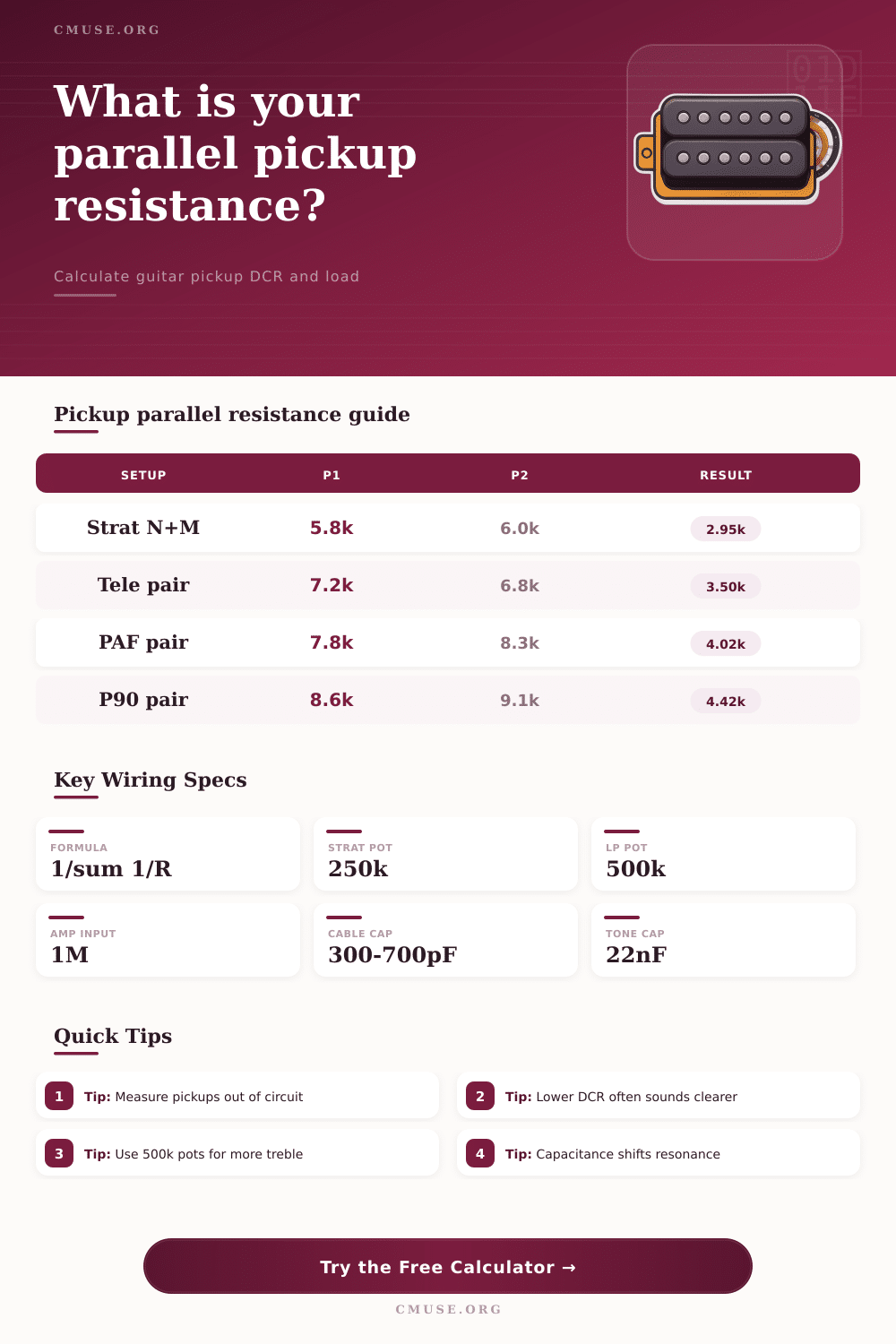
| Strat neck plus middle | 5.8 kΩ and 6.0 kΩ | 2.95 kΩ | Low DCR and low inductance help create a clear quack position. |
| Tele neck plus bridge | 6.8 kΩ and 7.2 kΩ | 3.50 kΩ | Parallel wiring keeps the middle position leaner than either pickup alone. |
| PAF neck plus bridge | 7.8 kΩ and 8.3 kΩ | 4.02 kΩ | Two humbuckers in parallel often read near half of one pickup. |
| P90 pair | 8.6 kΩ and 9.1 kΩ | 4.42 kΩ | Higher inductance keeps the result fuller than the DCR alone suggests. |
| Jazz Bass both pickups | 7.4 kΩ and 7.8 kΩ | 3.80 kΩ | The classic both-on tone comes from parallel coils and pickup spacing. |
| Three equal single coils | 6.2 kΩ each | 2.07 kΩ | Adding a third pickup lowers resistance and can soften output level. |
| Load part | Common value | Electrical role | Calculator field |
|---|---|---|---|
| Volume pot at full | 250 kΩ to 500 kΩ | Permanent resistive load across the pickup output | Volume pot value |
| Tone pot and capacitor | 250 kΩ or 500 kΩ with 22 nF | Frequency-dependent path to ground for treble | Tone pot, capacitor, and active share |
| Guitar cable | 200 pF to 800 pF | Capacitance that lowers the pickup resonant frequency | Cable capacitance |
| Amp input | 1 MΩ typical | Additional shunt load after the guitar cable | Amp or pedal input |
| Buffer input | 1 MΩ to 10 MΩ | Raises load impedance and keeps the resonant peak stronger | Amp or pedal input |
| Long pedal chain | 500 kΩ or lower first input | Can dull passive pickups before any active buffer | Amp or pedal input |
| Pickup style | Typical DCR | Typical inductance | Parallel wiring comment |
|---|---|---|---|
| Strat-style single coil | 5.6 kΩ to 6.5 kΩ | 2.0 H to 3.0 H | Very clear in two-pickup parallel positions. |
| Tele bridge single coil | 6.5 kΩ to 8.0 kΩ | 2.8 H to 4.2 H | Bridge DCR can dominate a weaker neck pickup slightly. |
| PAF-style humbucker | 7.2 kΩ to 8.8 kΩ | 3.8 H to 5.5 H | Middle position is lower DCR but still warm from inductance. |
| Hot humbucker | 12 kΩ to 17 kΩ | 6 H to 9 H | Can overpower a vintage neck pickup in conductance balance. |
| P90 single coil | 7.5 kΩ to 10 kΩ | 5 H to 7 H | Parallel pairs stay punchier than low DCR alone implies. |
| Filter'Tron style | 4 kΩ to 5.5 kΩ | 1.5 H to 2.6 H | Low inductance keeps parallel tones bright and quick. |
| Preset | Active pickups | Nominal harness | Expected calculator behavior |
|---|---|---|---|
| Strat Neck And Middle | 5.8 kΩ plus 6.0 kΩ | 250 kΩ pots, 22 nF tone cap | Low DCR, high resonance, balanced share. |
| Tele Neck And Bridge | 6.8 kΩ plus 7.2 kΩ | 250 kΩ pots into 1 MΩ | Middle setting sits near 3.5 kΩ before harness load. |
| PAF Les Paul Middle | 7.8 kΩ plus 8.3 kΩ | 500 kΩ pots, medium cable | Roughly 4 kΩ parallel DCR with a warmer peak. |
| Nashville Tele Three | Three single coils active | 250 kΩ volume, partial tone load | Very low DCR and wider conductance sharing. |
| Four Pickup Test Bench | Four mixed test coils | Selectable load values | Demonstrates how the lowest DCR coil carries more share. |
Positions two and four yield a hollow sound from a Stratocaster. They is thinner and brighter then either single pickup. But this isn’t magic, it’s physics at work. When you wire two pickups in parallel, the combined DC resistance drop to about half of what it was separately. Lower resistance means less loading on both your amp input and your cable. Less loading means high resonant frequencies don’t get squashed by capacitance; they’re allowed to live on.
That is where numbers matter. Use calculator above to do the math for yourself. Feed it the raw ohms values and watch as it paints a clear picture of how your particular harness will act electrically.
How Resistance Changes Your Guitar Tone
Pickup wire gauge and magnet strength are primary considerations in purchasing pickups among most players. Resistance doesn’t come into play until we’re at the soldering stage. But that’s a mistake, because while DC resistance is easy measured using a multimeter, it’s also one of the least understood measurements available. If you find a pickup that reads low, you know it will be fast and clear. If it’s high, then it must be warm and powerful. Those aren’t always true.
This is because people don’t consider what happens after the pickup. The volume pot loads the system. The tone cap bleeds treble. And the cable add capacitance. These element all interact with the internal resistance of the pickup to form your final tone.
When using this tool, begin with a measurement of your pickups out of circuit. Any variables like soldering irons and switch contacts muddy the data. Simply enter your real world DCR numbers into each field which will then calculate the parallel equivalent. Since the middle coil measure six kilo-ohms and the neck pickup measures seven kilo-ohms, combined measurement will be closer to three point five kilo-ohms.
The reduction of impedance is important as it alters the way signal drives your amp. But don’t leave it there: loaded output is important too. Usually, a volume pot of two hundred fifty or five hundred kilo-ohms sits between your guitar and its output jack. When set to max (full up), that’s still a load on your instrument; a permanent path to ground. If you prefer clarity and snap, pair low-DCR pickups with these higher-resistance pots: their higher value helps keep the high-end from being pulled down as hard.
The calculator reflects this coupling, letting you see what your amp ‘sees’ and helping you guess how tight and compressed versus loose and open it will sound. The silent killer of high-end detail is capacitance; each foot of cable has a small amount of capacitance. Combine that with a possible tone capacitor on your guitar that may be as much as twenty-two nanofarads and what do you have? This creates a low-pass filter in front of your pickups. This filter kills more treble the higher its resistance, but the lower its resistance the less effective the filter is.
The resonance estimate in results gives you an idea of where your peak brightness frequency will fall. If it’s too low your guitar won’t even make it to the amp before sounding dull. With parallel wiring, the path of least resistance wins. So if one pickup has a much lower DCR than the other two pickups, it will dominate the blend and the tool shows you exactly how much each coil contributes to that mix.
Why does this matter? Well, it’s the reason your mismatched pickups can sound unbalanced when mixed in the middle. Maybe you’re thinking you have fifty percent bridge, fifty percent neck but in fact you may be getting seventy percent of the lower resistance pickup. And that is how most people miss it.
Resistance says half the story. Resistance tell only half the story, with things like inductance and magnet strength filling in the rest, but it’s not hard to lose yourself in those numbers. Knowing your baseline helps when making smart decisions on wiring mods, picking capacitors and pots. You will no longer have to guess about having too light of a tone cap or the wrong pot value. It shows you the electrical relationship of everything.
Pickup height, magnet strength, and inductance plays huge roles as well. Now measure your coils, and understand how the harness is loading them. The unseen connection makes the trial-and-error of wiring turn into planned design. When you get it, you’ll discover that clarity isn’t always about buying new gear, but rather balancing the load on what you have so your pickups can sing.
You know that clear, bright sound you love? That’s low resistance letting the highs breathe. Actually, you should of seen how it worked before. It was naturaly moddern sounding.