Paradiddle Sticking Count Calculator
Count paradiddle strokes, right and left hand balance, accents, bars, tempo duration, and drum-kit orchestration from one editable practice setup.
Choose a named rudiment workout, then adjust the starting hand, repetitions, subdivision, tempo, accents, and kit voices. The calculator expands the sticking and counts every stroke.
Count Breakdown
Accent Reading
Accents appear on the first stroke of each selected pattern. Use the accent voice only after the sticking is steady.
Practice Cue
Play the hands quietly first, then add bass drum and hi-hat counts as separate coordination layers.
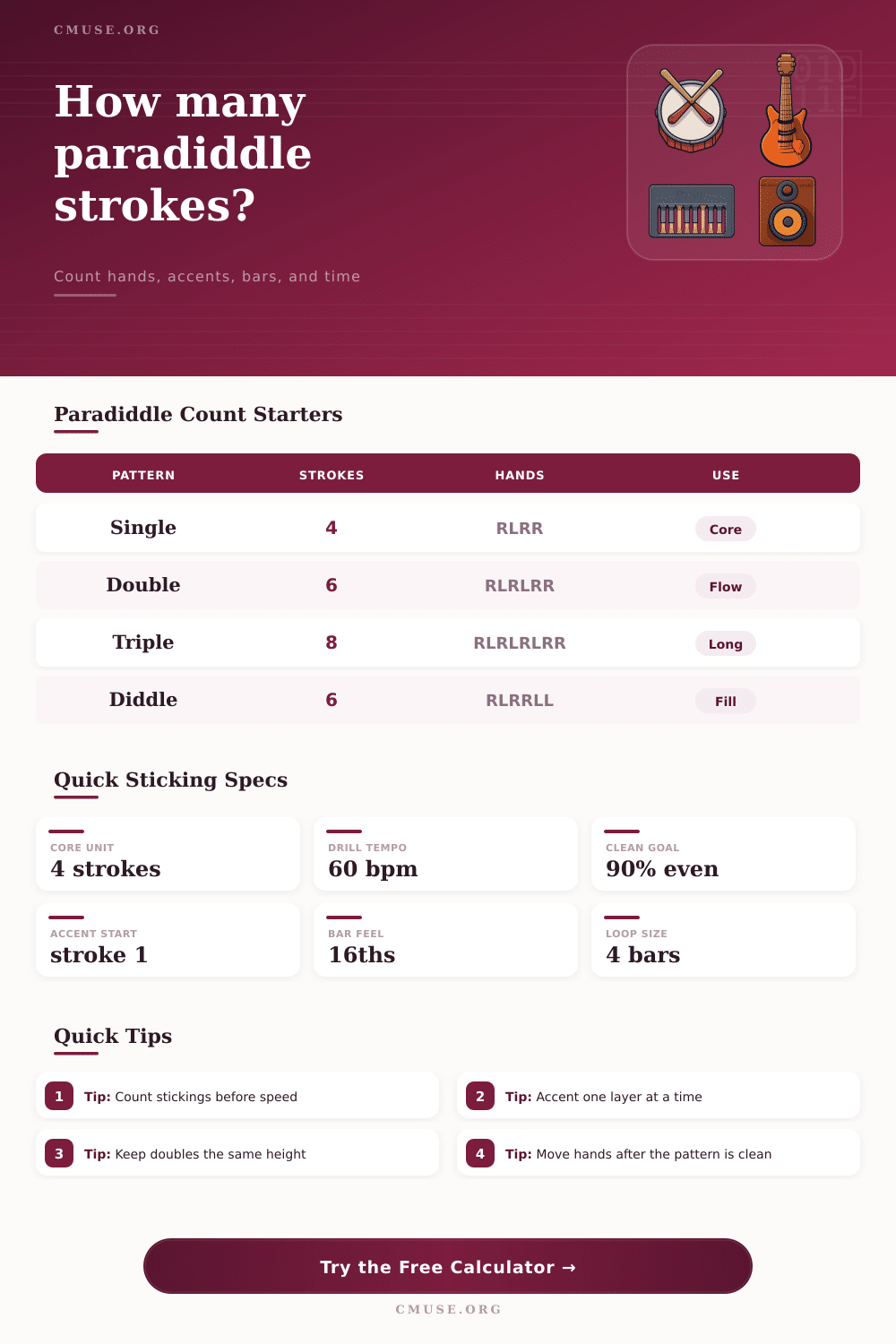
Single paradiddle strokes per base unit
Double paradiddle strokes per base unit
Triple paradiddle strokes per base unit
Balanced hand target for even repeats
Common drum-set subdivision
Useful BPM range for clean control
Short loop for accent displacement
Common phrase length for fills
| Pattern | Right Lead | Mirror Lead | Strokes | Best Count Use |
|---|---|---|---|---|
| Single paradiddle | R L R R | L R L L | 4 | Foundational hand balance, accents, and groove phrasing. |
| Double paradiddle | R L R L R R | L R L R L L | 6 | Six-note phrases, triplet fills, and rolling tom movement. |
| Triple paradiddle | R L R L R L R R | L R L R L R L L | 8 | Longer phrases where the diddle lands after several singles. |
| Paradiddle-diddle | R L R R L L | L R L L R R | 6 | Fast triplet fills and smooth hand-to-hand rolls. |
| Inward paradiddle | R L L R | L R R L | 4 | Interior doubles and backbeat-style accents. |
| Reverse paradiddle | R R L R | L L R L | 4 | Starting with doubles before shifting into singles. |
| Subdivision | Strokes Per Beat | At 60 BPM | At 90 BPM | At 120 BPM |
|---|---|---|---|---|
| Quarter notes | 1 | 1000 ms | 667 ms | 500 ms |
| Eighth notes | 2 | 500 ms | 333 ms | 250 ms |
| Eighth triplets | 3 | 333 ms | 222 ms | 167 ms |
| Sixteenth notes | 4 | 250 ms | 167 ms | 125 ms |
| Sixteenth triplets | 6 | 167 ms | 111 ms | 83 ms |
| Thirty-second notes | 8 | 125 ms | 83 ms | 63 ms |
| Orchestration | Right Hand | Left Hand | Accent Surface | Practice Goal |
|---|---|---|---|---|
| Pad control | Practice pad | Practice pad | Same surface | Make stick height and diddle spacing even. |
| Snare groove | Snare center | Snare ghost note | Rimshot | Separate loud accents from soft inner notes. |
| Tom melody | Rack tom | Floor tom | Crash or high tom | Hear the sticking as a moving phrase. |
| Hi-hat groove | Hi-hat | Snare | Hi-hat bark | Build a groove while preserving the rudiment. |
| Ride phrasing | Ride cymbal | Snare | Ride bell | Turn hand balance into cymbal-comping ideas. |
| Plan | Pattern And Reps | Tempo | Bars | Focus |
|---|---|---|---|---|
| Warmup loop | Single, 16 reps | 70-90 BPM | 4 bars | Even R/L count and relaxed doubles. |
| Accent shift | Reverse, 24 reps | 60-80 BPM | 6 bars | Hear the accent before adding kit movement. |
| Triplet fill | Paradiddle-diddle, 16 reps | 80-110 BPM | 6 bars | Blend singles and doubles in a triplet feel. |
| Tom endurance | Triple, 12 reps | 70-100 BPM | 6 bars | Keep the long phrase from rushing at the diddle. |
| Groove builder | Single, 32 reps | 90-120 BPM | 8 bars | Add foot layers only after the hands stay even. |
Likely you learned drums starting on a single paradiddle. You did it over and over till your hands gets the hang of it. Eventually, it becomes automatic.
Next, you attempt to play it in time while keeping a steady groove going on your feet, placing accents on various parts of kit. The simple four-stroke pattern doesn’t feel so simple anymore. Now your brain must follows sticking, rhythm, dynamics, and orchestration. All at the same time.
Plan Your Drum Practice with a Calculator
Most drummers gets lost not because they lack muscle memory, but because they lose count of what each limb is doing. That’s where calculator on this page comes in, by taking all of those variables and expanding them into a solid plan. Pick your basic pattern, decide how often you’d like to repeat it, define your tempos and subdivisions, and assign which hand plays on what surface of the drums.
Then add in any hi-hat and bass drum foot patterns you might wish to layer over it, and you’ll be able to see precisely how many strokes is coming from each limb. Why does that matter? Because if one limb is doing significantly more work then the other without your knowledge, coordination will fail.
When you see thirty-two on one line and then four in another, it tell you to balance the load before you even touch a stick. Your right hand might be performing thirty-two snare strokes, but if your left foot is only going through four counts, it’s unlikely that you’ll keep time without rushing or stumbling as you tire out.
The way this works depends off the subdivision, the number of strokes per beat in a given piece of music. By default that’s sixteenth notes (four hits per quarter note), but what happens if you select eighth-note triplets? Suddenly you’re down to three hits per beat instead of four. This requires an entirely new set of math for the bars. Everything need to be recalculated for you so you can keep time without having to think about it.
Oh yeah, it also displays the total practice time. This is really helpful when organizing a warmup session, because you can target precisely ten seconds of concentrated repetition instead of simply playing whatever comes up until you’re exhausted.
Counting also comes in handy when figuring out where to put your accents. If there is one thing that makes most basic exercises tricky to get right, it’s the fact that most exercises asks you to accent the first stroke of each pattern. Without mapping this out, you end up with something rhythmically uneven. You can set the calculator to accent every quarter note, only the right hand, or just the start of each figure.
Once done, it tells you how many times this occur and what surface these hits may land on such as a high tom or perhaps even a rimshot. Because now you not only have an abstract idea about creating dynamic contrast, but you literal know which hits need to be louder and on which surface.
The biggest trap for many drummer is to add motion into their playing too soon. Trying to switch both hands and feet and accents all at one time while playing a paradiddle on the snare and toms is usually a recipe for sloppy sticking. It overwhelms the form you want to develop. This chart breaks down common practice plans.
These plans suggests starting with pad work to get things even. Next, move to the center of the snare. Finally, introduce tom movement once you have a solid hand balance. The trick is to layer in complexity slowly and build the groove from inside out.
And tempo should of been considered too, not all slow is loose. In fact, a sixteenth-note on-beat paradiddle at sixty BPM sounds like it would take less control. In reality, you have more time for each note to feel out of sync with others. This visual presentation reveals that they’re separated by only a millisecond. This frames slow practice as a technical exercise instead of merely warming up.
As you increase your tempo, the math will change again. It will show how increasing the number of strokes per minute keeps the total bar count the same while keeping the repetition intact. In short, all this stuff eliminates guesswork from your practice. Counting backwards is not your goal; you want your brain to be focused on feel and timing rather than what your hands and feet is doing.
Whether you are playing triple paradiddles for endurance or double paradiddles for flow, knowing which hand goes where gives you a clear map. This helps you make the most of your practice session. Instead of wondering if your left hand is lagging behind, you can simply hear if it actualy is. That clarity translates into targeted improvement rather than just mindless repetition.
Then, when the diddle finally falls in place the way it should, neither dragging nor rushing, you’ll know exactly why.