Panel Resonance Frequency Calculator
Estimate the first bending resonance of a speaker enclosure panel, then see how material choice, thickness, boundary condition, bracing span, added damping, and mass loading move the result.
Cabinet presets
Panel material grid
Panel inputs
Calculation breakdown
| Mode | Frequency | Damped freq | Shape note |
|---|
| Brace spacing | Effective span | Fundamental | Change |
|---|
| Damping case | Loss factor | Added mass | Shifted frequency |
|---|
| Material swap | Density | Young modulus | Fundamental |
|---|
| Material | Density kg/m3 | E GPa | Design note |
|---|---|---|---|
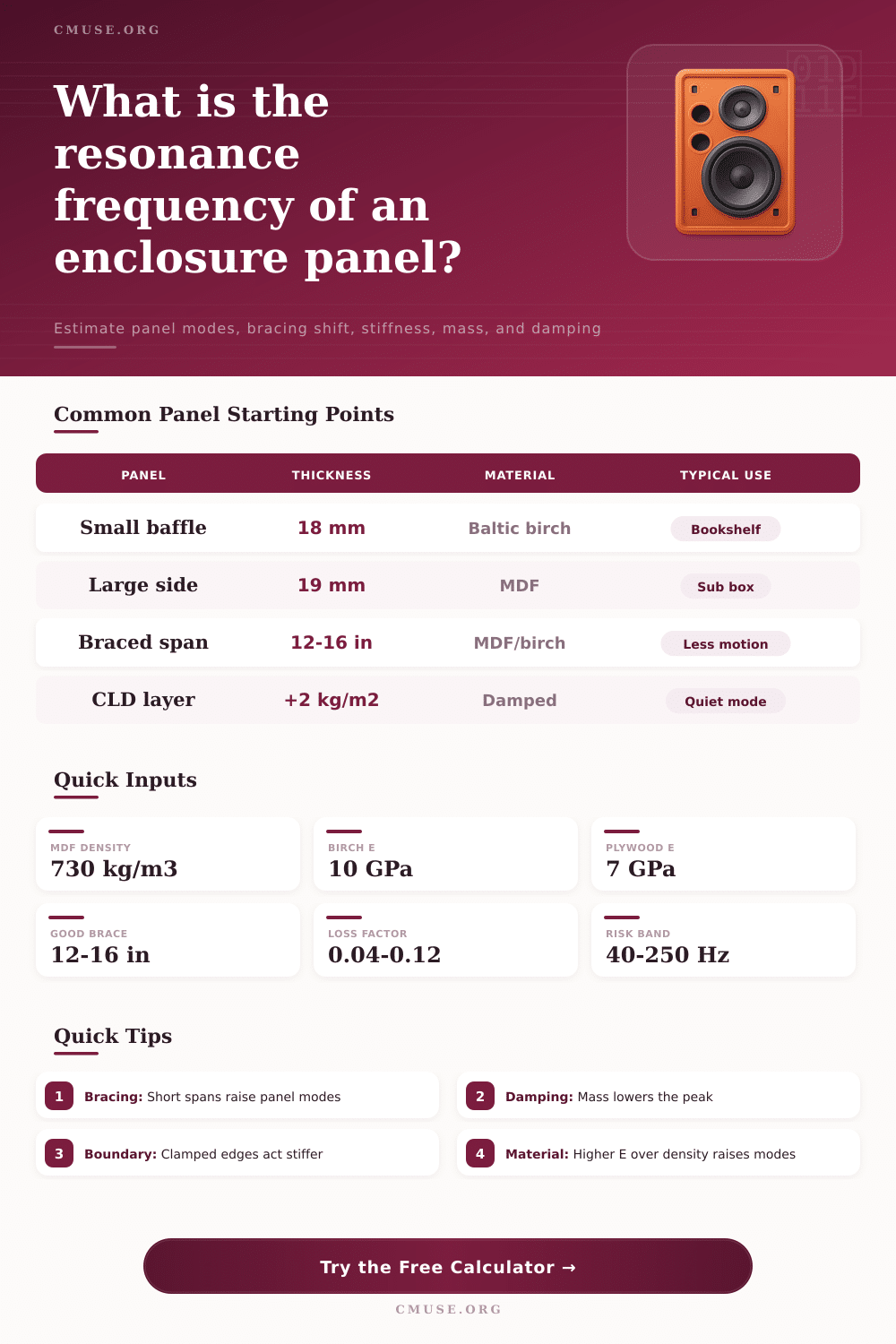
| MDF | 730 | 4.0 | Predictable, easy to damp, heavy. |
| Baltic birch | 680 | 10.0 | High stiffness, popular for portable and premium cabinets. |
| Cabinet plywood | 600 | 7.0 | Lighter, properties vary by layup. |
| HDF | 850 | 5.5 | Dense panel with higher surface hardness. |
Resonance happens when a speaker cabinet vibrate along with low frequencies. Perhaps you’ve built what appears to be a perfect-looking box, and yet one of your side panels start humming while playing back. It’s not the fault of the driver; rather, the cabinet itself is doing the singing. Each piece of plastic or sheet of wood has a natural frequency where it want to vibrate. If the music strikes this frequency, the panel will move too much and color sound with unwanted harshness or boominess.
With this system, you simply input your dimensions and material details, and let the calculator do the math for you. No more guesswork… Know before building if your material of choice are up to the task.
How to Stop Speaker Cabinets from Vibrating
How does it work? It’s all about understanding physics, namely, the relationship between mass and stiffness. Basically, panels want to bend. Stiffness, shown in terms of a material property called Young’s modulus, resist bending. Once it’s bent, its mass tend to make it move. Using a rigid but light material such as Baltic birch plywood create a panel with high resonant frequency. Stiffness dominates the relatively small mass. MDF, conversely, is less stiff and (for a given thickness) have higher mass. This typically places its main resonance at a lower point in the spectrum. And that’s precisely where energy of bass resides.
Cabinet design is all about tension between rigidity and weight. The second thing to think about is not so much about the material but rather the boundary condition. Does it rest loosely in a groove or is it glued into a stiff frame? You can choose that on the calculator. What does that mean? A clamped edge (a fixed anchor) increases the resonance frequency different than a hinge or loose edge. Most DIY constructions will be intermediate between hinges and glueing the edges. That means if you assume the edges are very rigid (they aren’t), you’ll be optimistic in your prediction of where the panel resonate. It will be lower than predicted. It may be right in the danger zone of 40 to 250 Hz.
The best solution for this issue (without modifying the whole cabinet) is bracing. Internal braces cut down on the spanned section of the panel. Because resonance frequency follows an inverse square of the span length relationship, doubling the number of braced sections will increase the fundamental mode four times over. That pulls the vibration up into high registers and makes it much harder to hear. You can enter space between the bracing in the tool and see that structural modification alter the result. Dense bracing is not necessary everywhere. Typically, placing it strategically to divide large flat surfaces are enough.
Complicating things further are damping materials. Adding mass to the panel with constrained layer damping or viscoelastic layers also lowers the natural frequency. That’s counterintuitive at first glance. Why would you want to lower the resonance that you’re trying to correct? The answer is in the loss factor. The damping convert vibrational energy into heat. This lowers and broadens the peak of the resonance curve. The net effect is that even though the fundamental frequency shift down, it does so with a less pronounced ringing. The calculator accounts for mass adds from the treatment and damping loss factors. This lets you see how they affect the final response.
It’s not about removing resonance completely. It’s about controlling its impact on the listening experience. No formula captures all variables of real world construction. Plywood stiffness varies depending on direction of the grain. That’s called being uneven in different directions. The panel is stiffer going with the grain than across it. Vents cut into the panel locally weaken the whole thing. Also, keep in mind that the driver’s load create internal air pressure that interacts with the panel vibrations. All this suggests that the predicted frequency isn’t an absolute truth but more like a starting point from which you can compare different designs. Suppose one has a fundamental mode at 150 Hz while another shift it upward by 300 Hz. In this case, you have a good idea of which one isolates you best from common bass content.
To some extent building a speaker cabinet is an exercise in both acoustics and structural engineering. If your cabinet looks pretty but rattles when played softly, then you has failed to do what cabinets are supposed to do: house their driver quietly. To build an enclosure that resists pressure without moving requires knowledge of how stiffness, mass, bracing and boundary conditions of the materials used work together. It’s all about transparency. You want your cabinet to be gone, just the music there for you to hear. Get the physics correct, and the wood will not move and the music will ring true.