Pan Law Calculator
Compare stereo left/right gain, mono-sum shift, center attenuation, and headroom impact for common DAW pan laws.
🎵Pan Law Presets
🎚Calculator Inputs
📊Pan Law Reference Grid
📝Center Law Comparison
| Pan Law | Center L/R Gain | Raw Mono Sum | Typical Use |
|---|---|---|---|
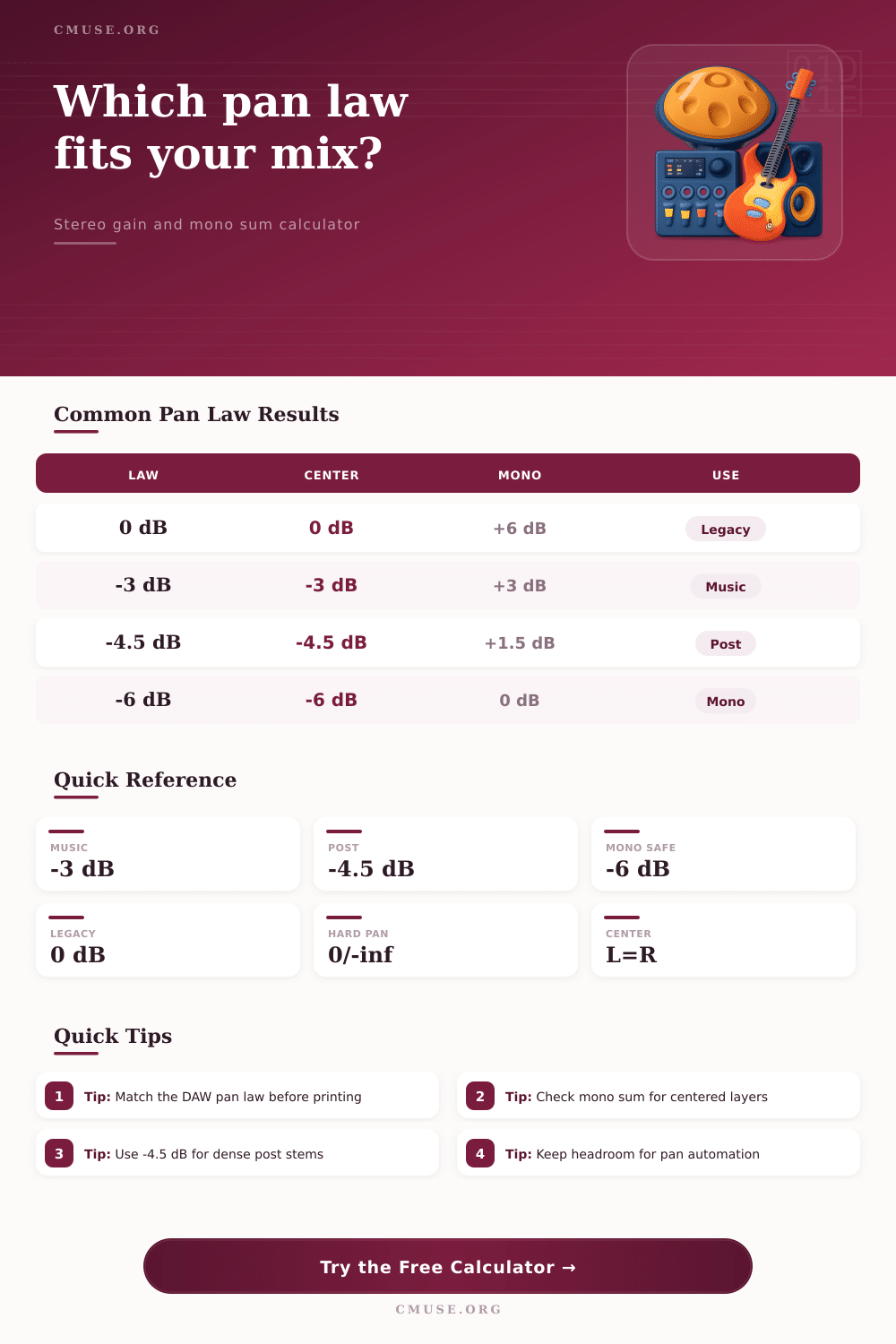
| 0 dB balance | 1.000 amplitude per side | +6.02 dB at center | Older balance controls, some legacy sessions, simple dual-mono routing |
| -2.5 dB compromise | 0.750 amplitude per side | +3.52 dB at center | Gentle center dip where -3 dB feels slightly narrow |
| -3 dB equal power | 0.708 amplitude per side | +3.01 dB at center | Common music mixing, pan automation, mono sources across stereo buses |
| -4.5 dB film / post | 0.596 amplitude per side | +1.52 dB at center | Dense dialogue, effects, broadcast stems, layouts needing calmer centers |
| -6 dB constant voltage | 0.501 amplitude per side | 0.02 dB at center | Mono compatibility checks, summing desks, phase-conscious fold-downs |
🔀Pan Position Gain Table
| Position | -3 dB Equal Power | -4.5 dB Post | -6 dB Constant Voltage |
|---|---|---|---|
| Center | L -3.0 dB / R -3.0 dB | L -4.5 dB / R -4.5 dB | L -6.0 dB / R -6.0 dB |
| 25% left | L -1.4 dB / R -5.1 dB | L -2.1 dB / R -7.6 dB | L -2.7 dB / R -10.2 dB |
| 50% left | L -0.7 dB / R -8.3 dB | L -1.0 dB / R -12.4 dB | L -1.4 dB / R -16.7 dB |
| 75% left | L -0.2 dB / R -14.2 dB | L -0.2 dB / R -21.3 dB | L -0.3 dB / R -28.4 dB |
| Hard left | L 0.0 dB / R muted | L 0.0 dB / R muted | L 0.0 dB / R muted |
🎼Common Session Starting Points
| Source Type | Suggested Law | Watch Closely | Practical Reason |
|---|---|---|---|
| Lead vocal, bass, kick, snare | -3 dB or -4.5 dB | Center stack level | Centered mono sources gain energy when folded into mono |
| Hard-panned guitars | -3 dB | Automation moves inward | Hard sides stay at unity while inward moves remain smooth |
| Dialogue and broadcast stems | -4.5 dB | Fold-down loudness | Reduces center buildup while preserving stereo motion |
| Mono-safe archive print | -6 dB | Perceived center dip | Raw L + R center sum lands close to the original source level |
Pan law is an set of rules for how the volume of an audio signal change as that audio signal is move between the left and right speakers. Pan law governs how much gain or attenuation are applied to the left and right channels of an audio signal. If the audio signal is paned to the center, the left and right channel will both recieve that audio signal.
Since both left and right channel are playing that same signal, the volume of that signal will be increased. If no attenuation is applied to the center channels of a stereo signal, the volume of the signal that is paned to the center will be louder then a signal paned to one side of the stereo system. Thus, pan law is use to adjust the volume of the audio signal so that the loudness of the signal remain consistent throughout the stereo field.
Pan Law: How Panning Changes Volume in Stereo and Mono
There is different types of pan law settings that can be use within a mixing environment. One type of pan law is constant power panning, in which the loudness of a signal are maintained regardless of the pan position of that signal. Another type of pan law is zero-law panning, in which no attenuation are applied to signals that are paned to the center channels of a stereo signal.
Pan laws can be shallow or deep. If pan law settings is shallow, very little attenuation is applied to the center channels. Deep pan laws apply more attenuation to the center channels of a signal than shallow pan law.
Mono compatibility is one of the primary reasons that audio engineers need to understand pan law. Mono compatibility refer to the sound quality of a mix when the left and right channel of a stereo signal are combine into a single mono audio channel. Many audio playback system play audio signals in mono, such as club speaker, car radio, and mobile phone.
If many audio signal are pan to the center of the stereo signal but pan law is not applied, the combined audio signal will be louder when those channels are combine into a mono signal. This loudness can lead to clipping of the audio signal or the center channel of the signal will be too loud. The center channel of a mix typically contain critical element of the mix, such as lead vocal.
Another reason that pan law is important is because layering many sound into a mix will impact the function of pan law. If many different audio signal are layered into a mix, such as multiple hi-hats or vocal track, the volume within the center channels will be louder than if those same sound are not layered. Folding that same mix into mono will combine those different audio channel.
The volume of each audio signal will add to the volume of the next signal, which will increase the volume of the mix. As such, headroom within the mix must be provide for these different signal. Otherwise, the signals will clip due to the overwhelming volume create by pan law and the layering of sound within the mix.
Mono compatibility should of be check within the mixing stage of a musical arrangement, not in the mastering stage. If the engineer check mono compatibility early in the mixing process, the engineer can adjust the pan setting and the volume level of each audio signal prior to finish the mix. Additionally, automation can be use to move sound between the left and right channels.
However, the engineer must take into account the pan law setting that are created for the audio signal. Using deep pan law settings, audio signal will experience a large change in apparent volume when they are move between the left and right channels. Audio signal will experience a smaller change in volume if shallow pan law settings is used.
Many different type of engineer work within different industry and apply pan law to the sound that they create. Post-production audio engineer often use deep pan law settings so that the dialogue within an audio signal remain audible even in the presence of other background sound. Music producer often seek pan laws that create an even loudness of the sound that are panned to the left and right channels of a stereo signal.
Audio engineer that work in the game industry must account for the presence of many sound that is moving across the stereo field, which also impact the pan law settings that are applied to those sound. Pan law is a tool that allow audio engineer to have an idea of the sound that will be create by their audio signal when played back on different type of audio device.