Output Transformer Impedance Calculator
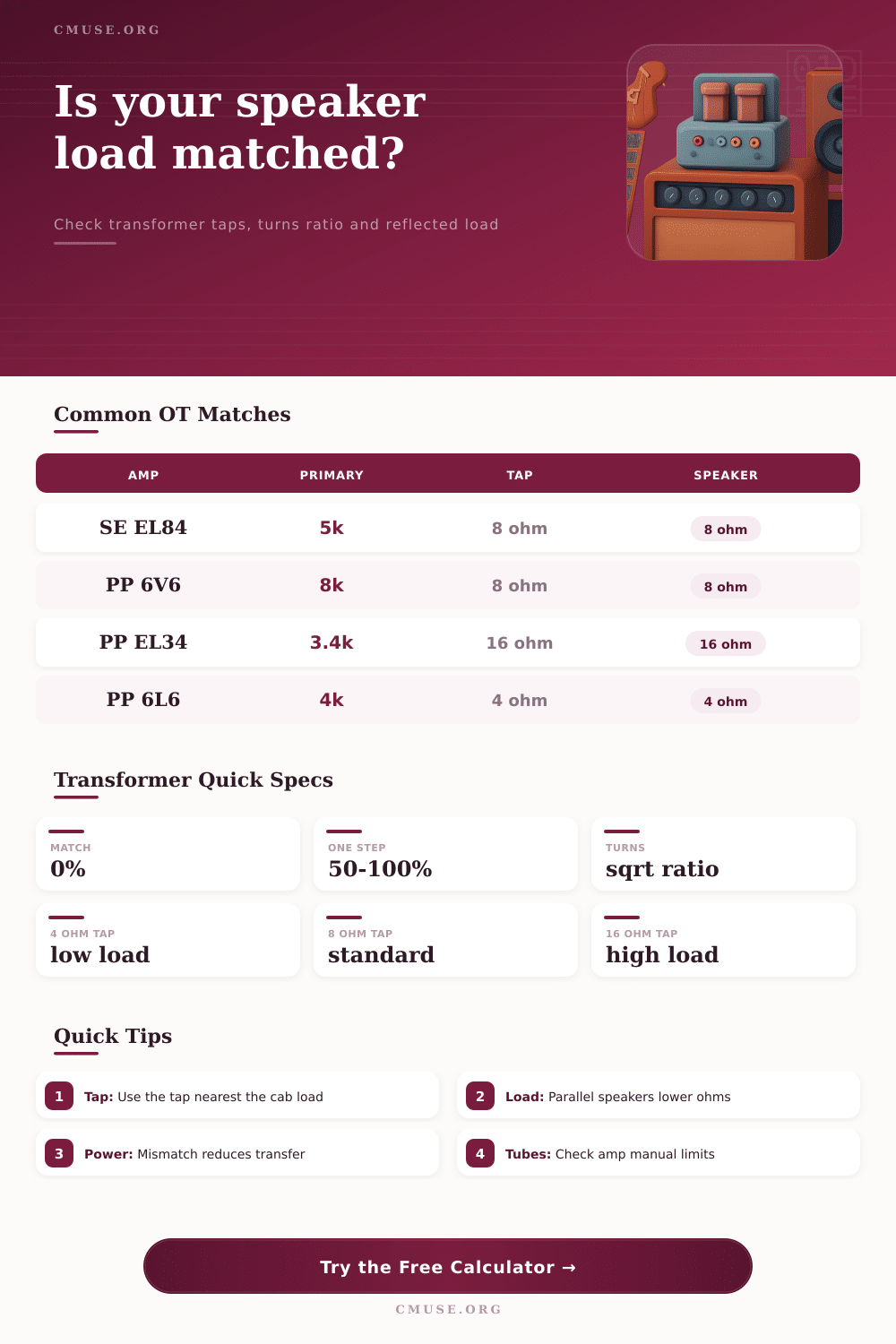
Estimate tube amp output transformer primary impedance, secondary tap loading, speaker cabinet match, turns ratio, reflected load, mismatch percent, and delivered power transfer.
Calculation Breakdown
| Tap | Actual cabinet load | Reflected primary | Mismatch | Power factor |
|---|
| Output stage | Typical primary | Power range | Common taps | Notes |
|---|---|---|---|---|
| Single-ended 6V6 | 5k to 8k ohms | 3 to 6 W | 4, 8 ohm | Higher primary often cleans up small amps. |
| Single-ended EL84 | 4k to 7k ohms | 4 to 6 W | 4, 8, 16 ohm | Often used in compact practice amps. |
| Push-pull 6V6 pair | 6.6k to 10k ohms | 12 to 22 W | 4, 8, 16 ohm | Classic small combo and studio amp range. |
| Push-pull EL84 pair | 6k to 8.5k ohms | 12 to 18 W | 8, 16 ohm | Common with cathode-biased guitar amps. |
| Push-pull 6L6 pair | 3.8k to 6.6k ohms | 25 to 50 W | 2, 4, 8 ohm | Lower primary supports more power current. |
| Push-pull EL34 pair | 3.2k to 4k ohms | 40 to 60 W | 4, 8, 16 ohm | Typical British 50 watt head territory. |
| KT88 or 6550 pair | 3k to 5k ohms | 50 to 90 W | 4, 8, 16 ohm | Hi-fi and high-headroom guitar designs. |
| Cab wiring | Example drivers | Nominal load | Use with tap | Comment |
|---|---|---|---|---|
| Single speaker | 1 x 8 ohm | 8 ohm | 8 ohm | The simplest match; nominal impedance still varies by frequency. |
| Parallel pair | 2 x 8 ohm | 4 ohm | 4 ohm | Parallel wiring halves equal speaker impedance. |
| Series pair | 2 x 8 ohm | 16 ohm | 16 ohm | Series wiring adds equal speaker impedance. |
| Series-parallel quad | 4 x 16 ohm | 16 ohm | 16 ohm | Two series pairs paralleled returns to one driver value. |
| Parallel quad | 4 x 16 ohm | 4 ohm | 4 ohm | Common high-power cab wiring when drivers match. |
| Mixed loads | 8 and 16 ohm | Calculated | Nearest safe tap | Power sharing will be uneven unless drivers are chosen carefully. |
| Mismatch | Reflected load shift | Power transfer | Tube stress clue | Practical reading |
|---|---|---|---|---|
| 0 to 10% | Very close | 99% or better | Normal | Essentially matched for guitar and audio work. |
| 10 to 25% | Mild | 98% to 99% | Usually fine | Comparable to normal speaker impedance tolerance. |
| 25 to 50% | Moderate | 96% to 98% | Check heat | Often tolerated by guitar amps, but verify the manual. |
| 50 to 100% | One tap step | 89% to 96% | Higher caution | Can change tone, current swing, and flyback margin. |
| Over 100% | Large | Below 89% | Risky | Use only for brief diagnosis unless the amp maker allows it. |
Congratulations. You’ve made a tube amp, installed all the wiring properly, biased it just right. It sounds good; warm and actualy as you hoped.
You plug in the speaker cabinet and play a chord. Instead of that punchy tone you was hoping for, you’re hearing something thin. Perhaps you think your transformer blew up or maybe the tubes themselves is shot? Perhaps not. Chances are you’ve got an impedance mismatch.
Why Impedance Matching Matters for Your Tube Amp
Lots of guys build amps like this; the disconnect between speaker load and transformer taps becomes unclear until it’s too late. Speakers is not driven by vacuum tubes themselves. An output transformer is used to convert high voltage swings produced in a vacuum tube down to current levels suited to a speaker coil. The output transformer does this by reflecting low impedance of the speaker back up to the tube as a high impedance load.
In order for the tube to swing properly it must see this reflected correctly, otherwise, tone and power will be lost. Your equipment may even be damaged. The calculator above do the math for you. Knowing what those numbers mean eliminates guessing games down the road.
Because of the type of tube used (i.e., single ended vs. Push pull), each transformer will be optimized for a certain impedance range for the primary winding. For example, a single ended EL84 may anticipate four to seven kilohms whereas a pair of 6L6s in push pull configuration may like three to five kilohms. These numbers aren’t just made up. They reflect the electrical load required by the tubes to function safely and most efficienty.
There are several taps on the secondary side, typically, two, four, eight, and sixteen ohms. Connecting your cabinet to the appropriate tap matches true impedance of your cabinet. If it’s an eight-ohm cabinet, you’d use the eight-ohm tap. This is simple enough in theory.
In reality, things get complicated when you’re connecting more than one speaker, or when speakers has nominal ratings that vary depending on frequency. If these values mismatch, your reflected load will change a lot. A sixteen-ohm tap reflects half the impedance that the eight-ohm cabinet will present to the tubes. They will pull more current which can lead to too much distortion and heat.
Placing an eight-ohm load on a four-ohm tap will double the reflected impedance. The tubes will experience a harder load. This will lower their output power significantly and reduce their swing. And it won’t simply be a reduction in volume but a shift in tone and stress profile of the amp as well.
Please note that real speakers are not fixed resistors. They have varying impedance depending on frequency. This means it’s often double at resonance with a slight dip above resonance, so the nominal rating represents an average. Due to this variability, you don’t normally blow your amp instantly with a slight mismatch. Typically ten to twenty percent change is undetectable compared to normal tolerance variations.
Moving one full tap step over causes a difference of 50% to 100%. And here’s where things get ugly. You may start noticing your amp lacks low-end clarity or breaks up sooner. Back then some amps were made with single-tap transformers. Take what they give ya. Now we have multi-tap transformers that provide options, but precision is required.
Say you wire two eight-ohm speaker in parallel. Your cabinet will now be four ohms. So you select the four-ohm tap. Not the eight-ohm tap there; that’s a recipe for disaster. The output tubes may gets stressed and/or the windings on the transformer can get too hot.
Know your cabinet load before you choose the tap. You can see those relations visualized here on this page. It calculates an estimate of the amount of power that will be transferred efficienty from amp to speaker, the turns ratio, and the reflected primary impedance. It flags how badly you are off center from the best match.
Plug in the amp after checking your wiring with this. You save yourself hours of troubleshooting if you just take a few minutes to check your wiring before plugging in. The idea is always to show the tubes the load they were designed for, that means max power transfer and stability.
You should of checked it first. The transformer matches the speaker load to the tubes’ impedance. That is just a technical phrase until it becomes a regular occurrence. Respect what your tubes can do. Respect what your transformers was designed for.
Now you know how the secondary side talks to the primary. You’re not guessing at all anymore on which wire goes where. You’re building confidently. And when you hear that tone, you know you got the match right.