OSHA Noise Exposure Calculator
Calculate OSHA noise dose percent, 8-hour TWA, allowable exposure time, protected exposure estimate, and NIOSH 85 dBA comparison across multiple workplace audio segments.
Pick a realistic starting pattern, then edit the level and time rows to match a dosimeter report, sound level survey, rehearsal log, or production shift.
Use one row per task, room, stage, vehicle, rehearsal block, or machine cycle. Duration is entered in hours, so 15 minutes is 0.25.
| Segment Name | Level dBA | Duration hr | Workers | Area Type |
|---|---|---|---|---|
Criterion
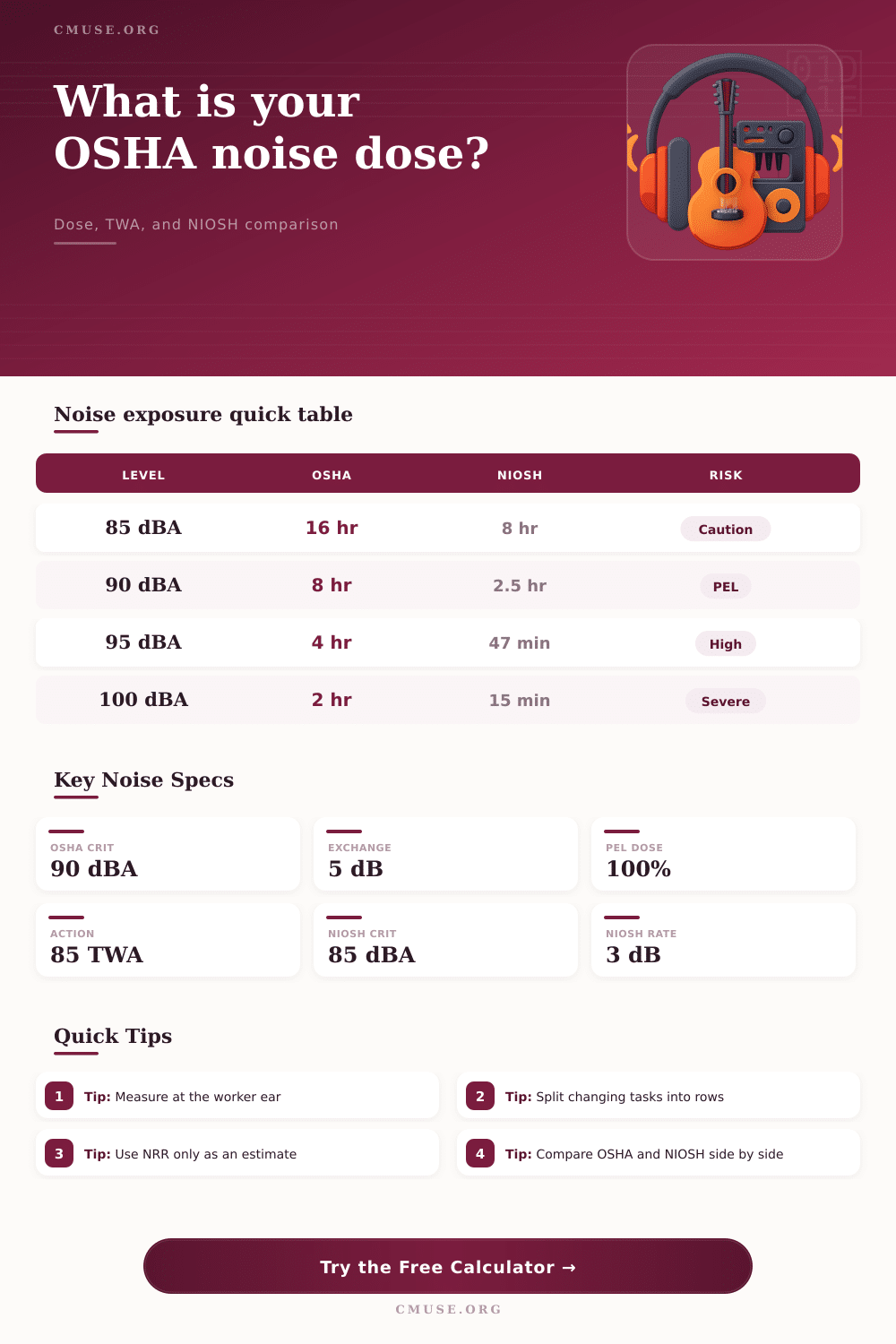
90 dBA
OSHA permissible exposure level basis
Exchange Rate
5 dB
Time halves for each 5 dB increase
Action Level
85 TWA
Hearing conservation trigger reference
NIOSH REL
85 dBA
Recommended limit with 3 dB exchange
| Sound Level | OSHA 90/5 Allowable Time | NIOSH 85/3 Recommended Time | Planning Note |
|---|---|---|---|
| 85 dBA | 16 hours | 8 hours | OSHA action level reference; NIOSH daily limit. |
| 90 dBA | 8 hours | 2 hours 31 minutes | OSHA PEL for an 8-hour workday. |
| 95 dBA | 4 hours | 47 minutes | Common threshold for rapid dose accumulation. |
| 100 dBA | 2 hours | 15 minutes | Short tasks can dominate the daily dose. |
| 105 dBA | 1 hour | 4 minutes 43 seconds | Requires strong controls and exposure planning. |
| 110 dBA | 30 minutes | 1 minute 29 seconds | Very high-energy noise; verify instrument limits. |
| Preset | Typical Segments | Exposure Character | Best Use |
|---|---|---|---|
| Machine Shop Shift | 88 to 96 dBA tools | Steady equipment plus short peaks | Industrial survey rough-in |
| Live Sound Engineer | 92 to 102 dBA show blocks | High evening exposure with quiet prep | Concert production planning |
| Nightclub DJ | 96 to 103 dBA booth | Dense music, long duration, low crest | Venue hearing conservation check |
| Orchestra Pit | 86 to 98 dBA rehearsals | Dynamic but close instrument sources | Performance and rehearsal scheduling |
| Airport Ramp | 94 to 108 dBA events | Short severe jet or ground support tasks | High-noise task isolation |
| Result Range | OSHA Meaning | Practical Audio or Workplace Response | Verification Step |
|---|---|---|---|
| Under 50% dose | Below OSHA action level equivalent | Keep monitoring if tasks or SPL change. | Spot-check with calibrated measurements. |
| 50% to 99% dose | At or above action level zone | Review hearing conservation, training, and scheduling. | Repeat with personal dosimetry when possible. |
| 100% to 199% dose | Meets or exceeds OSHA PEL | Reduce time, lower source level, add isolation, or improve protection. | Document controls and recalculate residual dose. |
| 200% dose or more | Substantial overexposure | Prioritize engineering controls and task rotation before relying on PPE alone. | Escalate to qualified safety or industrial hygiene review. |
| Metric | Formula Used | Inputs | Output Meaning |
|---|---|---|---|
| OSHA allowable time | T = 8 x 2^((90 - L) / 5) | Segment level L in dBA | Hours allowed at that level for 100% OSHA dose. |
| OSHA dose | D = sum(C / T) x 100 | Actual time C and allowable time T | Percent of daily permitted exposure. |
| OSHA TWA | TWA = 16.61 x log10(D / 100) + 90 | OSHA dose percent | 8-hour average equivalent used for compliance review. |
| NIOSH comparison | T = 8 x 2^((85 - L) / 3) | Same segments under 85 dBA, 3 dB rule | Recommended exposure comparison, not OSHA PEL. |
Noise exposures in the workplace can lead to noise-induced hearing loss over time. People who works in noisier environments might experience ringing in there ears after a shift, and eventually, they might find it harder to hear people when they are speaking to them. Since noise exposure is a preventable hazard in the workplace, the Occupational Safety and Health Administration (OSHA) created rules regarding noise exposure in the workplace to prevent hearing loss due to noise exposure.
These rules involves calculating the sound energy that reaches the worker and comparing that value to a limit for that worker. The limit is established with two numbers: the criterion level and the exchange rate. The criterion level is 90 dBA, and the exchange rate is 5 dB.
Check Noise at Work and Protect Your Hearing
The exchange rate indicates that if the sound level increase by 5 dB, the amount of time that an employee can be exposed to that noise are halved. For instance, an employee can be exposed to 90 dBA for 8 hours (which is the full limit for that employee), but if the employee is exposed to 95 dBA for 4 hours, they will have used up their daily allowance. The calculator can perform these calculations to determine the sound energy that reaches each employee each day, and this eliminates the need for the employee or employer to use tables to determine these allowance.
Work shifts may have varying noise exposure, so the noise exposure calculator allow employees to enter the noise exposures for a shift. For instance, a worker might enter that there will be a period of 2 hours at 95 dBA, 4 hours at 88 dBA, and 1 hour performing lighter task. Each shift will use up a portion of the daily allowance for that employee; the sum of all of these shifts will provide a percentage of the total allowable dose for that worker for that shift.
Furthermore, the calculator will provide an 8-hour time-weighted average (TWA) for that worker; inspectors use this number to determine if the worker’s noise exposure is within the limits set by OSHA. Many workplaces also compare the OSHA limit to the recommendations of the National Institute for Occupational Safety and Health (NIOSH). NIOSH set the criterion level at 85 dBA, and it establishes an exchange rate of 3 dB.
Because this criterion level is lower than the 90 dBA level established by OSHA, and because the exchange rate is lower, NIOSH requires that a worker be exposed to less noise in their environment than OSHA require. The calculator displays both sets of numbers in comparison to the worker, so the worker or employer can decide if they wish to follow OSHA requirements (the legal minimum) or the more restrictive NIOSH target. Various forms of hearing protection can be provided to workers in the workplace.
These values can be entered into the calculator. Furthermore, various deratings for this hearing protection can be entered; hearing protection typically does not provide as much noise reduction in real life as the Noise Reduction Rating (NRR) value provide for that product. By entering the derated value, the calculator will calculate the protected dose that would result from utilizing such hearing protection.
Furthermore, there is a reference table that show the time limits for various levels of noise exposure. For instance, at 100 dBA, employees are allowed 2 hour of exposure per day, and at 105 dBA, employees are allowed 1 hour of exposure per day. These time limits allow workers to understand the danger of short periods of high noise level; 15 minutes at 105 dBA may use up more of an employee’s daily allowance for noise exposure than several hours of exposure to quiet tasks in the workplace.
These limits are applied to each segment of noise exposure in the shift of an employee. Furthermore, there are options to provide impulse penalties and tonal penalties for workers exposed to impulse or tonal noises (rather than continuous noises) in their shifts. These penalties may be given to account for the damaging effect of impulse and tonal noises on the ear; however, these penalties are not required when entering the shift of an employee.
The results of the shift will be as accurate as the accuracy of the measurement of the noise exposure of each employee. For instance, taking noise measurements at each employee’s ear will be more accurate than measuring the noise level with a device placed across the room from the employees. Furthermore, each shift with varying tasks for the employees should be divided into separate rows within the calculator for accuracy.
Using the NRR value is only an estimate of the amount of noise that will be blocked by the hearing protection; the NRR is not a guarantee that this level of protection will prevent overexposure of the employee to high levels of noise. Thus, the calculator cannot be used to replace professional judgment in the workplace, but only as a tool to calculate the noise levels of the employees and their shift. Based on the results of the hearing protection dose and 8-hour TWA calculations for each employee, various decisions must be made regarding that employee.
For instance, if the dose that is calculated is below a certain level (which is outside the article), the employer may only have to continue to monitor the noise exposure of that employee. However, if the calculated dose of each employee is close to the limit for noise exposure, various forms of noise control may have to be implemented into their workplace to protect those employees from hearing loss due to noise exposure. Thus, calculating these value allows for employers and employees to make these decisions based on actual data regarding noise exposure in their workplace.