Open Tuning Calculator
Turn any open guitar tuning into its ringing chord, string notes, semitone shifts and net tension change
Per-String Breakdown
| String | Standard | Open | Shift | Freq (Hz) | Tension Δ |
|---|---|---|---|---|---|
| Run the calculator to fill this table. | |||||
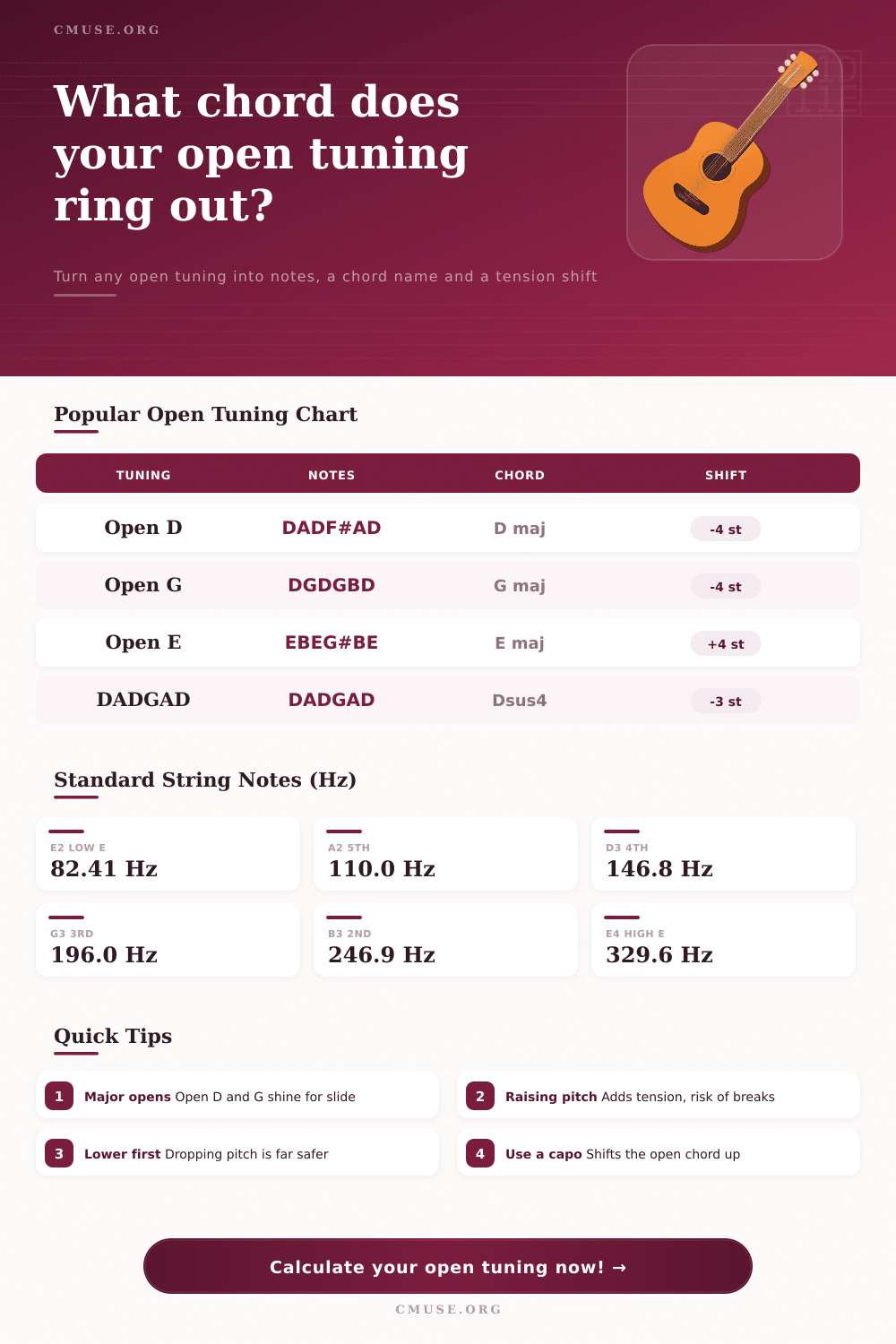
| Tuning | Notes (Low→High) | Open Chord | Net Shift |
|---|---|---|---|
| Open D | D A D F# A D | D Major | -4 semitones |
| Open G | D G D G B D | G Major | -4 semitones |
| Open E | E B E G# B E | E Major | +4 semitones |
| Open A | E A E A C# E | A Major | +4 semitones |
| Open C | C G C G C E | C Major | -7 semitones |
| DADGAD | D A D G A D | Dsus4 | -3 semitones |
| Open D Minor | D A D F A D | D Minor | -5 semitones |
| Open G Minor | D G D G Bb D | G Minor | -5 semitones |
| Open C6 | C A C G C E | C6 / Am7 | -5 semitones |
| Drop D Open | D A D G B E | Dsus / D5 | -2 semitones |
| String | Note | MIDI | Frequency (Hz) |
|---|---|---|---|
| 6th (Low E) | E2 | 40 | 82.41 |
| 5th (A) | A2 | 45 | 110.00 |
| 4th (D) | D3 | 50 | 146.83 |
| 3rd (G) | G3 | 55 | 196.00 |
| 2nd (B) | B3 | 59 | 246.94 |
| 1st (High E) | E4 | 64 | 329.63 |
| Semitones | Interval | Freq Ratio | Tension Factor |
|---|---|---|---|
| 0 | Unison | 1.000 | 1.000x |
| +2 | Major 2nd up | 1.122 | 1.260x |
| +4 | Major 3rd up | 1.260 | 1.587x |
| -1 | Semitone down | 0.944 | 0.891x |
| -2 | Whole step down | 0.891 | 0.794x |
| -3 | Minor 3rd down | 0.841 | 0.707x |
| -5 | Perfect 4th down | 0.749 | 0.561x |
| -7 | Perfect 5th down | 0.667 | 0.444x |
If this sounds foreign, then you are probably used to standard tuning, which was most likely first one you were taught. It’s comfortabley. It makes sense.
But what happens if you’re trying to play in certain keys that don’t fall into category of open chords? Or maybe you’d like to try playing some slide guitar. Suddenly you’re bending strings, dropping notes, fretting over whether or not your guitar’s neck will snap or your tone turn to mud. And that’s why we need an open tuning calculator.
How Open Tuning Calculators Help You Play Safely
Why? Because it eliminates the guess work. Instead of wondering where all those notes should go, the calculator will display them for you. Not only do you get the name of the chord, but you’ll also have a set of tension numbers that help protect your ears and your equipment.
This is why physics are the most neglected aspect of beginner learning: they look at Open E and say ‘oh, I just has to raise all my strings two whole steps‘. Sounds cool, so no problem, right? Wrong! Raising the pitch increase tension by the square of the amount of pitch rise. A tiny semitone rise will cause a massive increase in the tension pulling on your neck. To drop down a tone instead (e.g., to Open D) or move to Open G is much easier than you’re releasing tension not creating it.
The calculator does the maths for you. It spits out a number representing net change in tension. This tells you instantly if you need lighter gauge strings. Otherwise, you’ll end up with a warped fretboard or more likely, broken strings. Know when to push and when to pull back.
The other key is understanding the root note. When you play an open strum in DADGAD, it’s a suspended chord. That gives the open strings the uncertainty and dreaminess that folksingers adore. Go to Open G however, and suddenly, the root become G major. Your harmonic possibilities completely change.
Each string shift from standard tuning is broken out for you in the tool. Exactly which ones is going up? Which ones are dropping down? It sounds like a detail but it’s important to know because not all shifts are created equal. Some mix upward while some drop downward. This create tension that isn’t evenly distributed across the neck. It’ll need a careful truss rod tweak later on. Know about it now so you wouldn’t of had to make a repair shop visit.
There’s something interesting about scale length here too. A short scale guitar deals with higher tunings more effective than a long scale guitar. It doesn’t ‘absorb’ as much of the increased tension in the string length. When you type in your own scale length into the setup fields it becomes precise not approximate. That’s why a Stratocaster and a Les Paul might handle Open E differently. The shape alters the equation.
Online charts don’t account for this variable. This is generic advice that suits no one exactly. When you tailor the input to your real-world instrument, then it offer you a solid base from where you can experiment.
Adding another dimension is the use of capos. If you’re playing in Open D and put a capo on fret two, it is like playing in Open E but without the extra string tension. You can do this and reach higher keys. It means keeping string integrity while extending your vocal range possibilities. The calculator will take the capo position into account, displaying actual tuning against the sounding chord.
It fills the gap between what you know theoretically and how it work in practice. It enables you to plan out arrangements that work with your equipment and your voice.
The page also has reference tables to help place all of this into context. Interval ratios are laid out alongside their expected frequency. This lets you see at a glance that a perfect fifth down reduces tension by roughly half. That gives you an idea why Drop D sounds looser. Those numbers ground your intuition. You no longer have to guess if a string should be tight or floppy. Now you’re letting the math guide you.
It’s a subtle change in perspective but it makes your experimentation much more effective. At their core, open tunings are expressive devices. They tap into sounds that remain hidden in traditional tuning. They transform simple strumming into rich harmonies. Pursue a ghostly distant sound with DADGAD or seek the raw grit of an Open G slide; the knowledge of the mechanical price enables your performance without hesitation.
Fretting over snapped strings becomes unnecesary when focusing on making music. That’s where the calculator comes in. It provides that reassurance so you can venture fearlessly, carefully, into unknown sound areas. Your guitar will appreciate it. Check the tension before turning the pegs.