Open Pipe Frequency Calculator
Estimate the pitch of an open-open air column from pipe length, bore diameter, air conditions, end correction, and harmonic number.
Preset use: Load a real open tube example, then adjust length, inside diameter, temperature, humidity, correction style, harmonic, and tuning target.
Calculation Breakdown
| Opening Condition | Correction Per End | Typical Tube | Frequency Effect |
|---|---|---|---|
| Ideal no correction | 0 x radius | Formula checks only | Highest calculated pitch |
| Thin-wall open end | 0.600 x radius | Light metal or plastic tube | Slightly lowers pitch |
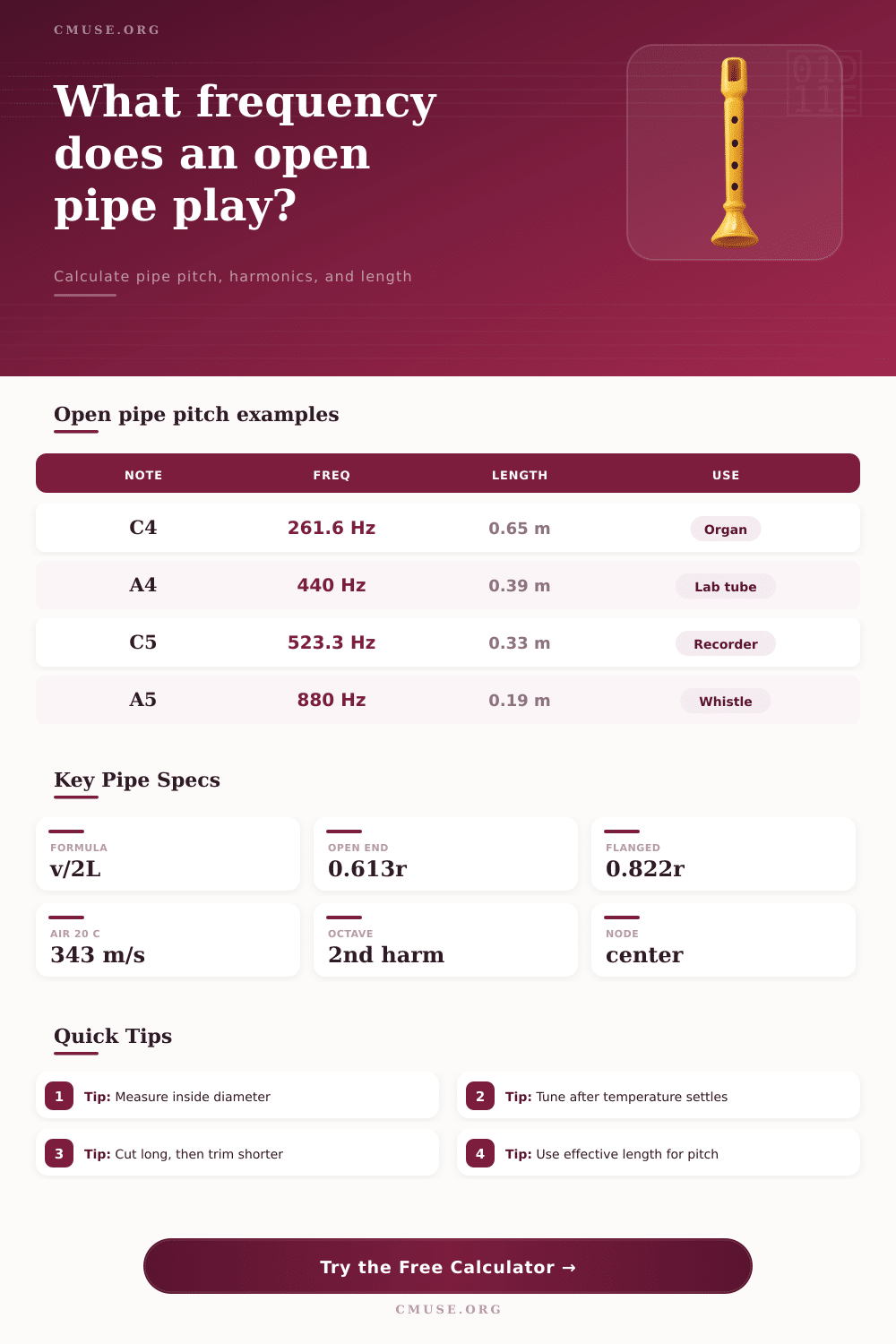
| Unflanged open end | 0.613 x radius | Plain open organ, PVC, lab tube | Common practical estimate |
| Flanged opening | 0.822 x radius | Large baffle or pipe mouth plate | More added acoustic length |
| Tone-hole style opening | 0.350 x radius | Embouchure or open key approximation | Smaller local correction |
| Harmonic | Frequency Ratio | Musical Interval | Air Column Pattern |
|---|---|---|---|
| 1st harmonic | 1 x fundamental | Unison | Pressure node at each open end, antinode near center |
| 2nd harmonic | 2 x fundamental | Octave | Additional pressure node at the pipe center |
| 3rd harmonic | 3 x fundamental | Octave plus fifth | Three half-wavelength sections fit the length |
| 4th harmonic | 4 x fundamental | Two octaves | Four equal half-wavelength sections |
| 5th harmonic | 5 x fundamental | Two octaves plus major third | All integer modes are theoretically present |
| Air Temperature | Approx Speed | Pitch Effect From 20 C | Practical Use |
|---|---|---|---|
| 0°C / 32°F | 331.3 m/s | About 69 cents flat | Cold outdoor pipe tests |
| 10°C / 50°F | 337.3 m/s | About 38 cents flat | Cool room or unheated hall |
| 20°C / 68°F | 343.2 m/s | Reference condition | Common workshop estimate |
| 30°C / 86°F | 349.0 m/s | About 29 cents sharp | Warm stage or outdoor air |
| 40°C / 104°F | 354.7 m/s | About 57 cents sharp | Very hot test environment |
| Target Note | Frequency | Ideal Half-Wave Length | Typical Open Tube Example |
|---|---|---|---|
| C3 | 130.81 Hz | 1.312 m / 51.7 in | Large open organ pipe or demo tube |
| G3 | 196.00 Hz | 0.876 m / 34.5 in | Medium organ pipe or long PVC resonator |
| C4 | 261.63 Hz | 0.656 m / 25.8 in | Open principal pipe, flute-length air column |
| A4 | 440.00 Hz | 0.390 m / 15.4 in | Lab tube or pitch demonstration tube |
| C5 | 523.25 Hz | 0.328 m / 12.9 in | Recorder-size or short open pipe |
The pitch of an open pipe are determined by the relationship between the length of the pipe and the speed of sound. An open pipe is a pipe that has two openings in it. The air within the pipe vibrate at a certain frequency that the length of the pipe and the speed of sound within that pipe determines.
The frequency of the open pipe is related to the length of the air columns within the pipe. Therefore, changing the length of that air column will change the pitch of the pipe. Additionally, changing the speed of sound within the pipe will also change the pitch of the pipe.
What Changes the Pitch of an Open Pipe
The length of the pipe in which the air vibrate is not the same than the length of the pipe itself. The air does not stop its movement at the rim of the pipe. Instead, the air continue to move a short distance beyond the pipe.
This is known as an end correction. The end correction increase the effective length of the pipe. The amount of end correction is related to the radius of the pipe and the type of end on the pipe.
For instance, pipes with larger bores has more end correction than pipes with smaller bores. Additionally, if the opening of the pipe is flanged instead of plain, there will be more end correction. Thus, increasing the end correction will increase the length of the pipe, which will decrease the pitch of the pipe.
The temperature and humidity within the pipe also affect the pitch of the pipe. Changes in temperature will change the speed of sound within the pipe. Warm air has a higher speed of sound than cold air.
Therefore, when the air within the pipe is warm, the pitch of the pipe will be sharp. When the air within the pipe is cold, the speed of sound will be slower, creating a flatter pitch for that pipe. Humidity also affect the speed of sound, though with a smaller effect on the pitch of the pipe than that of temperature.
For example, individuals often find that the pitch of their open pipes change if they move from a warm room to a cold hallway. This is due to the change in air temperature and, therefore, the speed of sound. Open pipes create harmonics that is different from the stopped pipes of the same length.
Because open pipes have two open ends, they have two nodes in their standing waves. Therefore, open pipes can create every integer multiple of the fundamental frequency of that pipe. For instance, the second harmonic is one octave higher than the fundamental frequency, while the third harmonic is an octave and a fifth above the fundamental frequency.
This is one of the reasons that open pipes tend to create a bright and clear sound. However, if the bore of the pipe is too wide and/or if the mouth of the pipe is too high, these open pipes may create unwanted overtones. When cutting a pipe to a specific pitch, it is important to understand that cutting the pipe to the length required to create the desired pitch immediately will not necessarily create that pitch.
When cutting pipes to specific pitches, it is best to begin with a pipe that is longer than the length required of the pipe. Then, gradually trim the pipe to its target length. It is important to measure the frequency of the pipe while it is within the pipe at room temperature.
The target frequency will lead to a physical length for the pipe, but you must shorten that length by the amount calculated for the end correction. The pitch of the pipe should then be tested with an electronic tuner prior to cutting the pipe to its target length. Tables are available that list the different types of openings for pipes and the change to the end correction based off those openings.
Additionally, there are tables that list the impact of different temperatures on the speed of sound within air. If, after making adjustments for the end correction and the temperature of the air within the pipe, the pitch is still flat, it is possible that the bore of the pipe is actualy larger than the measurement recorded for that pipe. Additionally, it is also possible that the end of the pipe is flanged rather than plain.
By calculating the length of the pipe based on the target pitch, the bore size, and the type of end on the pipe, it is possible to compensate for these differences prior to cutting the pipe. Once you have accounted for these three factor (length, bore, and end), the pitch of the open pipe will be more stable.