Onset Density Calculator
Measure note attacks per second, per bar, active time, and voice load from BPM, meter, rests, and counted onsets.
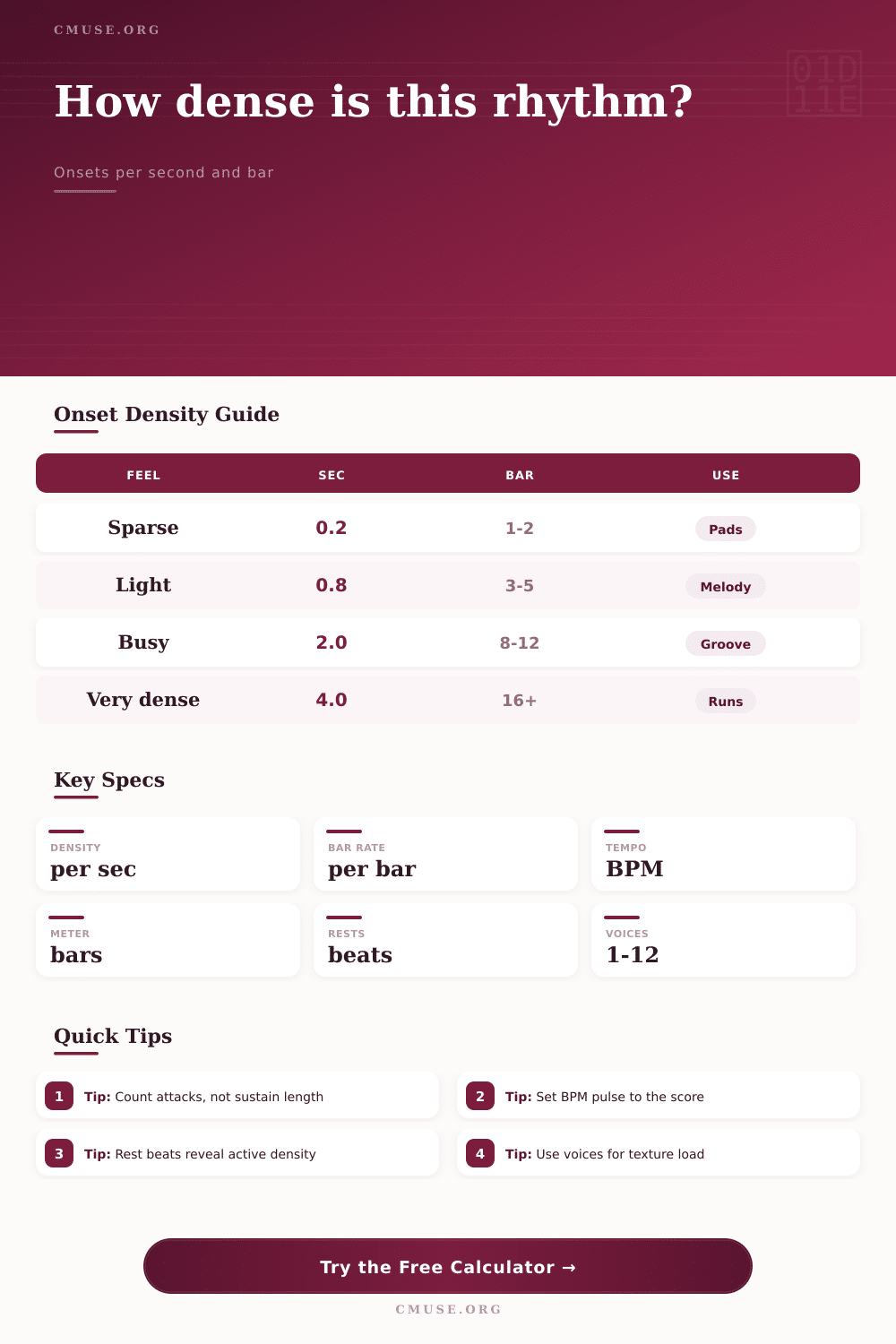
| Texture Range | Onsets / Second | Onsets / 4/4 Bar | Typical Musical Reading |
|---|---|---|---|
| Sparse | 0.10 to 0.50 | 1 to 2 | Long tones, pads, slow entrances, exposed rests |
| Light | 0.50 to 1.25 | 3 to 5 | Melody with space, simple accompaniment, chorale motion |
| Moderate | 1.25 to 2.50 | 6 to 10 | Steady eighth-note activity, comping, layered ostinato |
| Dense | 2.50 to 4.50 | 11 to 18 | Runs, fills, drum subdivisions, fast ensemble figures |
| Very dense | 4.50+ | 19+ | Tremolo-like attack streams, virtuosic passages, builds |
| Meter and Pulse | Tempo | Seconds / Bar | Use When Counting |
|---|---|---|---|
| 4/4, quarter pulse | 60 BPM | 4.00 sec | Slow ballads, chorales, practice counting |
| 4/4, quarter pulse | 120 BPM | 2.00 sec | Common groove and pop tempo comparisons |
| 3/4, quarter pulse | 90 BPM | 2.00 sec | Waltz-like phrases and triple-meter melodies |
| 6/8, dotted-quarter pulse | 112 BPM | 1.07 sec | Jigs, compound-meter tunes, fast two-beat feel |
| 5/4, quarter pulse | 100 BPM | 3.00 sec | Odd-meter riffs and asymmetric phrases |
| Texture Type | Voice Count | Counting Method | Density Meaning |
|---|---|---|---|
| Solo melody | 1 | Every articulated note | Part speed and melodic attack rate |
| Two-hand piano | 2 | Both hands combined, then divided if needed | Total keyboard activity plus hand workload |
| Quartet writing | 4 | Sum attacks across all staves | Ensemble texture, not just one instrument |
| Drum groove | 3 to 6 | Kick, snare, hats, cymbals, toms as lanes | Layered rhythmic activity and fill intensity |
| DAW arrangement | 4 to 12 | Count active tracks or MIDI lanes | Arrangement density over a selected window |
| Preset | Inputs Modeled | Good Comparison | Watch For |
|---|---|---|---|
| Bach Chorale Phrase | 4 voices, 4 bars, rests included | Balanced harmonic motion | Long tied notes can hide low onset counts |
| Funk Guitar Comp | Single voice, syncopated attacks | Groove tightness and rhythmic punch | Muted strums may count as attacks |
| Two-Bar Drum Fill | Multi-lane hits over short window | Fill intensity across tempos | Flams can be counted as one or two |
| 6/8 Fiddle Jig | Dotted-quarter pulse in compound meter | Fast compound-meter articulation | Use the printed metronome pulse |
| Ambient Pad Entrances | Few attacks over many measures | Entrance spacing and active-time contrast | Density per bar may be more useful than per second |
On this page of sheet music, there are sixteenth-note runs and lots of tremolo marks making it look complicated. If you were a member of an orchestra your conductor would ask if you could follow group for a four-bar phrase. You say yes but aren’t realy sure as there is so many attacks you don’t know which ones to count. This is when onset density is used.
What does that mean? It means being able to tell when something feel hurried and why it feels like that. Enter your tempo and the number of attacks in calculator below, and it will do calculation for you. You won’t have to guess whether passage is fast or simply more hard to play.
What Is Onset Density?
Attack frequency is something most musician do not consider when thinking on note values. If they are reading sixteenth notes, they presume an expected tempo. Many musicians fail to realize that two voices playing sixteenth notes at once doubles the mental load on their brains. By focusing entirely on the onset moment, the tool allow you to untangle rhythms from the visual complexity.
An onset is merely beginning of a sound. Even though a chord might sustain for eight beats, it’s considered only one attack. If a note repeats each beat with staccato, then each has its own distinct attack because the bow or air hits the string again, once more. That make a difference, since the ear hears bursts of energy not duration alone.
What you’ll find as well is how oddly meter interact with tempo. A phrase played in 4/4 time at a tempo of say 120BPM may be easy to manage with just three onsets per bar. At that pace the note entries feel comfortabley. However, in a 6/8 time signature, that same number of note entries feels frantic as subdivisions become denser by design. Because of this, the pulse feel tighter.
That’s why you can see in the table on page that the number of attacks can range from sparse textures hovering around one or two attacks per measure to dense grooves pushing double digits. These ranges show how much a transcription can match the feel of original recording. When transcribing, for example, a funk guitar line, if you’re only getting zero point five attacks per second then chances are you’ve missed muted strums that underpin the rhythm. Although no full pitch tone is produced, those ghost notes are still onsets.
The other element of this equation are rests. How does it calculates when half of a measure contains no sound? Well, that’s a less dense overall measure, but it’s more dense in terms of active time on those sounds. You can also enter the number of rest beats, and this will dramatically change how your intensity is read. Use this when contrasting a driving drum fill with an ambient pad entry that is sparse. They may both have same raw attacks across eight bars, yet their distribution are hugely different in terms of effort required and performance difficulty.
Another element that most people don’t consider until they get into rehearsals is voice stacking. One pair of hands will has a reasonable workout trying to play a piano solo with forty onsets spread over four bars. That same number of onsets split into four parts with a string quartet feel far lighter per player but creates a thicker sound for the group. You can also specify voice count with the tool and then see the workload per part vs. This show the total load on the texture.
This help with arrangement decisions, such as doubling a melody line or adding counterpoint, without overloading the mix. Using the preset buttons is also a quick way to see how your passages compares to established styles. An EDM hi-hat build stretches toward the very dense end of the scale; a Bach chorale phrase hovers around the light section.
Comparisons provide you with a vocabulary when talking about texture with a collaborator who may be familiar with words such as sparse or busy but not fluent readers of musical notation. Instead of this sounds too crowded, now it’s said at what onset rate per second? That transforms a subjective sense of unease into something objective that you can tweak back down by deleting some notes or repositioning rhythms.
For the player and the listener, onset counting is about attention span. Not enough attacks and the music stall with no forward movement. Too many attacks and the brain switch off from each event and instead hears a blur of noise. The trick to finding the sweet spot is to measure what you’ve written before attempting to play it.
When you get your density numbers showing, then you can design passages that challenge correct muscles but not break the groove. Now you know exactly how many attacks are in those four bars, so you could of relied on your parts being able to handle the pressure.