1/3 Octave Band Calculator
Find nominal band centers, exact geometric centers, and edge frequencies in one pass for monitoring, tuning, and spectrum analysis.
Enter a frequency and the calculator snaps it to the nearest third-octave band. Use the anchor field if you want a different geometric base than 1000 Hz.
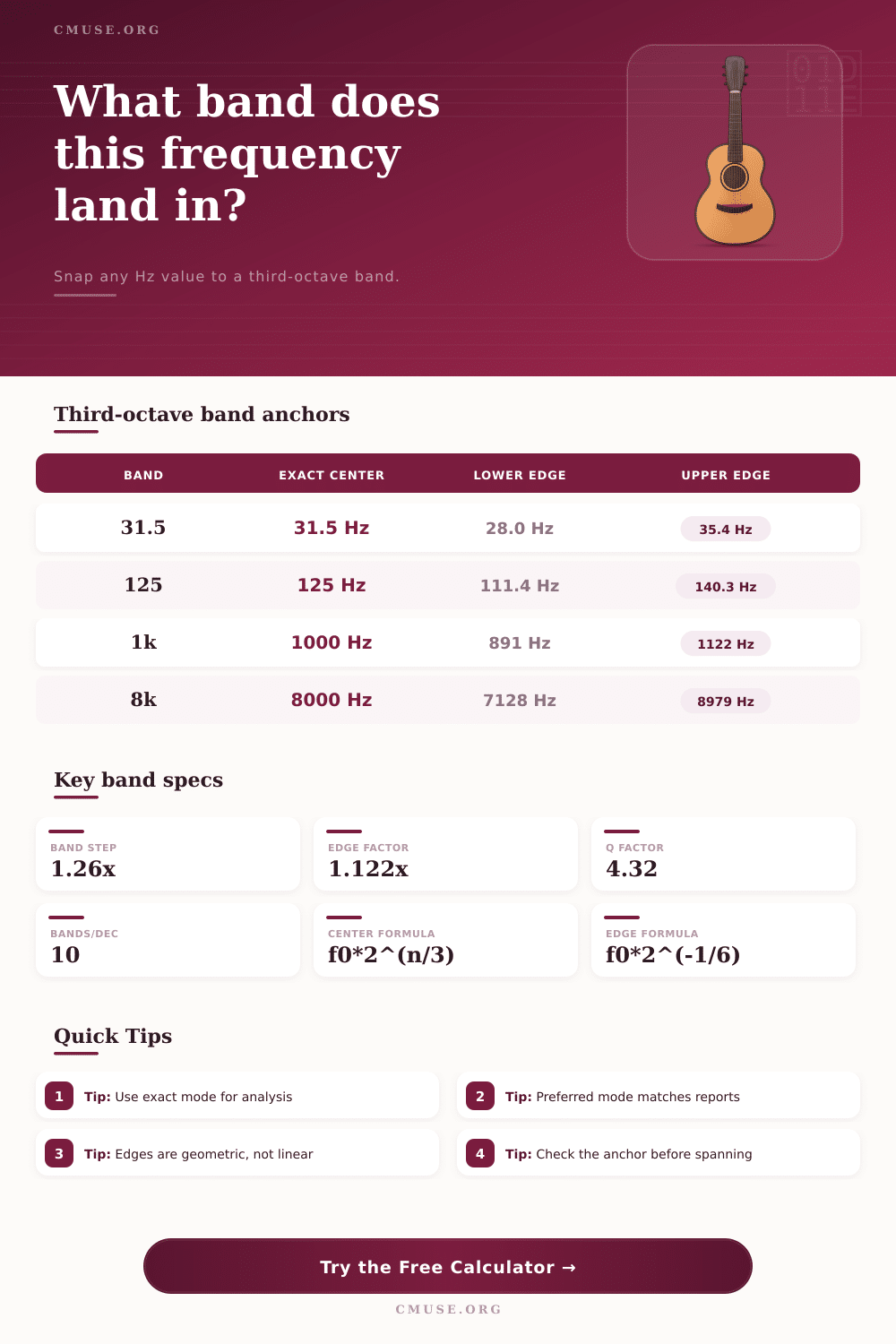
The 1/3 octave grid uses geometric spacing. The edges sit one-sixth octave above and below the center frequency.
| Band | Exact center | Lower edge | Upper edge |
|---|---|---|---|
| 31.5 Hz | 31.50 Hz | 28.06 Hz | 35.36 Hz |
| 125 Hz | 125.00 Hz | 111.36 Hz | 140.31 Hz |
| 1 kHz | 1000.00 Hz | 890.90 Hz | 1122.46 Hz |
| 8 kHz | 8000.00 Hz | 7127.18 Hz | 8979.69 Hz |
| Source | Band | Why it fits | Typical read |
|---|---|---|---|
| Kick drum | 63 Hz | Fundamental weight | Punch and thump |
| Bass guitar | 125 Hz | Body and notes | Warm low end |
| Speech | 1 kHz | Core intelligibility | Clear midrange |
| Cymbal air | 12.5 kHz | Shimmer and sheen | Bright top end |
Tip: Use exact mode when you need analysis-grade edges. The preferred series is best when you want reporting consistency.
Tip: Third-octave boundaries are geometric. The midpoint is not an arithmetic average, so the edges spread asymmetrically in Hz.
Third-octave bands is used to divide up the audio frequency spectrum into specific segments. Many people use third-octave bands because audio frequencys does not linearly increase, but logarithmic increase. As a result of the logarithmic increase of audio frequencies, the distance between frequencies will increase as the frequencies increase.
Third-octave bands account for this by creating bands of audio frequencies that have a geometric widths to each band. Each third-octave band has a factor of approximately 1.26 times the width of the previous third-octave band. Thus, there are ten third-octave band within an octave.
What are third-octave bands?
Each third-octave band has edges to its bands that are one-sixth of an octave away from the center frequency. For instance, a third-octave band with a center frequency of 1000 Hz will have lower and upper edge of approximately 891 Hz and 1122 Hz, respectively. These specific frequencies will allow the measurements to properly overlap with one another.
Additionally, if a person is measuring a specific frequency, that specific frequency might not be within the center of the third-octave band. For instance, if a person measures a subwoofer, the frequency might be 82 Hz. In this case, the third-octave band must be determined in which band the 82 Hz frequency reside.
This will allow for the identification of the bandwidth of that third-octave band, as well as it’s Q factor. The Q factor will indicate to the person the bandwidth that that filter should of have. A calculator can help to determining the deviation of that specific frequency from the third-octave band in both percentage and musical cents.
Many people make mistakes when using third-octave bands because the third-octave bands are not linear in relation to Hertz. For instance, a third-octave band with a center frequency of 100 Hz will only be 35 Hz in width. In contrast, a third-octave band with a center frequency of 10 kHz will be over 3,000 Hz in width.
Thus, the third-octave bands are wider at higher frequencies than lower frequencies. Therefore, people need to understand which third-octave bands are which, and they can use an anchor frequency to determine specific third-octave bands. An anchor frequency could be 1000 Hz, for instance, or it could be some other frequency, like the tuning frequency of a subwoofer.
Third-octave bands are useful for many audio-related tasks. For instance, third-octave bands can be used to determine if a low-pass filter is working as intended for live sound systems. Third-octave bands can also be used in speech intelligibility tasks; the 1 kHz third-octave band is one that is most importance in speech.
Additionally, HVAC technicians can use the third-octave bands to eliminate rumble frequencies from the sounds that HVAC systems create. For instance, people can check the edges of the 6.3 kHz third-octave band to ensure that cymbals in a sound system have the proper shimmer without being to harsh. A person can choose to use either the preferred nominal centers for third-octave bands or the exact geometric centers of each third-octave band.
The preferred nominal centers will use the standard third-octave bands, such as the 31.5 Hz and 125 Hz third-octave bands. For those who requires additional precision in their audio analyses, the exact geometric centers provide the third-octave bands with true logarithmic fidelity. Additionally, the tool that is used to measure these third-octave bands can be set to switch between the preferred nominal and the exact geometric third-octave bands.
Furthermore, the tool can also measure the number of third-octave bands within a certain range. For instance, between 20 Hz and 20 kHz there is 33 third-octave bands. There are some pitfalls in the effective use of third-octave bands.
One of the pit is ignoring the reference anchor frequency. In this case, it is better to default to 1000 Hz as the third-octave band. Another of the pit is to overlook the Q factor.
The Q factor for third-octave bands is 4.32. Thus, it is important for those who use third-octave bands to use that in setting parametric equalizers. Finally, people should also use range limits so that they can determine if the audio is spanning too many third-octave bands.
Audio that spans too many third-octave bands may have muddy low frequency. Third-octave bands are used for different reasons within different fields. For instance, in reverberant venues people might rely more upon there auditory perceptions rather than the third-octave bands.
For noise ordinance compliance, the preferred third-octave bands should be used so that the report matches the noise ordinance inspection equipment. Mastering engineer will use the exact geometric third-octave bands because every Hz is important when creating a mastering audio file. Thus, third-octave bands allow people to transform the chaos of sound into a reality that can be tuned and mastered.