Octave Fret Midpoint Calculator
Find the physical midpoint of any fretted note's active string length, confirm the fret n+12 octave target, and build scale-specific fret tables for guitar, bass, ukulele, mandolin, and custom instruments.
🎯 Octave Midpoint Presets
⚙ Scale, Fret, And Midpoint Inputs
Calculation Breakdown
📌 Instrument Scale Grid
📊 Selected Octave Midpoint Table
| Source Fret | Source Position | Active String | Octave Point | Target Fret | Playable Check |
|---|
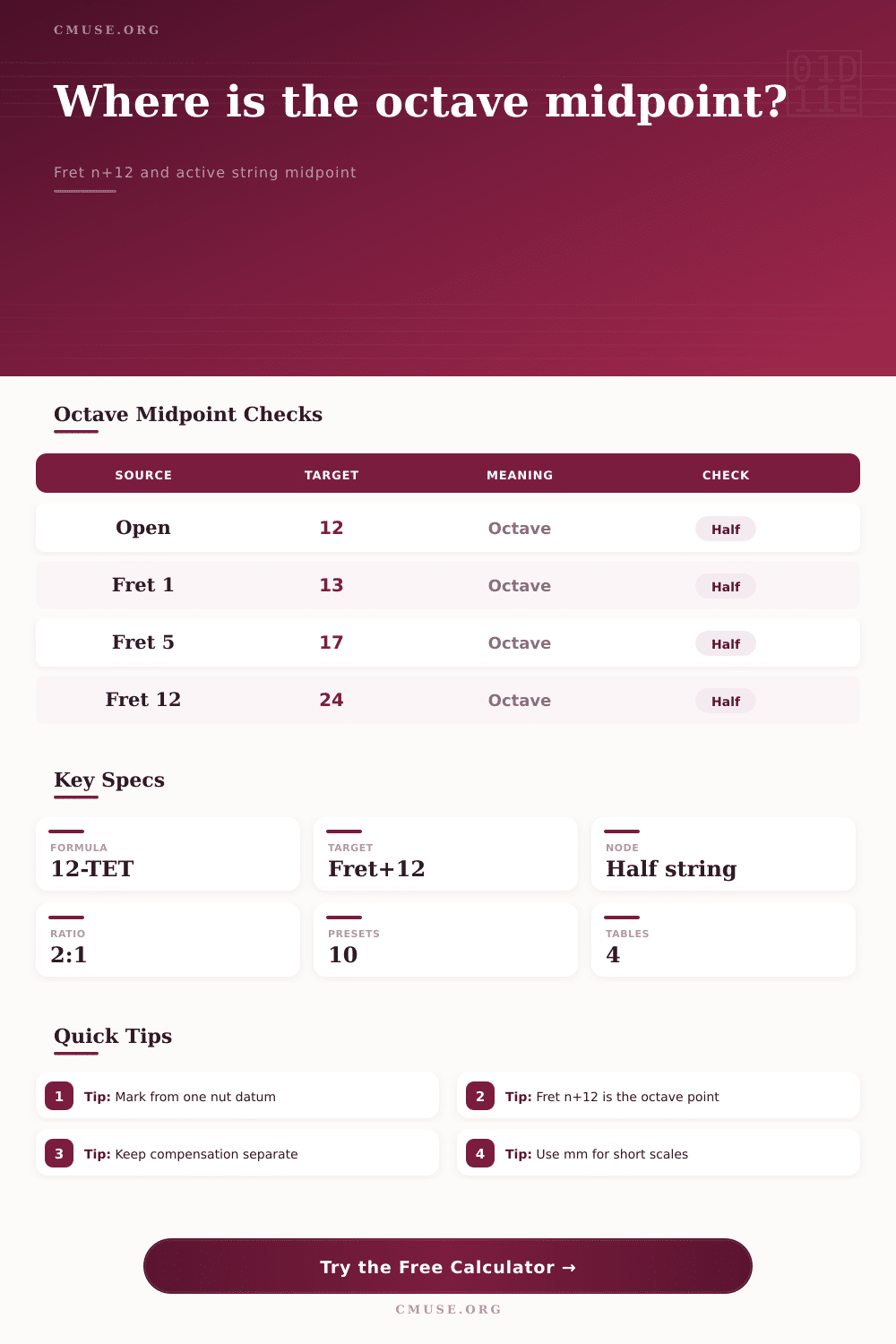
For a one-octave interval, the octave point is the active string midpoint. A two-octave interval shows the quarter-length node.
🎼 Octave Pair Checkpoints
| Pair | Lower Position | Octave Position | Distance Between | Remaining After Lower |
|---|
📏 Fret Region Measurement Table
| Fret | Nut Position | Remaining Scale | Midpoint To Bridge | Ratio From Open |
|---|
📐 Common Scale Midpoint Reference
| Instrument | Scale | Open Octave | Fret 5 Octave | Typical Frets |
|---|
💡 Midpoint Layout Tips
There’s nothing like having your ruler disagree with your tuner as you’re constructing a guitar neck. You’ve painstakingly measured out the scale length to the millimeter, fretted it all out, and now you find that high E string is sharp at the 12th fret. No worries: it’s not a bad day; it’s typically a geometry problem.
If you enter your desired scale length into the octave fret midpoint calculator, it will do the math for you. You no longer have to guess if your mistake was based off measurement drift or a misunderstanding of how string vibration work. Once you plug in your scale length, it will compute the physical midpoint of the length of any active string. It will then tell you exactly where the octave target should fall.
Why the Midpoint Calculator Helps Guitar Builders
This is a far more simple idea than it sounds. Equal temperament divide each octave into two parts that double in frequency. In practical terms, this means dividing the string by two (or rather, halving its length). When you depress a string onto the first fret, the string begins to vibrate again from that fret wire outwards. The next fret above has to be directly half way between the bridge and the first fret to create an octave above the note pressed. As it happens, thirteenth fret is halfway. The same principle apply throughout the neck. An octave above the fifth fret would be the seventeenth fret. Exactly half the length of the remaining string are between the fifth and the seventeenth fret.
It is a small thing but it matters immensely when you are marking wood that cannot be unmarked. The mid-point of the whole string at the 12th fret is regarded as a special place. Why? Well, it’s the middle. From any starting note, use the calculator to test this. Change the starting fret and you will find that no matter where you start, the string split into two equal lengths.
This becomes important if you’re tuning a guitar with a custom number of frets or an unusual scale length. A short-scale bass isn’t the same as a seven-string guitar with a twenty-six and a half inch scale, but the proportion are the same. The tool allows for this difference by maintaining the proportional logic while changing the absolute distances to match.
What you’ll notice is that active length of the string diminishes as it moves up the neck and with it the point at which the octave occur. Fretboard layout and intonation compensation are two different things. The reason that shorter and stiffer strings need to have the bridge point moved backwards (to compensate) has no bearing whatsoever on where the frets should sits. It only matter if the instrument is to sound in-tune with itself. The calculator maintain this distinction. When it computes the fret locations, it uses the actual (true) scale length… From nut to hypothetical zero-compensation bridge point. That’s why it asks for your saddle compensation reference, but displays it separately so you don’t inadvertently bake it into your fret placement. That’s what many builders tend to overlook.
Using millimeters instead of inches often helps reduce rounding errors, especially on longer scales like bass guitars where fractions of an inch become significant over thirty-four inches. Running the tool creates clear tables of references so you can cross check your calculations and go cut it down accordingley. The table will show you the original position compared to the octave point. If there is a difference between them, you will know that something went wrong and you need to start from scratch. Better to find out on the computer than on the maple wood.
The process of building an instrument is both an exercise in precision and one of trust. Trust in the math so you can then trust in your hands. By verifying the midpoint logic all over the neck, you ensure that geometry supports the music. Verify that the shape works for the sound. A dot on the board at the twelfth fret isn’t just there because it’s in the middle somewhere. It’s the anchoring point that keeps the other frets in line with each other.
When you realize that each fret produces another scale, and that each scale has a different midpoint, it’s no longer about memorizing numbers, but instead about honoring their relationship to each other. This is clearer then any precise measurement ever could of.