Octave Calculator for Note Frequencies
Map a note, compare octave jumps, and read the frequency, MIDI, ratio, and wavelength for quick music theory checks.
Pick a real musical reference, then the calculator fills the pitch pair, tuning standard, and display precision.
Transpose and cents move both pitches the same way, so you can compare a written note against any target octave cleanly.
These tables give quick anchors for octave ranges, interval ratios, and common instrument spans.
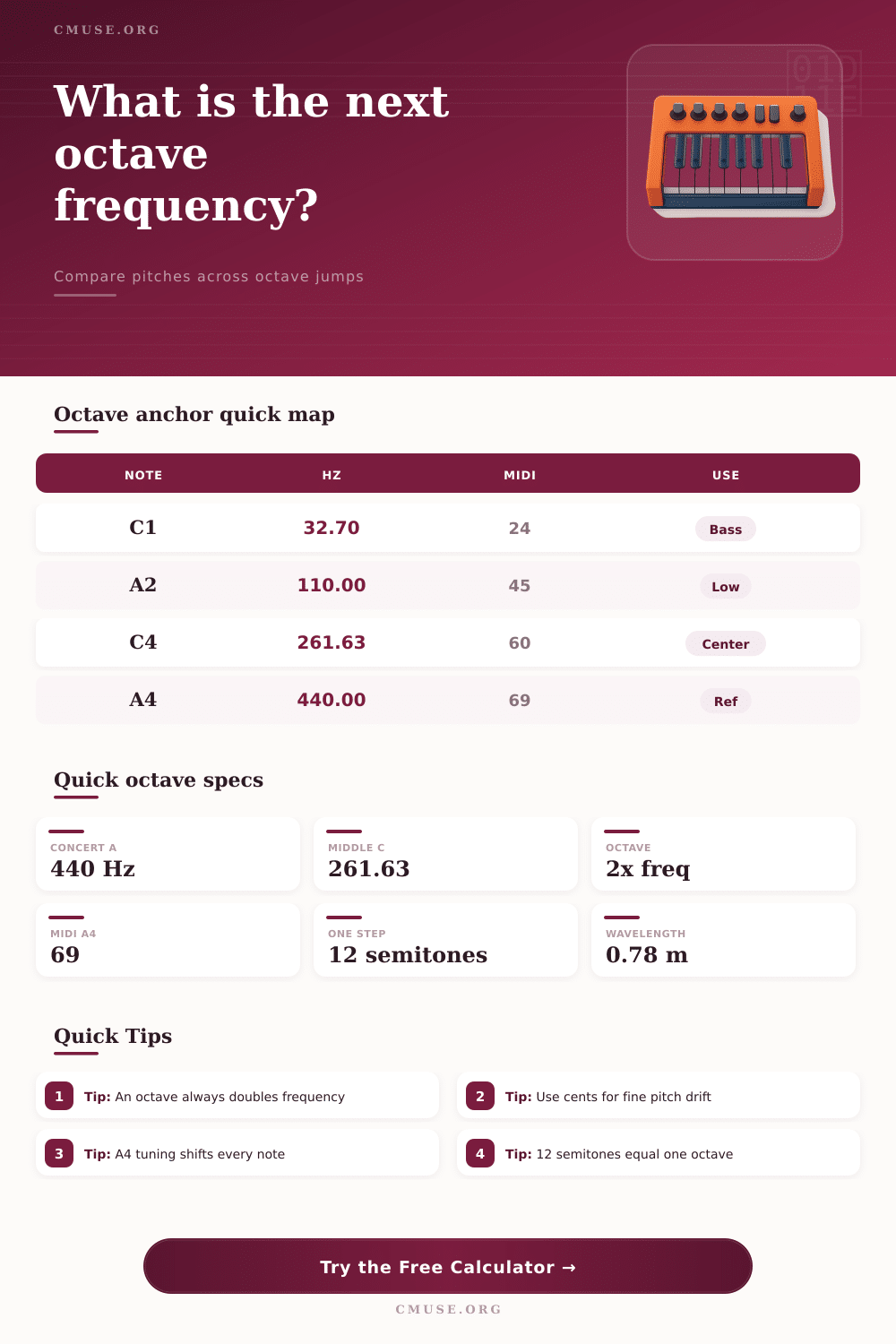
| Note | Hz | MIDI | Role |
|---|---|---|---|
| C1 | 32.70 | 24 | Bass |
| A2 | 110.00 | 45 | Low |
| C4 | 261.63 | 60 | Middle |
| A4 | 440.00 | 69 | Reference |
| C6 | 1046.50 | 84 | Bright |
| Band | Range | Hz span | Use |
|---|---|---|---|
| Sub contra | C0-B0 | 16.35-30.87 | Deep |
| Contra | C1-B1 | 32.70-61.74 | Bass |
| Great | C2-B2 | 65.41-123.47 | Low mid |
| Small | C3-B3 | 130.81-246.94 | Core |
| Upper | C4-B4 | 261.63-493.88 | Bright |
| Interval | Steps | Ratio | Effect |
|---|---|---|---|
| Unison | 0 | 1.0000 | Same |
| Semitone | 1 | 1.0595 | Tight step |
| Perfect 4th | 5 | 1.3348 | Stable |
| Perfect 5th | 7 | 1.4983 | Open |
| Octave | 12 | 2.0000 | Double |
| Instrument | Low | High | Span |
|---|---|---|---|
| Piano | A0 | C8 | 88 keys |
| Guitar | E2 | E6 | 4 oct |
| Bass | E1 | G4 | 3 oct |
| Violin | G3 | E7 | 4+ oct |
| Flute | C4 | C7 | 3 oct |
Tip: One octave means exactly 12 semitones and a 2x frequency jump.
Tip: If the pitch feels off, adjust A4 first, then fine-tune cents.
An octave occur when the frequency of a sound is doubled. If you double the frequency of a note, you move up an octave. The mathematical relationship of this doubling of frequency is what allow octaves to function within music.
Because an octave is a doubling of frequency, it represents a specific distance between two musical pitch. The standard musical pitch is A4 at 440 Hz. Many orchestra use 440 Hz as there standard pitch.
Octaves, Tuning and Instrument Ranges
Other orchestras use 442 Hz because the higher pitch make the symphony sound more brightly. Some historical music use 415 Hz which was the standard for orchestras during the Baroque period. If you change the frequency of A4, every other note within the scale will change its frequency as well.
Thus, if you change the frequency of A4, you change the frequency of all other notes in the scale. To transpose a note up one octave, add 12 semitones to that note. Adding 12 semitones to a note will double the frequency of that note.
Musicians also use a unit of measurement calls cents. There are 1200 cents in an octave (100 cent per semitone). A cent is used to make very smallly changes to the frequency of a musical note.
If you compare the base note with the target note, you can determine if the target frequency is a perfect double of the base note. The frequency of a sound dictates how a person will perceive that sound. Frequencies between 0 and 60 Hz is considered sub-bass frequencies and the listener often feel them rather than heard.
Middle C is 262 Hz and is the frequency where most melodies are heard. Frequencies in the thousands of Hz is considered high frequencies and can cause ear fatigue if listened to for long periods of time. Each frequency have a wavelength associated with it.
Low frequencies have long wavelengths and high frequencies has short wavelengths. Because low frequencies have long wavelengths, they can reflect off the walls in a room. High frequencies does not reflect off the walls.
Each instrument have its own range of frequencies that it can play and that range is measured in octaves. The piano have a range of over seven octaves. A guitar play between the notes of E2 and E6. A bass guitar focuses upon low frequencies and plays within three octave.
A violin plays high frequency and ranges between G3 and E7. For each instrument to play within its proper range, understanding the frequency of that instrument is crucial. If a note is played too low for that instrument, it will produce a rumble. If the note is too high for that instrument, it will produce a shrill sound.
There are different ways to tune the notes on a musical scale. One way is to use equal temperament. With equal temperament, each semitone multiply the frequency by 1.06.
This allow for perfect double within octaves. The other method is known as just intonation in which the ratios of frequencies are to simple numbers, like 3:2 for perfect fifths. The issue with just intonation is that some note can clash in certain keys.
Additionally, when you use a capo on a guitar, the pitch of each string change. Thus, when the pitch of the string changes, the timbre of that string change. Many musical decisions are based off the type of music being create.
For instance, rock band use 442 Hz to help their music cut through the amplifier in the venue. However, a Baroque musician will use 415 Hz to create the historical sound of the music they are performing. Producers use the concept of wavelength to decide where to place the microphone for the sound creation.
Microphones should be placed to capture the low frequencies of the sound being create in the room. Finally, MIDI numbers is used in music software to assign musical notes numbers. MIDI number 60 is used for the note of Middle C. Understanding the mathematical relationship of the note of an octave will allow musicians to properly create there harmony and ensure that there notes are within the proper frequency range.