Octave Designation Calculator
Convert scientific pitch notation into MIDI note number, frequency, piano key position, Helmholtz name, wavelength, and instrument range status.
Formula Breakdown
| Scientific Octave | C Example | MIDI Range | Frequency Span at A4 440 | Common Description |
|---|---|---|---|---|
| -1 | C-1 | 0-11 | 8.18-15.43 Hz | Sub-audio / MIDI floor |
| 0 | C0 | 12-23 | 16.35-30.87 Hz | Sub-contra octave |
| 1 | C1 | 24-35 | 32.70-61.74 Hz | Contra octave |
| 2 | C2 | 36-47 | 65.41-123.47 Hz | Great octave |
| 3 | C3 | 48-59 | 130.81-246.94 Hz | Small octave |
| 4 | C4 | 60-71 | 261.63-493.88 Hz | One-line octave |
| 5 | C5 | 72-83 | 523.25-987.77 Hz | Two-line octave |
| 6 | C6 | 84-95 | 1046.50-1975.53 Hz | Three-line octave |
| 7 | C7 | 96-107 | 2093.00-3951.07 Hz | Four-line octave |
| 8 | C8 | 108-119 | 4186.01-7902.13 Hz | Five-line octave |
| Note | MIDI | Piano Key | Frequency | Typical Use |
|---|---|---|---|---|
| A0 | 21 | 1 | 27.50 Hz | Lowest standard piano key |
| C1 | 24 | 4 | 32.70 Hz | Organ pedal / low synth register |
| E2 | 40 | 20 | 82.41 Hz | Guitar 6th string sounding pitch |
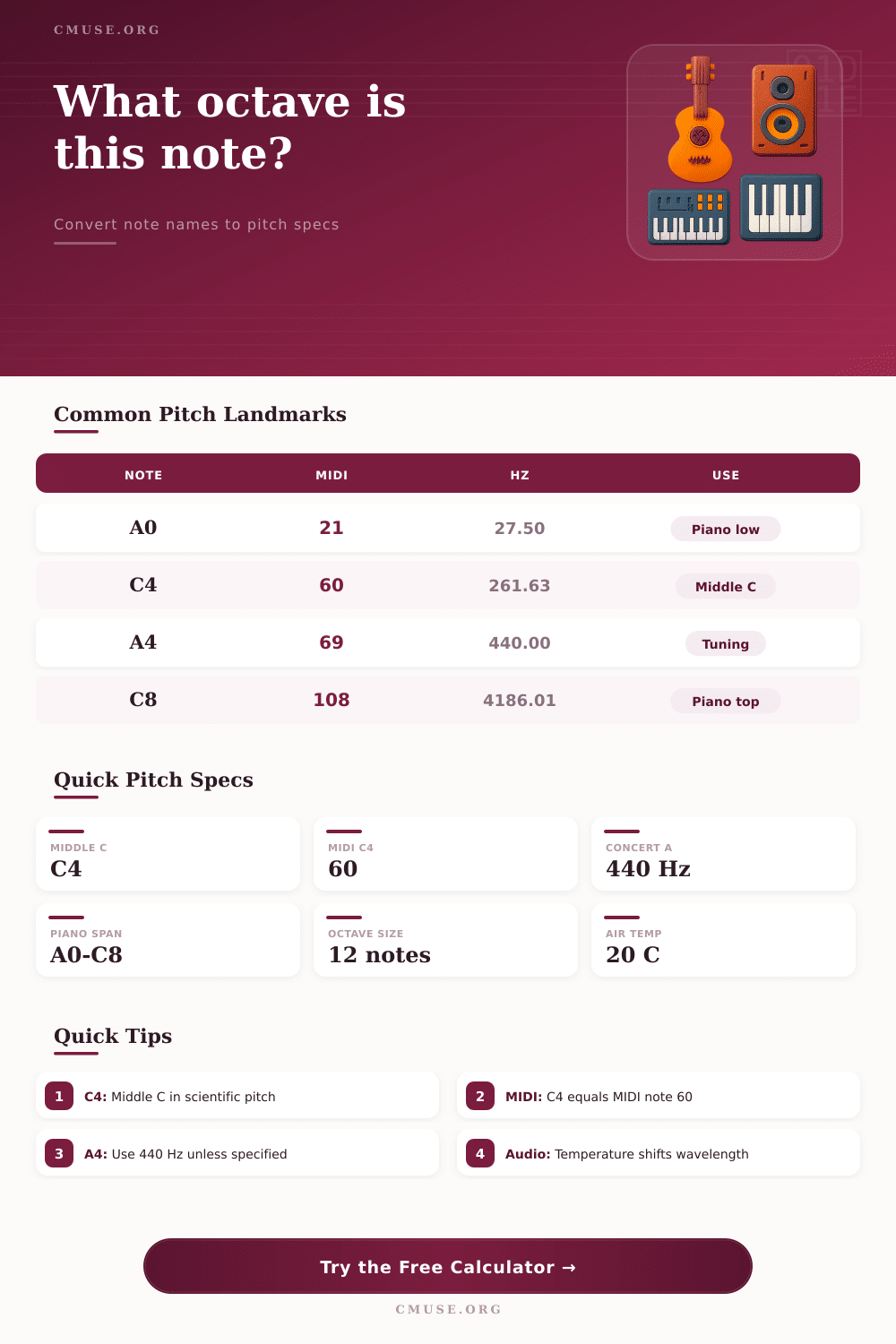
| C4 | 60 | 40 | 261.63 Hz | Middle C |
| A4 | 69 | 49 | 440.00 Hz | Concert tuning reference |
| C6 | 84 | 64 | 1046.50 Hz | Soprano high C / piccolo region |
| C8 | 108 | 88 | 4186.01 Hz | Highest standard piano key |
| Instrument / Context | Practical Written or Sounding Range | MIDI Range | Octave Designation Note | Range Check Use |
|---|---|---|---|---|
| 88-Key Piano | A0 to C8 | 21-108 | Scientific pitch matches sounding pitch | Keyboard mapping and score entry |
| Guitar | E2 to E6 sounding | 40-88 | Guitar is written one octave higher than it sounds | Tabs, MIDI export, orchestration |
| 4-String Bass | E1 to G4 sounding | 28-67 | Bass clef notation often sounds as written or octave-shifted by context | Low-end register checks |
| 5-String Bass | B0 to G4 sounding | 23-67 | Low B enters the sub-contra octave | Bass extension checks |
| Violin | G3 to E7 practical | 55-100 | Open strings are G3, D4, A4, E5 | String writing and sample keyswitches |
| Cello | C2 to A5 practical | 36-81 | Lowest open string is C2 | Orchestral register checks |
| Concert Flute | C4 to D7 practical | 60-98 | Sounds as written in concert pitch | Woodwind range checks |
| Piccolo | D5 to C8 sounding | 74-108 | Written one octave lower than sounding pitch | High-register verification |
| Instrument Type | Written C Sounds As | Semitone Offset | Example Result | Calculator Setting |
|---|---|---|---|---|
| Concert pitch instruments | C | 0 | Written C4 = sounding C4 | Transpose 0 |
| B♭ clarinet / trumpet | B♭ | -2 | Written C4 = sounding B♭3 | Transpose -2 |
| E♭ alto sax | E♭ | -9 | Written C4 = sounding E♭3 | Transpose -9 |
| F horn | F | -7 | Written C4 = sounding F3 | Transpose -7 |
| Guitar / tenor voice | C one octave lower | -12 | Written E3 = sounding E2 | Transpose -12 |
| Piccolo | C one octave higher | +12 | Written C5 = sounding C6 | Transpose +12 |
| Pitch Class | Equal Temperament | Just C Major | Pythagorean C | Quarter-Comma C |
|---|---|---|---|---|
| C | 0.0 cents | 0.0 cents | 0.0 cents | 0.0 cents |
| D | 0.0 cents | +3.9 cents | +3.9 cents | -6.8 cents |
| E | 0.0 cents | -13.7 cents | +7.8 cents | -13.7 cents |
| F | 0.0 cents | -2.0 cents | -2.0 cents | +3.4 cents |
| G | 0.0 cents | +2.0 cents | +2.0 cents | -3.4 cents |
| A | 0.0 cents | -15.6 cents | +5.9 cents | -10.3 cents |
| B | 0.0 cents | -11.7 cents | +9.8 cents | -17.1 cents |
When you read a score and come upon a letter name you might find yourself asking whether this is a sharp snare crack or a low bass rumble. Without musical context, note names are pointless because they just circle back along the spectrum. Even with two identical notes named A (such as an A2 compared to an A4), they don’t sound the same at all.
That’s where the calculator comes in. It runs the math so that these vague letters can be changed to clear numbers that represent precise frequencies in midi numbers and physical wavelengths. It connects the dots between written notes and actual sound waves.
How Note Names Turn Into Sound Waves
Why? This is because your ears reacts to the hertz value, not a letter grade. Scientific pitch notation is at the center of this system, using an integer for every octave from C. The system assigns an integer to each octave starting at C. For most music written in western culture, middle C (C4) becomes the centre point of reference. Each octave number increase by one and the doubling in frequency occurs every twelve semitones.
Why does this make MIDI note numbers so effective for computers? This makes them think of pitch as nothing more than a straightforward series of integers. A computer can easily transpose whole sections of music on a click of a button with this approach. We humans do not perceive pitch in integers though. Our perception of pitch depends on ratios. If you take your voice down an octave, the frequency is half but it has halved twice meaning the air moves more slowly resulting in a bigger physical wavelength that will be perceived as larger in a space.
The surprising thing is that these waves can be affected by temperature. If you’ve ever recorded outdoors on a warm day or tuned an instrument in a cold church, the calculator will assume standard room conditions. These conditions won’t apply to your situation. Sound travels quicker through warmer air and because it does so then the wavelength become longer (for the same frequency). This is where the tool has a temperature field. It is a small detail that’s easily overlooked until you realise your piano isn’t quite sounding as in-tune with the room acoustics. It’s not only the pitch of the source but also the medium that carries it to your ear.
To make things even more confusing, there are transposing instruments that trip up many arrangers and students. When you write a C on a score it sounds like an actual B-flat if played by a B-flat clarinetist. That’s not good when you send that part off to a synth and don’t account for the transpose. The harmony goes pear-shaped. How does it work? The table below explains how much each instrument’s actual note differs from what is written on the stave. In ensemble situations, knowing this offset will save you from some disastrous mix-up. Before taking any frequency reading as gospel, you need to understand if you are dealing with concert pitch or transposed notation.
Flexibility is also required when considering historical context. Baroque ensembles often tune to A415, which is a whole tone different than today’s standard of A440. For early music lovers, there is an option to try just intonation or Pythagorean tuning that changes the cents value of individual intervals. This can result in pure consonance in one set of keys and dissonance in another. The solution here has been to even out the extremes in equal temperament. In this system, we divide the octave into 12 equal steps, allowing any key to be played although without the full ring and harmony of the pure intervals. The choice of temperament is, therefore, up to you: do you want something mathematically consistent or acoustically resonant?
To determine whether a note falls comfortabley inside an instrument’s range it’s useful to know what MIDI number represents it. For example: the lowest note on a piano is A0 (MIDI number 21). This equates to about 27.5 Hertz. Below this you are in a region of vibration where the sound becomes more felt than actually audible. Instead of resolving into distinguishable pitches, the sound vibrates through our body. At the top end we find frequencies such as C8 at well over 4 kilohertz. Here the human ear begin to falter as we age. What this means is that as a composer you can be aware of how far an instrument can stretch without compromising natural limits. No need to ask a singer to sing in their breaking voice, or a violinist to reach beyond the length of her fingerboard.
In the end, this is all about accuracy. If you’re fixing a pipe organ, mixing audio files, or just curious why the bass line is muddying up your guitar’s sound, knowing how to find the exact pitch provides answers. Your ear is the final judge while the device gives you the tech details. It is set up by numbers and filled in with music. Keep in mind that a note isn’t good or bad until you hear it within its context. On paper, middle C may appear straight forward, yet it represents centuries of acoustic physics and tuning standards. Honor the frequency and everything else will fall into place.