Nylon String Tension Calculator
Estimate nylon, fluorocarbon, Nylgut, and gut string pull from scale length, diameter, pitch, and material density.
Calculation Breakdown
| Material | Density | Typical Use | Calculator Note |
|---|---|---|---|
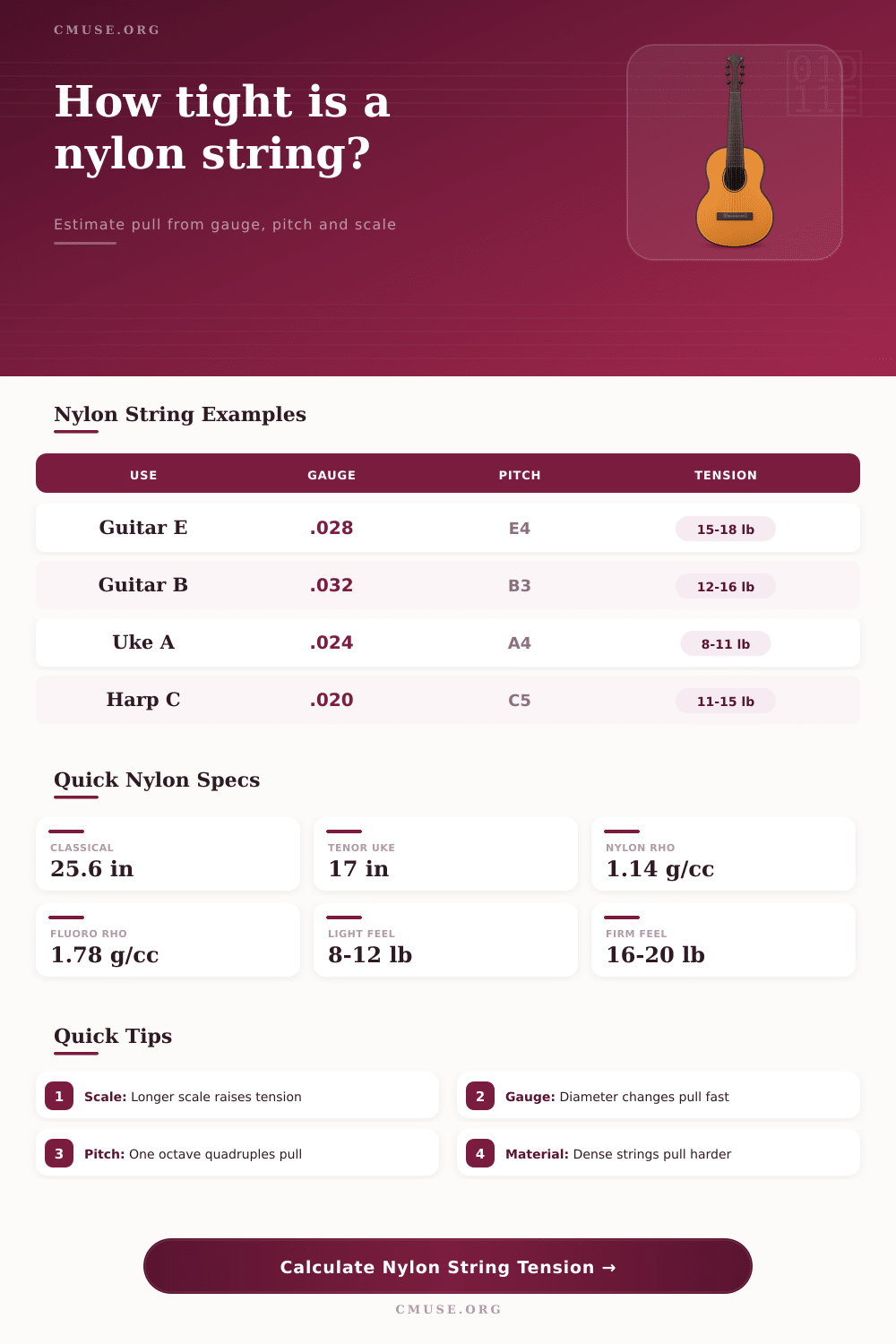
| Clear nylon | 1.14 g/cc | Classical trebles | Warm, standard pull |
| Rectified nylon | 1.15 g/cc | Precise trebles | Slightly firmer feel |
| Black nylon | 1.13 g/cc | Folk, flamenco | Close to clear nylon |
| Fluorocarbon | 1.78 g/cc | Uke, harp, lute | Higher pull at same size |
| Synthetic gut | 1.30 g/cc | Uke, early music | Between nylon and fluoro |
| Natural gut | 1.28 g/cc | Historical strings | Estimate only |
| Wound nylon | 3.20 g/cc | Basses, low strings | Composite estimate |
| Instrument / String | Scale | Gauge | Pitch | Typical Feel |
|---|---|---|---|---|
| Classical guitar high E | 25.6 in | .027-.029 | E4 | Light to high |
| Classical guitar B | 25.6 in | .031-.033 | B3 | Normal |
| Classical guitar G | 25.6 in | .039-.041 | G3 | Normal |
| Tenor ukulele A | 17 in | .023-.026 | A4 | Medium |
| Baritone ukulele D | 20 in | .034-.038 | D3 | Medium |
| Lever harp treble C | 14 in | .018-.022 | C5 | Light |
| Pitch | Frequency | Common Nylon Role | Octave Note |
|---|---|---|---|
| D3 | 146.83 Hz | Baritone uke first | Below middle C |
| G3 | 196.00 Hz | Classical 3rd | Treble string |
| B3 | 246.94 Hz | Classical 2nd | Treble string |
| E4 | 329.63 Hz | Classical 1st | High E |
| A4 | 440.00 Hz | Ukulele first | Concert pitch |
| C5 | 523.25 Hz | Harp / uke high | Treble C |
| Band | Single String Pull | Feel | Best Use |
|---|---|---|---|
| Very light | 5-8 lb | Soft and flexible | Small uke, light harp |
| Light | 8-12 lb | Easy left hand | Uke, lute, folk |
| Normal | 12-17 lb | Balanced response | Classical trebles |
| High | 17-22 lb | Firm projection | High tension sets |
| Very high | 22+ lb | Stiff or risky | Check instrument limits |
| Term | Formula | Unit | Meaning |
|---|---|---|---|
| Area | pi d2 / 4 | in2 | Round string section |
| Unit weight | density x area | lb/in | Mass per inch |
| Tension | UW(2LF)2/386.4 | lb | Standard string pull |
| Target dia | inverse tension | in / mm | Gauge for target pull |
To start with, the harder you pull a string against the nut and the bridge, the more tension there is in the string. That sounds obvious yet it’s not as straightforward as one would think. Changing a single string can make all the difference. It isn’t just about pitch; the tension do change too. Most players think that tension derives solely from tuning to A440. This is true up to a point but doesn’t tell the whole story.
Tension come from three factors: the material density, the scale length and the gauge. Each variable interacts with others in complicated ways. You often cannot trust your intuition here unless you snap a string or lift a saddle! Using that data, the calculator above takes care of the rest. All you need to do is plug in the specs for your set-up.
How String Tension Works
First, enter the scale length, or how far the strings vibrate from the saddle to the nut. Second, enter the pitch you want those strings to play at. Lastly, the diameter of each string. From there, it’ll crunch some numbers based off the density of the material combined with your other two inputs to give you an idea of amount of pull.
That’s important because Nylon isn’t Steel. It stretches more, settles slower and behaves quite differentaly under varying levels of humidity than metal strings do. Mixing materials will also throw things off. For example, you might run a course of fluorocarbon (much denser) through a ukulele for the trebles. A 025 dia nylon will have much higher tension then a 024 dia nylon. You might think they’d feel about the same given the same diameter, but they don’t. That’s because of density.
Why is that important? Understanding what density has to do with string selection can help you make better purchases. Density: clear nylon is ~1.14, rectified is ~1.15, and fluorocarbon is ~1.78 g/cm3 Density: 15. 78 What does that mean? When you pick the material from the tool, you’re asking it how much of that material are within the scale length. The more material, the more tension at the same gauge and pitch. So to get a lighter feeling without altering your tuning, you have to go with something less dense or a thinner gauge. To get more projection and not care as much about a firmer hand, then you’d go with something denser or thicker.
The table in the tool lays this out. You’ll notice that natural gut estimates sits somewhere in the middle historically but don’t represent a standard so much as a historical starting point. The other variable is scale length. A classical guitar has a longer scale than a tenor ukulele. That means the strings needs more tension to produce the same note using the same thickness, or use thicker strings to get the same feel as a guitar set. If you place a guitar string onto a short scale instrument the tension go through the roof. To counteract this there are dedicated sets of strings available for the ukulele precisely because they’re designed around the specific span.
Changing the scale in the calculator lets you play around with this. It can help you see what happens when you move across scales. For example, moving from a 17-inch tenor uke to a 20-inch baritone uke dramatically reduces the tension for the same gauge and pitch. That’s why if you’re accustomed to guitar tension you find baritone strings seem so slack despite their similarity in appearance.
Beyond pull force, material choice also affects tone and longevity. The stretch of nylon means the string’s core can relax over time under stress and expand accordingly. To counter this, rectified strings are now available that has had this elasticity removed. This makes intonation more stable, but it tends to come at the expense of some warmth. For Flamenco, black nylon strings are also popular as they give a slightly different tactile feel and brighter attack; their density is almost the same as clear nylon. Synthetic gut strings are a middle-ground option for early music players or those who feel nylon strings are too plasticky. Natural gut still provides the best level of historical authenticity but must be carefully managed with regard to humidity, as it is fragile when left unchecked.
Be aware that when using the tool it will give you the tension bands they suggest. Typically light is 8-12 pounds per string. Normal is 12-17 pounds. Anything beyond that is considered high tension, reaching toward 20 pounds or more. Remember these are guidelines not laws. Some people like high tension on their strings for clarity and volume. Other players find that light sets is most comfortable and learn fast with the light tension. The answer to this depends on you, your instrument, and its structural limitations. Always check total tension of all the strings together against the manufacturer’s recommendations. Too much total pull on the bridge will cause it to raise out of position.
Balance is where string choice becomes an experiment. You’re balancing comfort against durability, tone, and structure. On one hand you have physics; on the other, there’s you. The calculator takes the physics out of the equation. It provides a baseline so you can consider your choices and make comparisons without errors. When you know density, scale, and gauge, you no longer purchase strings randomly but choose them purposefully. Maintenance becomes customization. Every time you sit down to play, it feels more rewarding.