🎵 Note to Frequency Calculator
Convert any musical note to its exact frequency in Hz — supports custom tuning, cents offset & MIDI note numbers
| Note | Octave 2 | Octave 3 | Octave 4 | Octave 5 | Octave 6 |
|---|---|---|---|---|---|
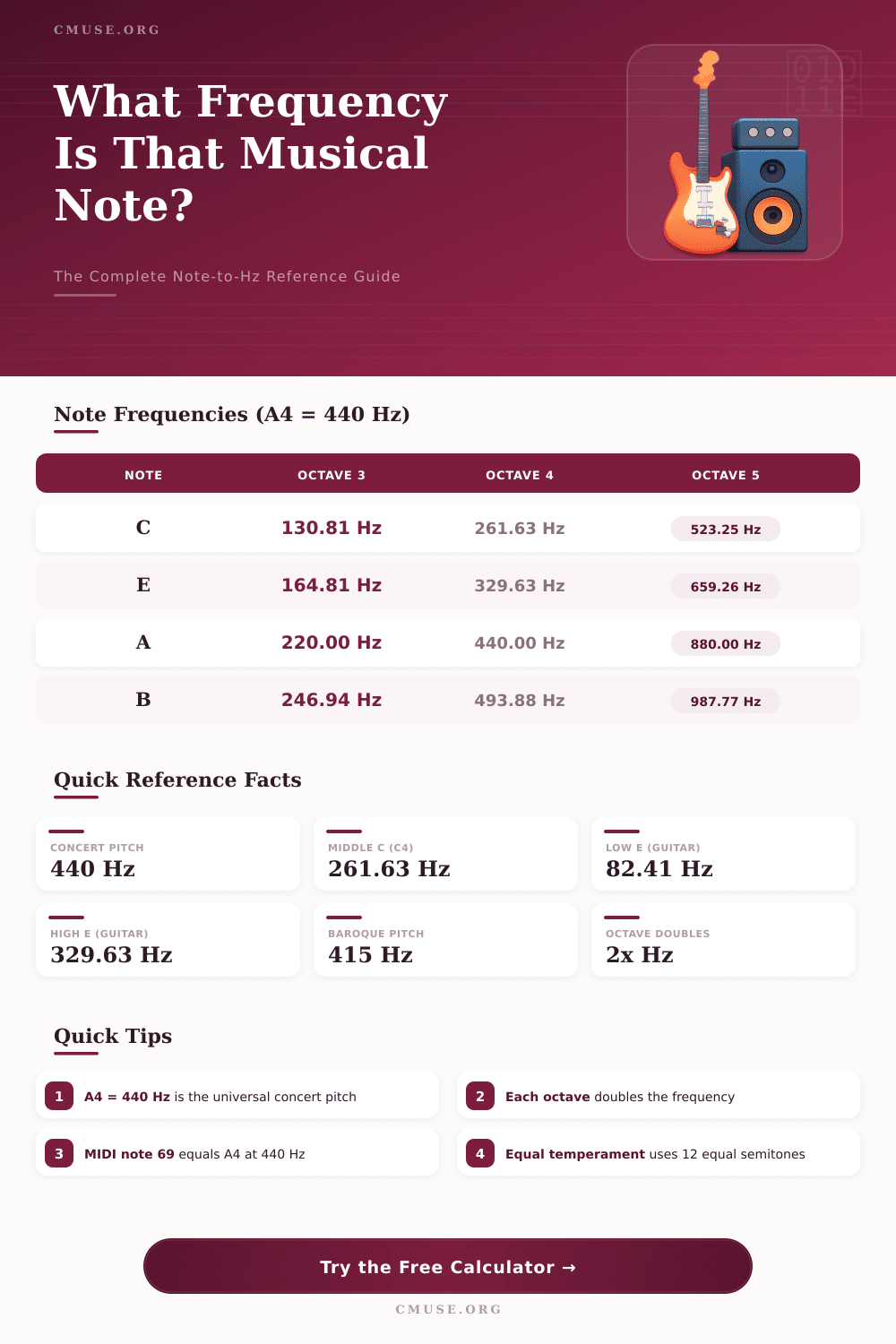
| C | 65.41 Hz | 130.81 Hz | 261.63 Hz | 523.25 Hz | 1046.50 Hz |
| C♯/D♭ | 69.30 Hz | 138.59 Hz | 277.18 Hz | 554.37 Hz | 1108.73 Hz |
| D | 73.42 Hz | 146.83 Hz | 293.66 Hz | 587.33 Hz | 1174.66 Hz |
| D♯/E♭ | 77.78 Hz | 155.56 Hz | 311.13 Hz | 622.25 Hz | 1244.51 Hz |
| E | 82.41 Hz | 164.81 Hz | 329.63 Hz | 659.26 Hz | 1318.51 Hz |
| F | 87.31 Hz | 174.61 Hz | 349.23 Hz | 698.46 Hz | 1396.91 Hz |
| F♯/G♭ | 92.50 Hz | 185.00 Hz | 369.99 Hz | 739.99 Hz | 1479.98 Hz |
| G | 98.00 Hz | 196.00 Hz | 392.00 Hz | 783.99 Hz | 1567.98 Hz |
| G♯/A♭ | 103.83 Hz | 207.65 Hz | 415.30 Hz | 830.61 Hz | 1661.22 Hz |
| A | 110.00 Hz | 220.00 Hz | 440.00 Hz | 880.00 Hz | 1760.00 Hz |
| A♯/B♭ | 116.54 Hz | 233.08 Hz | 466.16 Hz | 932.33 Hz | 1864.66 Hz |
| B | 123.47 Hz | 246.94 Hz | 493.88 Hz | 987.77 Hz | 1975.53 Hz |
| Instrument | String/Note | MIDI# | Frequency (Hz) |
|---|---|---|---|
| Guitar (Standard) | E2 (Low E) | 40 | 82.41 Hz |
| Guitar (Standard) | A2 | 45 | 110.00 Hz |
| Guitar (Standard) | D3 | 50 | 146.83 Hz |
| Guitar (Standard) | G3 | 55 | 196.00 Hz |
| Guitar (Standard) | B3 | 59 | 246.94 Hz |
| Guitar (Standard) | E4 (High E) | 64 | 329.63 Hz |
| Bass Guitar (Standard) | E1 (Low E) | 28 | 41.20 Hz |
| Bass Guitar (Standard) | A1 | 33 | 55.00 Hz |
| Bass Guitar (Standard) | D2 | 38 | 73.42 Hz |
| Bass Guitar (Standard) | G2 | 43 | 98.00 Hz |
| Violin | G3 | 55 | 196.00 Hz |
| Violin | D4 | 62 | 293.66 Hz |
| Violin | A4 | 69 | 440.00 Hz |
| Violin | E5 | 76 | 659.26 Hz |
| Piano | A0 (Lowest) | 21 | 27.50 Hz |
| Piano | C4 (Middle C) | 60 | 261.63 Hz |
| Piano | C8 (Highest) | 108 | 4186.01 Hz |
| MIDI# | Note | Octave | Frequency (Hz) |
|---|---|---|---|
| 21 | A0 | 0 | 27.50 Hz |
| 36 | C2 | 2 | 65.41 Hz |
| 48 | C3 | 3 | 130.81 Hz |
| 57 | A3 | 3 | 220.00 Hz |
| 60 | C4 | 4 | 261.63 Hz |
| 64 | E4 | 4 | 329.63 Hz |
| 69 | A4 | 4 | 440.00 Hz |
| 72 | C5 | 5 | 523.25 Hz |
| 81 | A5 | 5 | 880.00 Hz |
| 84 | C6 | 6 | 1046.50 Hz |
| 96 | C7 | 7 | 2093.00 Hz |
| 108 | C8 | 8 | 4186.01 Hz |
| Register Name | Octave Range | Freq Range (Hz) | Common Use |
|---|---|---|---|
| Sub-bass | 0–1 | 16–60 Hz | Kick drum, sub synth |
| Bass | 1–2 | 60–130 Hz | Bass guitar, tuba, cello |
| Upper Bass | 2–3 | 130–261 Hz | Baritone voice, guitar body |
| Midrange | 3–5 | 261–1047 Hz | Piano, vocals, guitar |
| Upper Midrange | 5–6 | 1047–2093 Hz | Guitar lead, flute, voice harmonics |
| Presence | 6–7 | 2093–4186 Hz | Snare, clarity, attack |
| Brilliance / Air | 7–8+ | 4186+ Hz | Cymbals, high harmonics |
All musical notes match a particular Note Frequency, measured in hertz or Hz. The Note Frequency relates to the amount of vibrations each second which creates different pitches. No matter if the sound comes from piano, guitar or synthesizer each has a basic Note Frequency value.
The usual base note used currently is A4 at 440 Hz. It is the note above middle C. Strings and schools that build around it follow a logarithmic scale with 12 notes per octave in equal spacing. Here, use of 440 Hz does depend on convention.
How Musical Note Frequencies Work
One could easily base scales on 442 Hz or 428 Hz. Various base notes were used during history.
Doubling any Note Frequency value raises the note by one octave. Like this 880 Hz matches to one octave above 440 Hz. Halving it results in 220 Hz, which is one octave below.
Something that does not come buy means of doubling or halving will sound as another note or sound away from the melody line.
In each octave there are 12 semitones. According to equal spacing, each semitone up boosts the Note Frequency amount by the twelfth root of two, which matches around 1.0595. To reach A4, one multiplies 440 Hz by that number.
Getting to B4 needs multiplying 440 Hz by the twelfth root of two twice or once by almost 1.122462. The frequencies of notes create a geometric sequence, not arithmetic.
The chromatic scale is similar to the idea of cutting string. If one cuts string to two thirds of its length, that gives 1.5 times more frequency, which produces a fifth. Going by fifths many times will return to the starting note after twelve steps.
Middle C sits at 261.63 Hz. In zeroth octave it matches 27.50 Hz, which is also the lowest note on piano. The lowest Note Frequency of a big piano is around 27 Hz.
Some values for first octave include C1 at 32.70 Hz, D1 at 36.71 Hz and A1 at 55.00 Hz.
On deep guitar the low B-string goes down to around 31 Hz. Very few speakers or cabinets manage to handle that Note Frequency level with real power. For standard guitar the Note Frequency range starts at the low hihg end and can reach up to E7 at 2637 Hz on the 24th fret.
The D-string of acoustic guitar sounds at 147 Hz, while the G-string does that at 196 Hz.
Every note that is not a pure sine sound carries several frequencies in the form of overtones and harmonics. The basic frequency stays the strongest and matches the name of the note. Overtones create the character of note sounds on various instruments, which one hears as tone color instead of separate notes.
The same note on tuba sounds different than onclarinet because of this.