Note Density per Bar Calculator
Measure how crowded a rhythm feels from counted notes, BPM, meter, subdivision grid, rests, voices, accent weight, and articulation style.
Preset use: Load a realistic rhythmic situation, then replace the note count, bars, meter, and rest space with your passage.
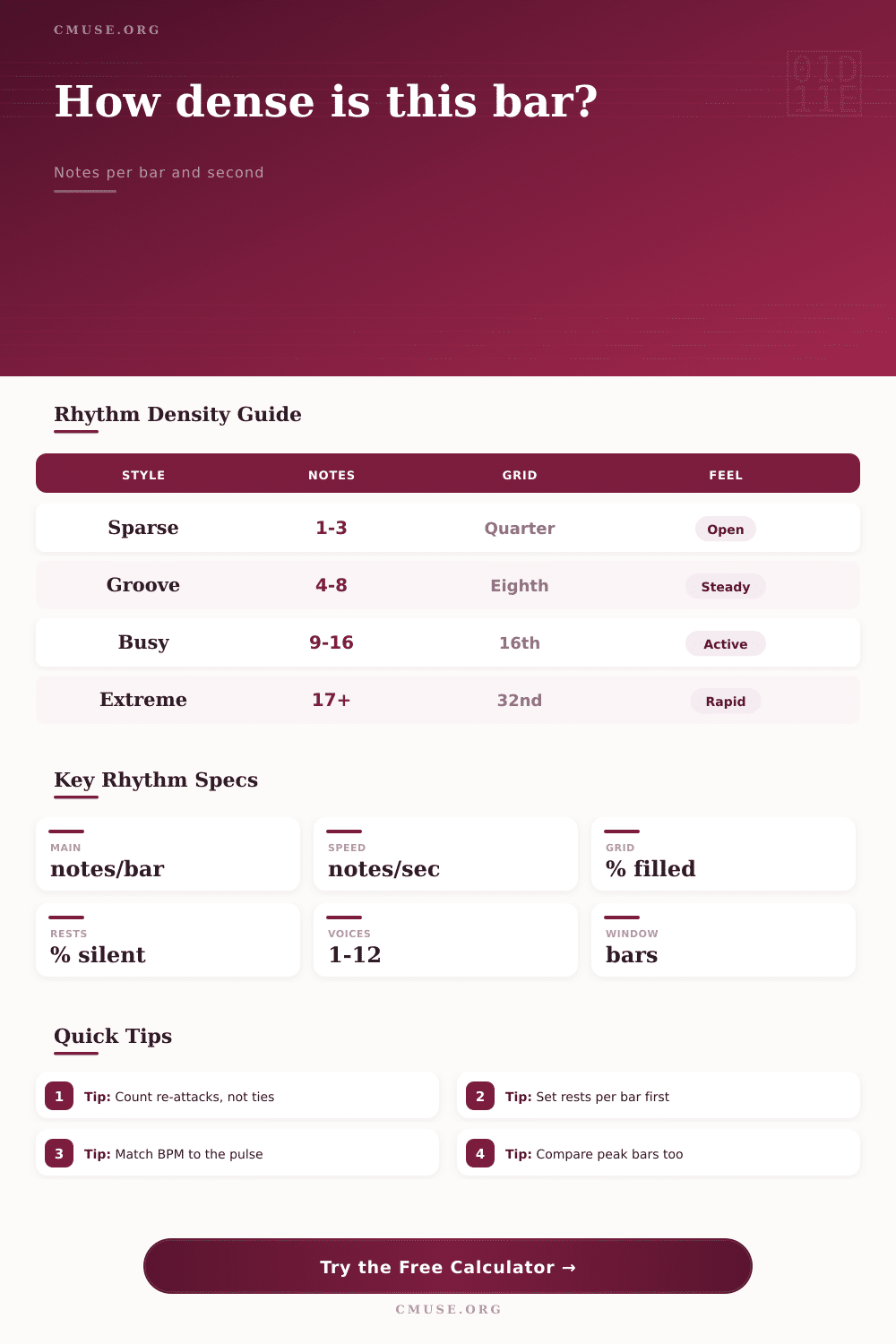
Sparse
One to three attacks per common-time bar. Useful for pads, chorale suspensions, bass punctuations, and phrases where space carries the line.
Groove
Four to eight attacks per bar. Typical of quarter and eighth-note patterns, comping shells, pop verse motion, and stable accompaniment figures.
Busy
Nine to sixteen attacks per bar. This is the zone for sixteenth riffs, melodic runs, dance hi-hat lift, and active drum programming.
Extreme
Seventeen or more attacks per bar. Peak fills, tremolo-like streams, blast passages, and showcase runs need clean grouping to stay readable.
| Band | Notes per 4/4 bar | Subdivision load | Typical reading |
|---|---|---|---|
| Sparse | 1 to 3 | Under 20% of a 16th grid | Open rhythm, long values, or isolated entrances. |
| Light | 4 to 6 | 20% to 38% of a 16th grid | Simple melody, steady bass, or roomy accompaniment. |
| Moderate | 7 to 10 | 39% to 63% of a 16th grid | Continuous eighths, syncopated comping, or active riffs. |
| Dense | 11 to 16 | 64% to 100% of a 16th grid | Sixteenth passages, fast fills, and layered percussion. |
| Very dense | 17+ | Above a full 16th grid | Thirty-second bursts, tremolo streams, or multi-lane hits. |
| Meter and pulse | Tempo | Seconds per bar | What density means |
|---|---|---|---|
| 4/4, quarter pulse | 60 BPM | 4.00 sec | Eight notes per bar feels spacious at two notes per second. |
| 4/4, quarter pulse | 120 BPM | 2.00 sec | Sixteen notes per bar equals eight notes per second. |
| 3/4, quarter pulse | 90 BPM | 2.00 sec | Nine notes per bar can feel as active as 12 in 4/4. |
| 6/8, dotted-quarter pulse | 112 BPM | 1.07 sec | Twelve notes per bar reads fast because the bar is short. |
| 5/4, quarter pulse | 100 BPM | 3.00 sec | Compare normalized 4-beat density before judging workload. |
| Grid | Slots in 4/4 | Common notation | Use for |
|---|---|---|---|
| Quarter | 4 | One pulse per beat | March-like pulses, chorales, sparse bass hits. |
| Eighth | 8 | Two equal notes per beat | Pop grooves, walking lines, regular melodic motion. |
| Triplet | 12 | Three notes per beat | Swing, shuffle, blues, compound-feel passages. |
| Sixteenth | 16 | Four notes per beat | Funk, rock riffs, drum grooves, dance programming. |
| Thirty-second | 32 | Eight notes per beat | Short bursts, fills, ornaments, tremolo-like motion. |
| Preset | Starting window | Density cue | Counting caution |
|---|---|---|---|
| Chorale Inner Motion | 8 bars, 4 voices | Low per-voice motion with a layered texture. | Do not count held tied tones twice. |
| Funk Guitar Comp | 4 bars, 16th grid | Syncopated attacks make rests as important as notes. | Muted scratches may count if they are real attacks. |
| Bebop Eighth Line | 4 bars, fast BPM | Moderate notes per bar but high notes per second. | Pickups should stay inside the selected bar window. |
| Two-Bar Drum Fill | 2 bars, multiple lanes | High texture density across a short peak window. | Decide if flams are one hit or two hits. |
| 6/8 Fiddle Jig | 8 bars, dotted pulse | Compound meter needs correct pulse selection. | Use dotted-quarter BPM when the tune is counted in two. |
When you open up the score and try to play melody, it’s complicated, hard to decipher, and when you come to play it, there is no rhythm. It sounds fine written down but difficult to perform. Perhaps tempo is too brisk? Maybe your technique isn’t good enough.
In fact, the issue frequently lie in what I call note density. What’s that? Note density refer to the number of rhythmic details contained within any given musical bar. This is not always a question of speed. Instead, it is about how many notes you pack into each measure. If you forget about density then you run the risk of losing clarity.
What Is Note Density?
The calculator (above) calculates the density for you. It convert messy measures into clear numbers. These numbers reveal where music becomes too dense. Musicians often look at page and guess how dense they should play that passage. A quarter note has less mass than a sixteenth note. Generally speaking, they is correct with this assumption. However, that’s only generally true. It depends on context.
The more information we can put into the tool, the better output. We need to specify what grid we want to use for subdivisions. Does playing thirty-two consecutive notes on a sixteenth-note grid sound different then a thirty-second-note grid? Yes. The former sounds like a blur; the latter sounds like a well-structured pattern. Next, include rests as an input. Rests don’t exist without purpose. They provide space for notes to breathe.
The system measure the amount of active material versus the total space. Is music clear or is it merely noise? Density are altered by tempo. Sixty beats per minute makes even a very dense passage feel possible. Each note has a chance to be heard by the brain. One hundred and twenty beats per minute make that same density into a brick wall.
Notes per second is what the calculator count. It eliminates the illusion offered by tempo. What it reveal is the actual cognitive effort required to perform the piece. When writing out a solo, this allow you to make an informed decision about slowing down the music or simplifying rhythmic figures. You cannot outrun physics when it comes to cognitive load.
The following table shows how different styles range from sparse to extreme. You can then gauge your efforts against the norms of any genre. A chorale requires an opening for the harmonies to resonate. A metal riff demands density for its power. Both are correct, but they fail if you ignore rules of their density.
Another layer of confusion involve multi-voice textures. Having three instruments playing together increase the number of notes being played. Different frequencies make that sound less dense. How many voices do you have? Input this into the calculator. This works out the workload and averages it.
Composers writing for drums or hands will find this important. One hand might be playing a run while the other is idle. The average sounds fine. However, the peak demand is high. Look at busiest bar. This is the measure where technical limit of the piece is. This is what makes the run easy or hard to play.
The music becomes easier or harder depending on how it are articulated. Legato notes tend to take less out of the body than staccatos. They might sound similar in pitch, but that’s about it. There’s an articulation pressure multiplier included in the tool. If you pick at the note, it sounds thicker to your hand and ear. It has a percussive effect. That starts to add up very soon.
Write a page of staccato sixteenth notes and you’re not only playing fast, you’re playing hard too. This lets you balance the score and combine thin accompaniments against a thick melody line. The contrast keeps interest in the ear and doesn’t overwhelm the listener. It’s never about taking away notes. It’s always about making it clearer. Good music is planned well, so when something sounds effortless it probably would of been thought through.
When you’re measuring your own density, it prevents you from guessing at what isn’t working in a passage. At what speed is it actualy going? Where are the rests? What is the grid you don’t know you were feeling? Then when you know the numbers, you can alter the feel. You can thin out a busy section. Add weight to a spare one.
Instead of a tangle, the music is now a structure. You have regained command of the pulse. Every note exists for a reason.