Note Above Interval Calculator
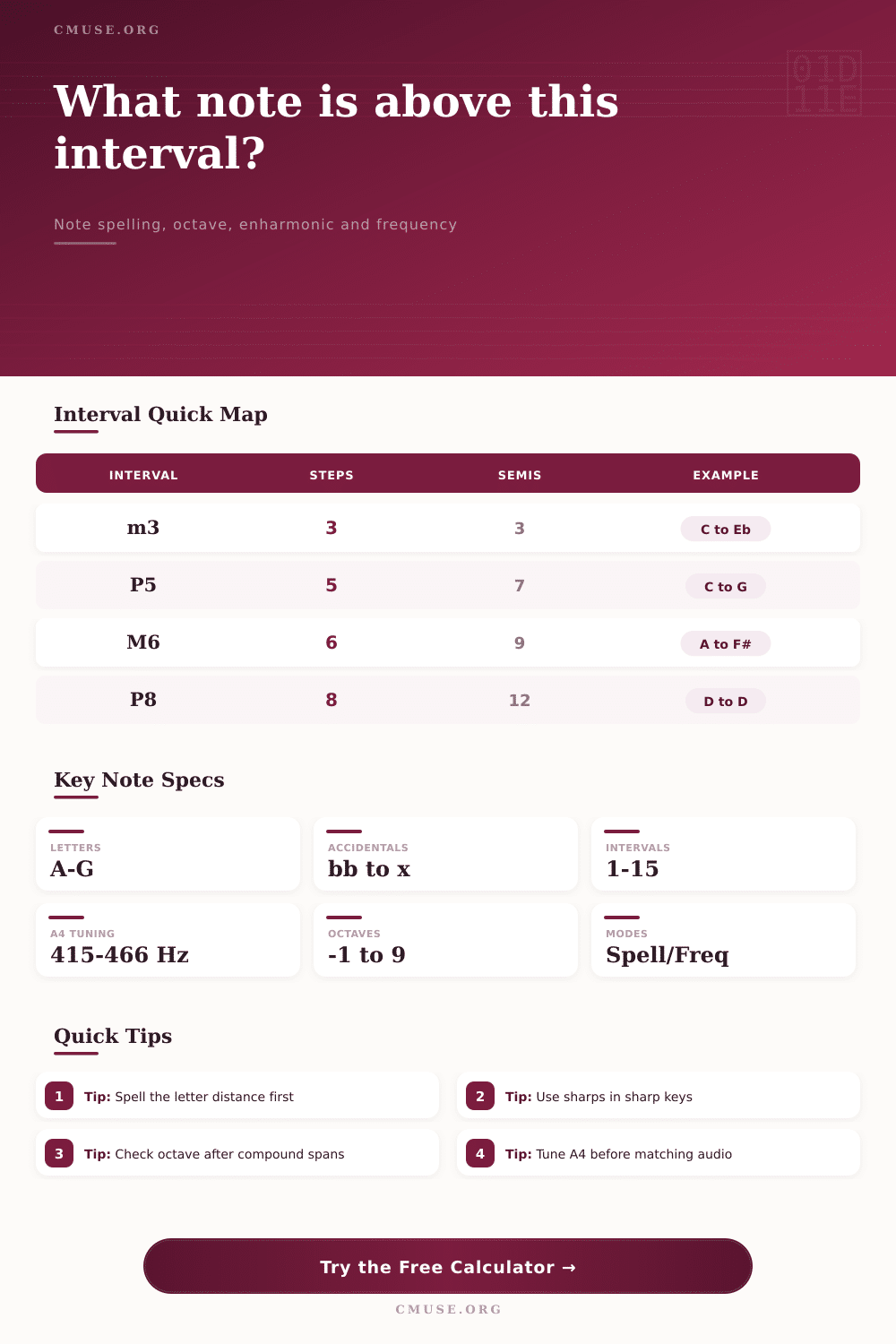
Find the correctly spelled note above any starting pitch, then compare octave placement, enharmonic names, chromatic distance, and equal-tempered frequency from your chosen A4 tuning.
🎯 Interval presets
⚙ Note and interval inputs
Calculation Breakdown
📊 Interval reference cards
Perfect Class
Unisons, fourths, fifths, and octaves use perfect as the stable form.
Major/Minor Class
Seconds, thirds, sixths, and sevenths use major and minor forms.
Augmented
Augmented intervals are one chromatic semitone larger than perfect or major.
Diminished
Diminished intervals are one semitone smaller than perfect or minor.
📘 Simple interval semitone table
| Number | Minor / Diminished | Perfect / Major | Augmented | C example above |
|---|---|---|---|---|
| 1 - unison | d1 is -1 semitone | P1 is 0 semitones | A1 is 1 semitone | C to C or C# |
| 2 - second | m2 is 1 semitone | M2 is 2 semitones | A2 is 3 semitones | C to Db, D, or D# |
| 3 - third | m3 is 3 semitones | M3 is 4 semitones | A3 is 5 semitones | C to Eb, E, or E# |
| 4 - fourth | d4 is 4 semitones | P4 is 5 semitones | A4 is 6 semitones | C to Fb, F, or F# |
| 5 - fifth | d5 is 6 semitones | P5 is 7 semitones | A5 is 8 semitones | C to Gb, G, or G# |
| 6 - sixth | m6 is 8 semitones | M6 is 9 semitones | A6 is 10 semitones | C to Ab, A, or A# |
| 7 - seventh | m7 is 10 semitones | M7 is 11 semitones | A7 is 12 semitones | C to Bb, B, or B# |
| 8 - octave | d8 is 11 semitones | P8 is 12 semitones | A8 is 13 semitones | C4 to C5, Cb5, or C#5 |
🎹 Note spelling table
| Written Start | Interval Above | Correct Spelling | Why It Spells That Way |
|---|---|---|---|
| B natural | minor second | C natural | The letter above is C; B to C is already 1 semitone. |
| E natural | minor second | F natural | The letter above is F; E to F is already 1 semitone. |
| F sharp | perfect fifth | C sharp | Five letters above F is C; sharp preserves 7 semitones. |
| B flat | augmented fourth | E natural | Four letters above B is E; Bb to E is 6 semitones. |
| A flat | minor tenth | C flat | A to C is a third plus octave; flat makes it minor. |
🔀 Enharmonic comparison table
| Pitch Class | Sharp Name | Flat Name | Common Theory Use |
|---|---|---|---|
| 0 | C | B# / Dbb | Tonic C, raised leading-tone from B |
| 1 | C# | Db | Sharp keys use C#; flat keys use Db |
| 3 | D# | Eb | Eb is common in minor thirds above C |
| 6 | F# | Gb | Tritone spelling depends on fourth or fifth |
| 8 | G# | Ab | G# leads to A; Ab is common in flat keys |
| 10 | A# | Bb | Bb is common for minor sevenths above C |
🎼 Notation comparison grid
C to F#
Augmented fourth: four staff letters and 6 semitones. It is not a diminished fifth because the target letter is F.
C to Gb
Diminished fifth: five staff letters and 6 semitones. Same piano key as F#, different interval spelling.
B to C
Minor second: two letters and 1 semitone. Calling it augmented unison would require B to B#.
E to F
Minor second: the natural half step between E and F means no flat or sharp is needed.
📚 Compound interval octave table
| Compound Interval | Simple Equivalent | Extra Octaves | Example Above C4 |
|---|---|---|---|
| 9th | 2nd | 1 octave | M9 = D5, 14 semitones |
| 10th | 3rd | 1 octave | M10 = E5, 16 semitones |
| 11th | 4th | 1 octave | P11 = F5, 17 semitones |
| 12th | 5th | 1 octave | P12 = G5, 19 semitones |
| 13th | 6th | 1 octave | M13 = A5, 21 semitones |
| 15th | Octave | 2 octaves | P15 = C6, 24 semitones |
For example, if you’ve ever played a perfect fifth on the piano, you don’t need to know what it’s called. Your ears have locked onto distance of seven semitones (C to G), and it sounds right.
If we look at music theory then the next step is getting it spelled correctly before you hear it. This is where many students trip up and this is where a calculator will come into its own. Simply type starting note plus the interval you want to work out and the tool above do the rest for you. You no longer have to try and count how many letter there are. You also don’t have to change your mind about which accidental to add. It all adds up.
Why Spelling Notes Correctly Matters
Interval spelling relies off the staff letter rather than the key of the piano. So when starting from C the next note for a fourth should has the target letter F. Five semitones or six don’t matter. The calculator begins by counting the number of letter steps and only then applies the accidental to give correct semitone difference. In this way, the notation conform to conventional rules of harmony.
For instance, C to F is a perfect fourth and C to F sharp is an augmented fourth. Both require upward leap of four letter names, but the accidental alters to match the additional semitone. This is where people commony go astray. They simply hear the sound without remembering how to spell it in terms of its grammar.
The reasoning remains the same when you choose a compound interval such as a tenth or a ninth. An octave plus a second equals a ninth. In the case of a ninth, the calculator will count number of octaves up from the starting note to land exactly on the required pitch class in scientific notation. So, a major ninth upwards from C4 would land you on D5.
It also includes frequency information relative to your selected A4 tuning. By default, this is set at 440 Hz, but there have been many historic performances where A4 has been performed around 415 Hz or even 466 Hz. Altering this reference point change all subsequent frequencies. This matters if you need to match a certain performing ensemble or period instrument. The calculator ensures your theoretical spelling align with the actual acoustic reality of a performance.
It is the practical application that is most important. For example, in equal temperament, C sharp and D flat both play the same note; however, they act differently in a piece of music. You can set the enharmonic preference with the calculator but it will take precedence over correctly spelled intervals. Asking for E flat as a minor third above C yields E flat whereas D sharp would be the wrong spelling. This can make all the difference when considering key signatures and voice leading.
A simple sequence becomes a tangled mass of accidentals if right spelling is not used. It could of hide the harmony function of any given chord. The table of references on the page explains why B to C is considered a second even though they are only a semitone apart. Knowing this makes for clearer notation. This avoids accidentaly cluttering your scores and ensures that what you write can be easily understood by others.
While it may not make a difference listening to a performance, clear notation on paper do. Using the calculator eliminates need to guess at the arithmetic and can help focus on the implications of your music. What was previously a hard exercise in counting becomes an easy and trustworthy point of reference. Whether you are writing a piece of Classical music for String Quartet or analyzing a Jazz Standard, the key lies in nailing the spelling first. As they say, the name’s the thing; the notes are no better than their labels.