Notation Page Count Calculator
Estimate engraved score or part pages from measures, systems, staves, paper size, spacing density, repeats, lyrics, chords, and ensemble size.
🎼Notation Presets
📝Score Inputs
📏Notation Spec Grid
📚Reference Tables
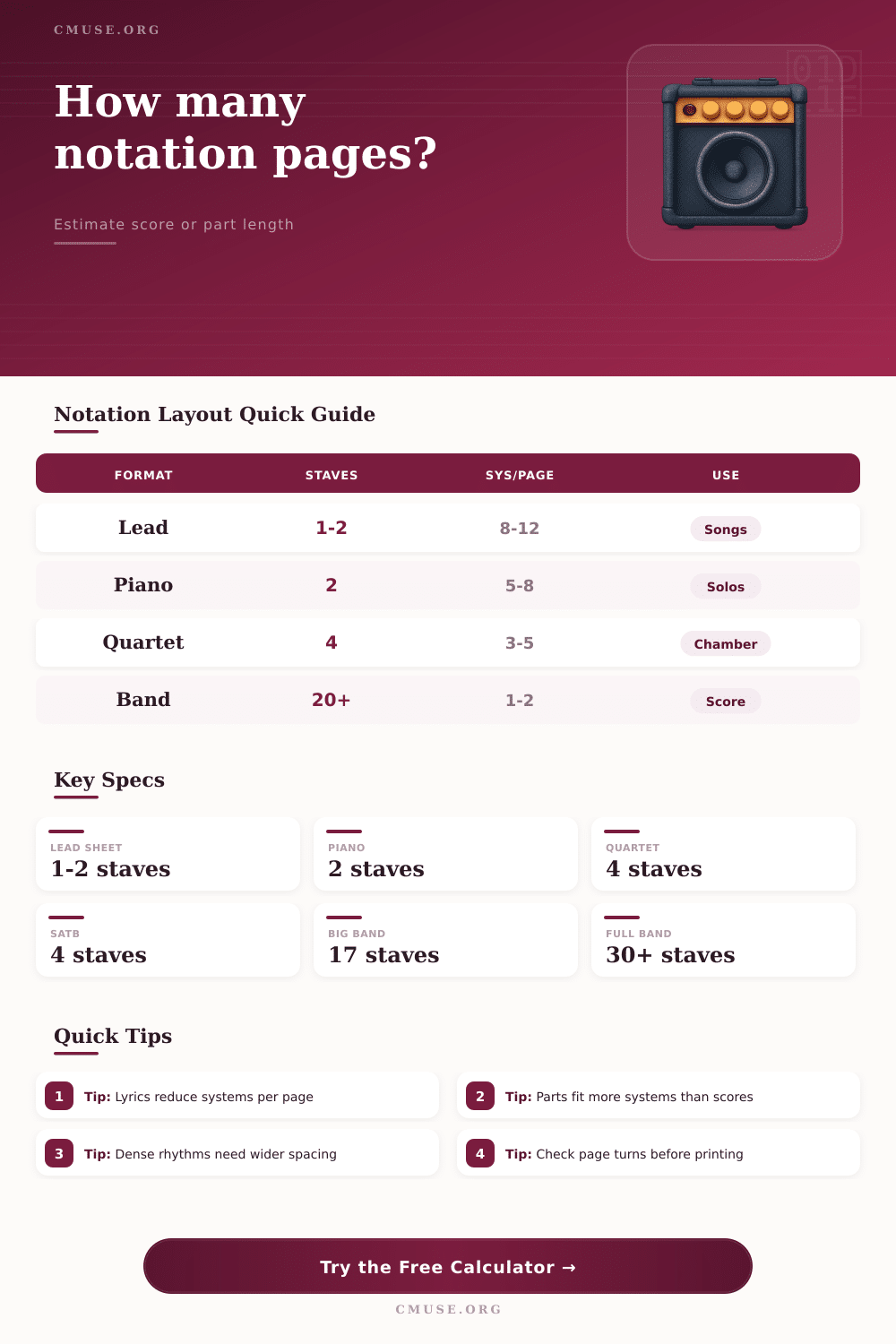
| Notation Format | Typical Staves | Systems Per Page | Measures Per System |
|---|---|---|---|
| Lead sheet or fake book page | 1 to 2 | 7 to 12 | 4 to 8 |
| Piano solo or vocal piano | 2 to 3 | 4 to 7 | 3 to 6 |
| String quartet score | 4 | 3 to 5 | 3 to 5 |
| Big band conductor score | 16 to 18 | 1 to 2 | 4 to 6 |
| Concert band or orchestra score | 24 to 36 | 1 to 2 | 3 to 5 |
📄Page Size and Staff Capacity
| Page Size | Notation Use | Width Factor | Height Factor |
|---|---|---|---|
| US Letter 8.5 x 11 in | Parts, school scores, drafts | 1.00 | 1.00 |
| A4 210 x 297 mm | International parts and scores | 0.97 | 1.06 |
| Concert 9 x 12 in | Published chamber and piano | 1.06 | 1.13 |
| Tabloid 11 x 17 in | Large conductor scores | 1.29 | 1.64 |
| Marching 6.75 x 10.5 in | Lyre cards and flip folders | 0.79 | 0.94 |
🔢Density Multipliers
| Input | Compact | Standard | Expanded |
|---|---|---|---|
| Horizontal spacing | Tight engraving: more bars | Balanced reading | Large rehearsal spacing |
| Rhythmic complexity | Simple notes fit tighter | Mixed rhythms use average space | Tuplets and cues spread systems |
| Lyrics underlay | No text: normal staff gap | One lyric line adds vertical space | Multiple verses reduce systems |
| Chord symbols | No symbols | Regular chord grid | Dense symbols need more clearance |
🎵Common Project Sizes
| Project | Measures | Staves | Expected Pages |
|---|---|---|---|
| 32-bar lead sheet | 32 | 1 to 2 | 1 to 2 pages |
| Short piano solo | 64 to 96 | 2 | 3 to 8 pages |
| Chamber score movement | 120 to 180 | 4 to 6 | 8 to 18 pages |
| Big band chart | 120 to 180 | 16 to 18 | 18 to 45 pages |
| Large ensemble conductor score | 120 to 220 | 24 to 36 | 35 to 90 pages |
💡Notation Planning Tips
Before printing out that score, think about what amount of physical space it will take up. Often you find that somewhere in a difficult passage, the page has turned. Suddenly you have to turn a pile of paper over and read all those densely packed notes. That breaks the flow of the music and throws rhythm. Underestimate the space needed less frequentley.
A forty-measure composition does not automatically become four pages. The number of pages will depend on how complex the ensemble is, the size of your paper, and how far apart staves are from one another. After you select your page layout options, and the number of measures in your score, it will give you an estimate. That way, you don’t have to guess if a part will fit onto one or several pages.
How to Plan Your Music Pages
However, you do need to know something about the math behind engraving to believe their results. How many pages you get isn’t simply determined by how much music there is but how much ink can be placed on a page without making it unreadable. First thing to think about is how many musicians you want to play from one piece of paper. Consider a sparse lead sheet for guitar and vocals, then compare that with a big band chart with seventeen staves.
On the eight-stave score there will be seventeen staves crammed onto the page in a vertical stack. Each system occupy almost half of the height of the page. The calculator includes this vertical load in its calculation. If you add densely rhythmic parts, lyric lines, or chord symbols, what free space you have left diminish further. This is more than simply printing music; it’s managing real estate.
This also depends a lot on paper format. Home printers typically hold letter-sized paper. Arrangers tend to print on tabloid, or other custom wide formats if they are concert band directors. The wider format enables more measures to fit onto a single system. This results in fewer systems and therefore fewer pages. You can avoid turning the page in an awkward direction by changing the orientation (portrait vs. Landscape). By taking into account the size of your paper, the tool compares your page width with the horizontal density you chose.
Tight vs Loose: Sometimes what is best for your eyes isn’t necessarily best from a professional standpoint. For example, tight engraving lightens the pages. It also uses less paper. But, it’s hard to sight read on paper that has been engraved tightly. When you’re rehearsing as a musician, you want to be able to glance at the score and see the beat pattern clearly. The more spacious the choice of notes becomes, whether by design or educationally, the higher number of pages. It means readability is considered above all else. You can always edit down, but it is not so easy to add space later on without starting again.
This gets trickier when there are repeats and endings. There’s another option that the calculator needs: playable measures vs written measures. Using repeats means a composer writes less but hears it more. But, the visible notation requires its own set of physical pages. If the length of the song remains the same then writing out each repeat rather than using repeat signs will double your number of pages. The tool lets you see this balance before you’ve committed to one layout or another.
If you are working with big groups, print expenses accumulate rapidly. Printing thirty pages for a concert band is not cheap. Then there’s the time spent binding it correctly. If you know your approximate number of pages ahead of time, you can be sure to set aside money accordingly. This will also tell you if you need to divide long movements across several books (or shorten systems to save space).
The solution isn’t one-size-fits-all. That depends on the venue, players, and how much binding glue you want to deal with. A good engraver is invisible on the page. When you play, you shouldn’t be thinking about the page at all. Just listen to the music.
If you keep these variables in mind and plan to match them, then paper won’t get in the way of performing. You will no longer dread turning mid-phrase. You won’t have to frantically flip through rest sections. Create a document that supports performance instead of getting in its way. Begin by counting measures. Make adjustments based off reality. Allow the page layout to support music instead of the opposite.