Normal Order Music Theory Calculator
Sort pitch-class sets, compare inversions, and track prime forms with a compact set-theory workflow.
🎵 Real Presets
📖 Analysis Inputs
⚙ Set Specs
📊 Reference Tables
| Pitch Class | Sharp Name | Flat Name | Use |
|---|---|---|---|
| 0 | C | C | Anchor |
| 1 | C♯ | D♭ | Minor 2nd |
| 2 | D | D | Major 2nd |
| 3 | D♯ | E♭ | Minor 3rd |
| 4 | E | E | Major 3rd |
| 5 | F | F | Perfect 4th |
| 6 | F♯ | G♭ | Tritone |
| 7 | G | G | Perfect 5th |
| 8 | G♯ | A♭ | Minor 6th |
| 9 | A | A | Major 6th |
| 10 | A♯ | B♭ | Minor 7th |
| 11 | B | B | Major 7th |
| IC | Semitone Pair | Span | Example |
|---|---|---|---|
| 1 | 1 or 11 | 1 | m2 |
| 2 | 2 or 10 | 2 | M2 |
| 3 | 3 or 9 | 3 | m3 |
| 4 | 4 or 8 | 4 | M3 |
| 5 | 5 or 7 | 5 | P4 |
| 6 | 6 | 6 | TT |
| Set | Prime Form | Count | Note |
|---|---|---|---|
| Triad core | 0-3-7 | 3 | Compact |
| Minor triad | 0-3-7 | 3 | Inversional |
| Diminished 7th | 0-3-6-9 | 4 | Symmetric |
| Whole tone | 0-2-4-6-8-10 | 6 | Even steps |
| Transform | Formula | Action | Check |
|---|---|---|---|
| Tn | (x + n) mod 12 | Shift | Same class |
| I0 | (0 - x) mod 12 | Invert | Mirror |
| TnI | (n - x) mod 12 | Invert + shift | Axis based |
| Compare | Rightmost tie test | Choose compact | Shortest span |
✨ Tips
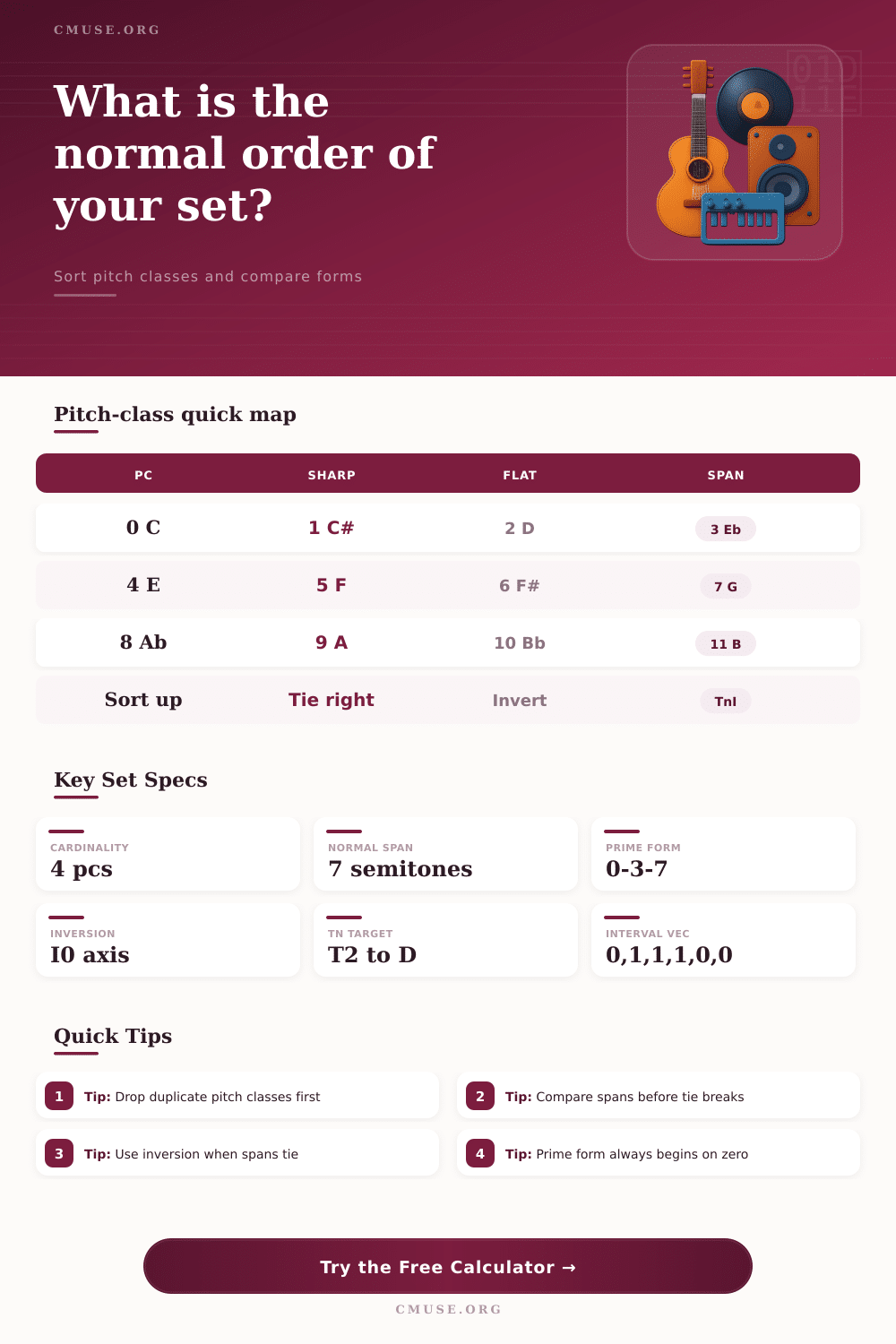
Normal orders is a process used to find the most compact version of a musical set. Musical sets contain pitch class, which are the individual notes in the musical set. Each pitch class can be represented by a number ranging from 0 to 11.
To find the normal order of a musical set, one must first find the pitch class in that musical set. All duplicate note within that musical set must be removed. Each of the remaining pitch classes can then be arranged in an ascending order.
How to Find the Normal Order of a Musical Set
Each of the possible rotation of that sorted musical set can then be considered to find the musical set with the smallest span. The span of a musical set is the difference in numbers between the highest and lowest pitch class in that musical set. The rotation of a musical set with the smallest span is the normal order of that musical set.
If there are two different rotations of a musical set with the same span, the rotation with the smallest interval at the right end of the musical set is the normal order of that musical set. Therefore, normal order is both the most compact form of a musical set and the specific rotation of that musical set that satisfies these rules. Inversion is another process used in musical set theory.
Inversion creates a new musical set by reflect the original musical set around a specific axis. To create an inversion of a musical set, one can find each of the pitch classes in that musical set by subtract each pitch class from the axis. Those numbers can be found using modulo 12 math.
The normal order of a musical set’s inversion may not be the same as the musical set itself. To find the prime form of a musical set, one must compare the normal order of that musical set and its inversion. Each of the two normal orders can be transpose so that they begin on pitch class 0.
The version of the musical set that is more compact than the prime form of that musical set. The concept of normal order can be used in the process of composing and arranging music. A composer can use normal order to find the prime forms shared by different rows of music.
Using this information, a composer can create unity within there composition. An arranger can use normal order to find the best voicing for musical clusters. Using this information, an arranger can ensure that the individual musical notes dont interfere with one another within the musical piece.
Many musical style, such as blues or electronic dance music, utilize musical sets with specific prime forms. Despite the usefulness of normal order within music theory, there are some mistake that can be made when using this process. One mistake is to consider the spelling of the musical notes.
For example, notes like C-sharp and D-flat have the same pitch class, so their spellings wont change the calculation performed within the normal order process. Another mistake is to include duplicate musical notes in the calculation of the normal order. Any inclusion of these duplicate notes will widen the span of that musical set, which will lead to an incorrect calculation of the normal order of that musical set.
Another concept that is utilized alongside the concept of normal order is the use of interval vector. Interval vectors are a series of numbers that represent the number of times each interval class exist within a musical set. These series of numbers act as the “fingerprint” of that musical set; they can show the relationship between two musical sets.
If two musical sets have the same interval vector, they may belong to the same set class within music theory. There are several formulas that can be used to assist in the performance of these task. The formula for calculating transpositions is (x + n) mod 12.
The formula for calculating inversions is (axis * 2, x) mod 12. These mathematical formula allow for the generation of musical families. Normal order is a process that transforms pitch classes into organized musical shapes.
It makes musical sets easy to analyze.