Node Position Calculator
Locate standing-wave nodes and antinodes for strings, open pipes, closed pipes, and room axial modes using length, harmonic number, wave speed, tuning frequency, and end correction.
Choose a real musical or acoustic situation, then adjust the values. Each preset fills the resonator type, length, harmonic, wave-speed model, temperature, origin, and tolerance before calculating.
Calculation Breakdown
After calculation, this list shows the first practical node positions and antinode positions using the selected origin and physical offset.
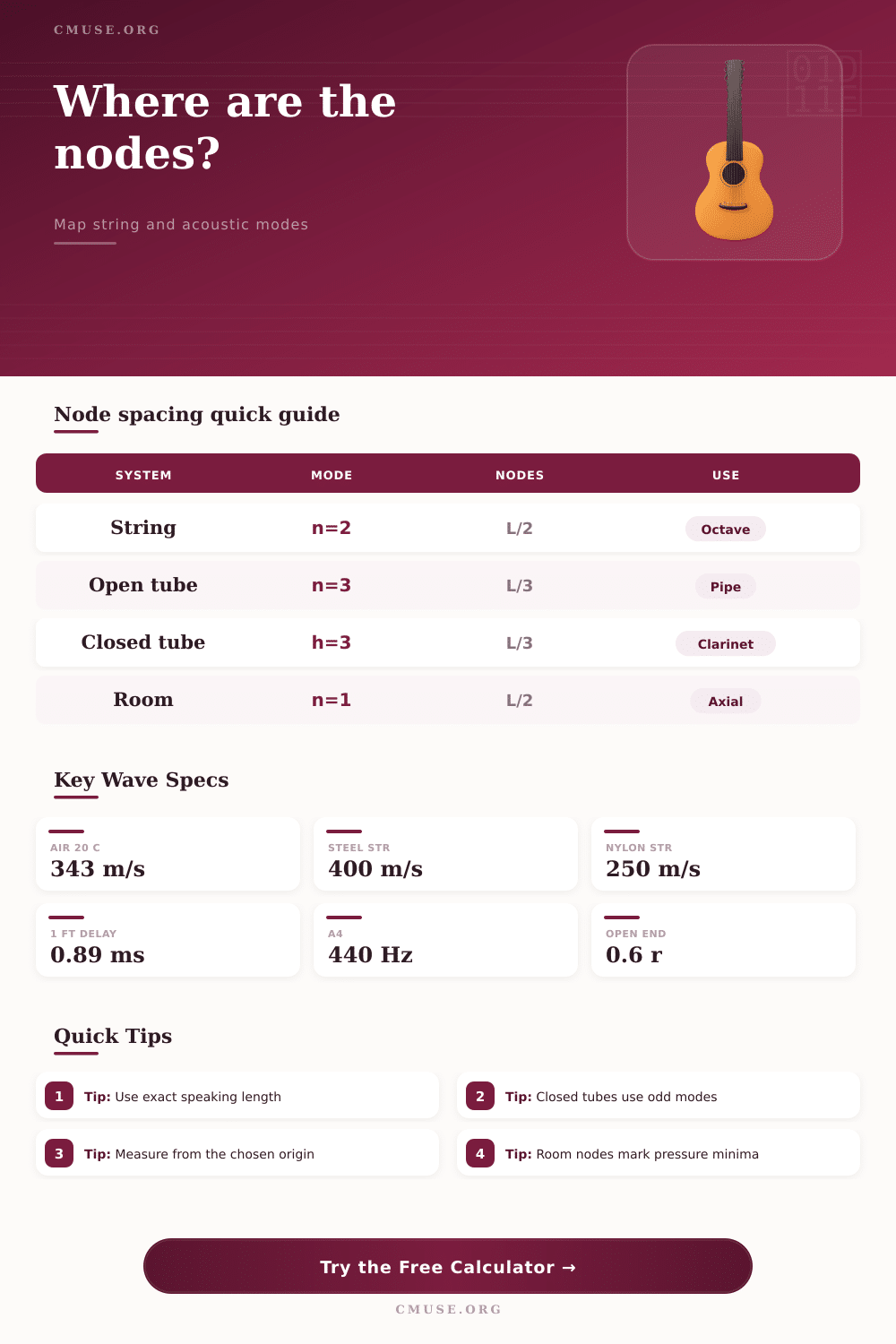
343 m/s
Air at 20 C
400 m/s
Steel string reference
250 m/s
Nylon string reference
0.6 r
Typical open-end correction
| System | Node Pattern | Antinode Pattern | Frequency Rule |
|---|---|---|---|
| Fixed string | x = kL / n, k = 0 to n | x = (k + 0.5)L / n | f = nv / 2L |
| Open-open tube | Pressure nodes at x = kL / n | Pressure antinodes halfway between nodes | f = nv / 2L effective |
| Closed-open tube | Pressure nodes at odd quarter-wave points | Pressure antinode at closed end and repeats | f = hv / 4L, h odd |
| Room axial | Pressure minima between boundary maxima | Pressure maxima at opposing boundaries | f = nv / 2L |
| Harmonic | String Node Landmarks | Open Tube Pressure Nodes | Typical Musical Check |
|---|---|---|---|
| 2nd | 0, L/2, L | 0, L/2, L | Octave harmonic at midpoint |
| 3rd | 0, L/3, 2L/3, L | 0, L/3, 2L/3, L | Octave plus fifth partial |
| 4th | Quarter-length spacing | Quarter-length pressure spacing | Two-octave partial |
| 5th | Fifth-length spacing | Fifth-length pressure spacing | Major-third color partial |
| 7th | Seventh-length spacing | Seventh-length pressure spacing | Flat-seventh color partial |
| Use Case | Measure From | Most Useful Output | Practical Note |
|---|---|---|---|
| Guitar or bass harmonics | Nut or bridge saddle | String displacement nodes | Lightly touch the string at the node mark. |
| Flute, organ, or open pipe | One physical pipe end | Pressure node spacing | Add end correction before judging pitch. |
| Clarinet or stopped pipe | Closed end or reed end | Odd-mode pressure pattern | Even harmonics do not form the basic closed-tube series. |
| Studio room mode | Front wall, side wall, or floor | Pressure minima and maxima | Small mic moves can cross a strong modal zone. |
| Resonator tube trimming | Closed cap or open lip | Quarter-wave length | Check temperature before final cuts. |
| Preset Context | Length | Mode | Primary Node |
|---|---|---|---|
| Electric guitar scale | 25.5 in / 64.8 cm | n = 2 | 12.75 in from nut |
| Violin string scale | 32.8 cm / 12.9 in | n = 3 | 10.9 cm from nut |
| Clarinet air column | 66 cm / 26 in | h = 3 | 22 cm from closed end |
| 12 ft control room | 12 ft / 3.66 m | n = 1 | 6 ft center null |
| 8 ft organ stop | 96 in / 2.44 m | n = 1 | open-end pressure node |
You pluck a string on a guitar half way along and listen as it sparkles with sound. That’s not magic; that’s physics. You played just the even harmonics while muting fundamental frequency. The result is a pure sine wave that cuts through the mix.
Finding the position for your finger on the fret by eye is an exercise in frustration: it goes either too far towards bridge, or it slips off the fret. Suddenly, your harmonic becomes a muddy thud. Standing waves do not forgive. The maths of resonance doesn’t care how well intended you were.
How to Find Where the Sound Waves Stand Still
It also removes guesswork from finding the nodes and antinodes by doing all the geometry for us in the calculator above. It plots where the steel or air is moving violently and where it stay still.
To use this, select the type of system then input the speaking length. The inputs is more important than most people think. That’s because the length becomes the boundary condition. When modeling an open flute, you need to include end correction to account for air vibrating past actual lip. That fraction of an inch can throw your pitch calculations off enough to make you sound flat.
For closed systems like clarinets, the calculator force odd harmonics only. That’s what accounts for their hollow timbre in comparison with bright brilliance of open strings.
This applies to room acoustics as well, except with more dire consequences since you can’t tune the walls. A corner forms a standing wave where it’s a pressure maximum and the center of the room is frequently a node. This means bass energy simply vanish there. This is why your favorite song sounds boomy in one chair and thin in another. Enter the tool, which allows you to enter your room dimensions to find these nulls prior to purchasing panels or drilling holes. Knowing that your mixing position is located in frequency void is preferable than wondering why your kick drum sounds hollow.
It’s all about wave speed, but here’s where materials and temperature come into it. If you put your organ in an unheated loft, the node position will be affected ever so slightly. This is because the speed of air depends on its temperature, and hot air move faster than cold air. With strings, what matters is density and tension. A tight, heavy bass string moves slower than a thin steel treble string, which shorten the wavelength at the same pitch. These material models makes the calculator adjust frequency outputs accordingly. This way you can check your node placement.
Do you need to remember how fast sound travels through steel compared to nylon? No, just understand that it does and affects where the harmonics land.
It’s a dexterity thing, playing harmonics, but consistency come from knowing the theory. You’re killing the node by pressing down so hard that you fret the note. That kills the node and changes length of speaking string. Your finger needs to lightly touch without quite stopping unwanted overtones for a clean chime. Your hand has to do this, and the calculator will show you where to place it.
Small details make big differences; precision in placement equals clarity of tone. Subwoofers and a guitar’s neck also need to be positioned well to have control. You need to aim the energy in right direction.
These reference tables shows how the nodal points gets closer together with higher harmonic numbers. This makes them increasingly difficult to place accurately. Advanced players prize sixth and seventh position harmonics because they are hard to hit accuratley. They require a steady hand and an ear that trusts the math.
Begin by gaining confidence with simple modes at lower numbers and lengths. Get a feel for the way it works. Double check what you’re doing against what you know is right before getting into more complicated interactions. Let it tell you the coordinates and you supply the context.
After that, you’ll begin to understand how the speed, length, and boundary conditions all work together and the shimmering tones aren’t some lucky accident anymore. They become intentional choices as you remove the ghosts from the room and put them where they should of been.