Neapolitan Chord Calculator
Spell the lowered supertonic triad, show the usual N6 inversion, and map note names, bass motion, and frequencies for classical harmony.
🎵 Presets
⚙ Calculator Inputs
Breakdown
📊 Reference Tables
| Key | Neapolitan | Bass | Comment |
|---|---|---|---|
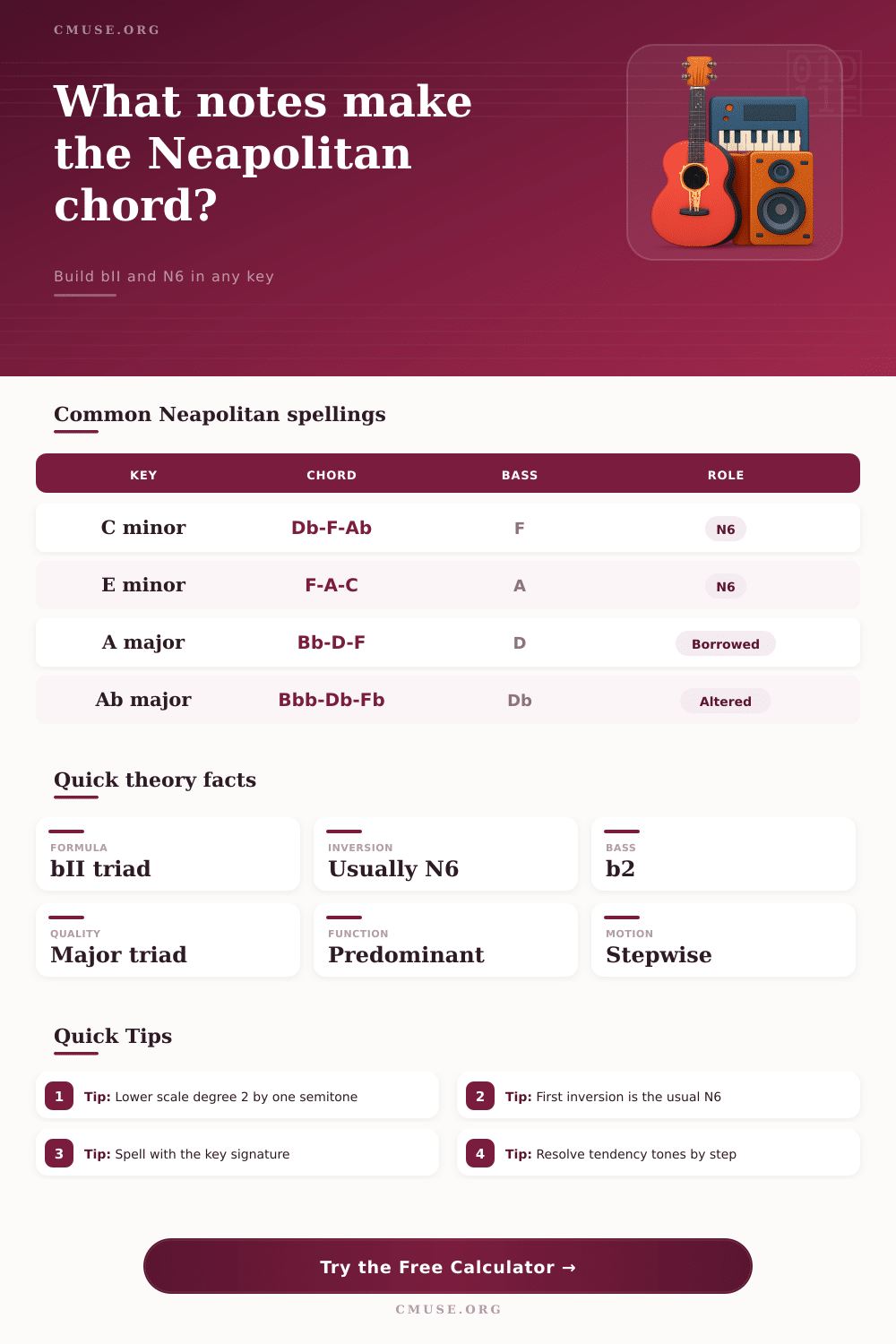
| C minor | Db-F-Ab | F | N6 |
| E minor | F-A-C | A | N6 |
| A minor | Bb-D-F | D | Classic |
| F minor | Gb-Bbb-Db | Bbb | Dense |
| G minor | Ab-Cb-Eb | Cb | Predom. |
| D major | Eb-G-Bb | G | Borrowed |
| Ab major | Bbb-Db-Fb | Db | Altered |
| Cb major | Dbb-Fb-Ab | Fb | Rare |
| Position | Figure | Bass | Use |
|---|---|---|---|
| Root | bII | Root | Uncommon |
| First inv. | N6 | 3rd | Standard |
| Second inv. | N64 | 5th | Rare |
| Function | Pred. | b2 | V-bound |
| Step | Semitones | Ratio | Example |
|---|---|---|---|
| Root | +1 | 1.0595x | Db |
| Third | +5 | 1.3348x | F |
| Fifth | +8 | 1.6818x | Ab |
| Octave | +12 | 2.0000x | Repeat |
📖 Practical Tips
This neapolitan chord calculator shows the lowered second scale degree, its major-triad spelling, the usual first inversion, and the chord tones and frequencies needed for fast harmonic analysis in any key.
A Neapolitan chord is a specific types of musical chord that is often used within the composition of musical pieces. A Neapolitan chord are created by lowering the second scale degree of a specific key by a half tone (or semitone), then creating a major chord upon that lowered scale degree. For instance, within the key of C minor, the second scale degree is the note D. By lowering that note by a half tone, it become the note Db.
A major chord built upon that note have the notes Db, F, and Ab. Because the second scale degree was lowered to create this chord, the Neapolitan chord is often referred to as a chromatic chord. The Neapolitan chord often function as a predominant chord.
What Is the Neapolitan Chord and How to Use It
A predominant chord is one that often leads to a dominant chord. The reason for the use of a chromatic chord within the Neapolitan chord is that it create a sense of tension within the chord. The tension the Neapolitan chord creates is different than chords like diminished chords, which also create tension within a chord.
Many composer utilize the tension created by the Neapolitan chord to increase the emotional intensity of a piece of music, as well as to provide a smooth transition to the dominant chord. The Neapolitan chord is most frequent used in its first inversion. A chord in first inversion mean that the third note of a chord is moved to the bass note of that chord.
Within the key of C minor, for instance, the chord contains the notes Db, F, and Ab. Thus, in first inversion, the bass note would be F. Using the first inversion of a chord allow for the bass line of a composition to move step-wise to the dominant chord. In root position, it is possible for the chord to sound somewhat blockily, and the bass note may not move smooth to the dominant chord.
Because the Neapolitan chord often leads to a dominant chord within a piece of music, resolution of the chord is required to ensure smooth voice leading. Each of the notes of a Neapolitan chord have specific tendency to move to another chord. For instance, the root of the Neapolitan chord may move by a leap to the dominant chord, but the other notes of the chord typically move by a step.
If the chord is not resolved according to these tendencies, smooth voice leading will not be achieved. Additionally, care must be taken to spell the notes of the chord correctly. Spelling the chord incorrectly may lead to unnecesary accidentals within the chord.
While the notes of the Neapolitan chord change in different keys, the logic of the chord remain the same. In the key of E minor, for instance, the lowered second scale degree is F, leading to a Neapolitan chord with the notes F, A, and C. In the key of Ab major, the lowered second scale degree is Bbb. Thus, the Neapolitan chord contain the notes Bbb, Db, and Fb.
In these examples, the requirement of double flat within the key of Ab major indicate the importance of understanding the relationship between scale degree and the formation of the Neapolitan chord. A Neapolitan chord can be used within both minor and major key. Within minor keys, it is often used to increase the emotional intensity of a piece of music.
Within major keys, it may be used to add a sense of borrowedness to the music. Regardless of the key in which a piece of music is composed, the Neapolitan chord will function as a predominant chord. Thus, a composer typically uses it in compositions where a composer desire to create a transition from tonic chords to dominant chords.
By understanding the proper inversions and resolutions of a Neapolitan chord, composers can effectivey use the chord to create smooth musical progressions within there compositions.