Natural Harmonic Position Calculator
Find exact natural harmonic touch points on a string, including node distance from the nut, nearest fret marker, frequency multiple, and practical touch tolerance.
Choose a common instrument and harmonic target, then adjust the scale length, capo position, node number, and tolerance to match the real speaking length you are checking.
Calculation Breakdown
This table recalculates from your current scale, capo, compensation, and partial settings, so it can be used for layout marks or quick bench checks.
| Node | Distance From Nut | Distance From Bridge | Nearest Fret | Offset |
|---|---|---|---|---|
| Run calculator | -- | -- | -- | -- |
| Partial | Frequency Multiple | Strong Node Examples | Approx Fret Markers | Musical Interval |
|---|---|---|---|---|
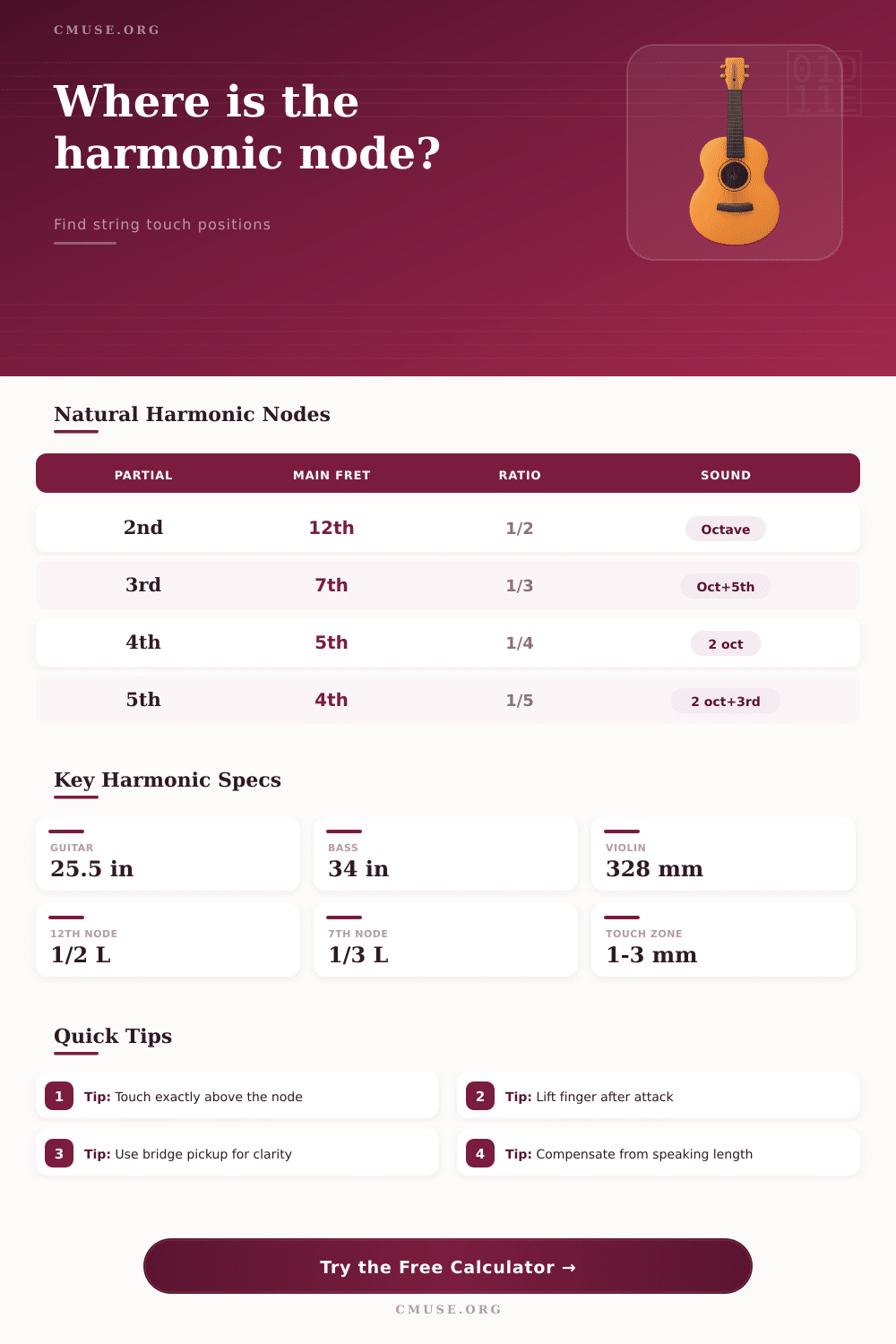
| 2nd | 2.00x | 1/2 length | 12th fret | Octave above open string |
| 3rd | 3.00x | 1/3 and 2/3 length | 7.02 and 19.02 | Octave plus perfect fifth |
| 4th | 4.00x | 1/4, 1/2, 3/4 length | 4.98, 12, 24 | Two octaves above open string |
| 5th | 5.00x | 1/5, 2/5, 3/5, 4/5 | 3.86, 8.84, 15.86 | Two octaves plus natural major third |
| 7th | 7.00x | 1/7 through 6/7 length | 2.67, 6.31, 10.79 | Natural seventh color, flatter than ET |
| Instrument | Typical Scale | 12th Harmonic | 7th Harmonic Node | Use Case |
|---|---|---|---|---|
| Fender-style guitar | 25.5 in / 647.7 mm | 12.75 in / 323.9 mm | 8.50 in / 215.9 mm | Intonation and setup checks |
| Gibson-style guitar | 24.75 in / 628.7 mm | 12.375 in / 314.3 mm | 8.25 in / 209.6 mm | Neck and bridge reference |
| Long-scale bass | 34 in / 863.6 mm | 17 in / 431.8 mm | 11.333 in / 287.9 mm | Clear octave harmonic checks |
| Mandolin | 13.875 in / 352.4 mm | 6.938 in / 176.2 mm | 4.625 in / 117.5 mm | Double-course layout marks |
| Violin | 12.913 in / 328 mm | 6.457 in / 164 mm | 4.304 in / 109.3 mm | Fingerboard harmonic stops |
| Partial Range | Node Spacing | Finger Accuracy | Best Technique | Common Problem |
|---|---|---|---|---|
| 2nd to 3rd | Wide | Forgiving, about 2 to 4 mm | Light touch over the marker | Pressing down to the fret |
| 4th to 5th | Medium | Moderate, about 1 to 3 mm | Use the fingertip edge | Touching between nodes |
| 6th to 8th | Narrow | Precise, about 1 mm | Pick near the bridge | Weak attack or noisy release |
| 9th and higher | Very narrow | Very precise, under 1 mm | Mark from calculated distance | Nearby partials speaking instead |
When you place your finger lightly over a fret marker and gently pluck that string, you hear a clear natural harmonic. This sounds simple enough; however, accuratley making this happen on higher partials is quite another matter. Playing natural harmonics are not magic; it’s physics.
You can find the exact millimeter measurement you need using this calculator. Knowing what they are help you get better results and avoid dull-sounding notes.
The Physics of Guitar Harmonics
For many guitarists, an octave harmonic should of occur at twelfth fret marker. While true for non-compensated playing, it’s not true when considering intonation adjustment. As we know from guitars with compensated saddles, the strings is not all the same tension or thickness. Also, often scale length (nominal) does not equal the true speaking length. If you touch exactly over the visual dot on your low E string, you might be millimeters off actual midpoint. It’s that small amount of misalignment that interrupt the overtone series.
With those numbers, saddle compensation move the node to a realistic spot instead of using perfect geometry. Partial 5 at fifth fret can be managed, while partial 17 need less than a millimeter tolerance window. That’s not much room for a human finger. Remember your finger has width; it doesn’t exist as a single point in space. That’s why high harmonics are problematic on old guitars whose frets aren’t even.
To see how these windows narrow, refer to the table below. It illustrates clustering of nodes. When they get crowded, they start interfering and making it hard to play the touch zone effectivly.
Think about the sound you want to produce. How is it achieved? It’s a question of position but also an attack. On a natural harmonic, the attack has to be in this order: light touch followed by a strong pluck and immediately let go. If you press down then you stop the string. Letting go too gradually will dampen resonance.
The shorter the scale (such as a violin), the more precisely timing needs to be correct. With longer-scale basses there’s more physical area for locating sweet spot. The violinist works with perhaps a three-foot scale, that’s roughly thirty two centimetres; accurate timing is essential.
These notes are used by technicians to set up guitars and make sure the nuts and bridges is properly aligned. When you stop a note on the twelfth fret, it should be in tune with its twelfth harmonic. This is common practice but rarely do they check other nodes to determine saddle height or neck relief problems. The calculator gives you distance to the bridge as well as distance to the nut. This can be helpful if you want to mark your custom fingerboard. No more guessing and a baseline that can be argued based off.
Playing harmonics well mean respecting the geometry of the string. Not only do you need to know where the fret is located but also where the string want to vibrate. When you have learned those locations, you can then find note by feel. You stop hunting for the marker and begin to feel the node itself. This change in perspective change how you will play.