🎵 Octave Calculator
Find frequencies, intervals & note relationships across all octaves instantly
| Note | Octave 2 | Octave 3 | Octave 4 | Octave 5 | Octave 6 |
|---|---|---|---|---|---|
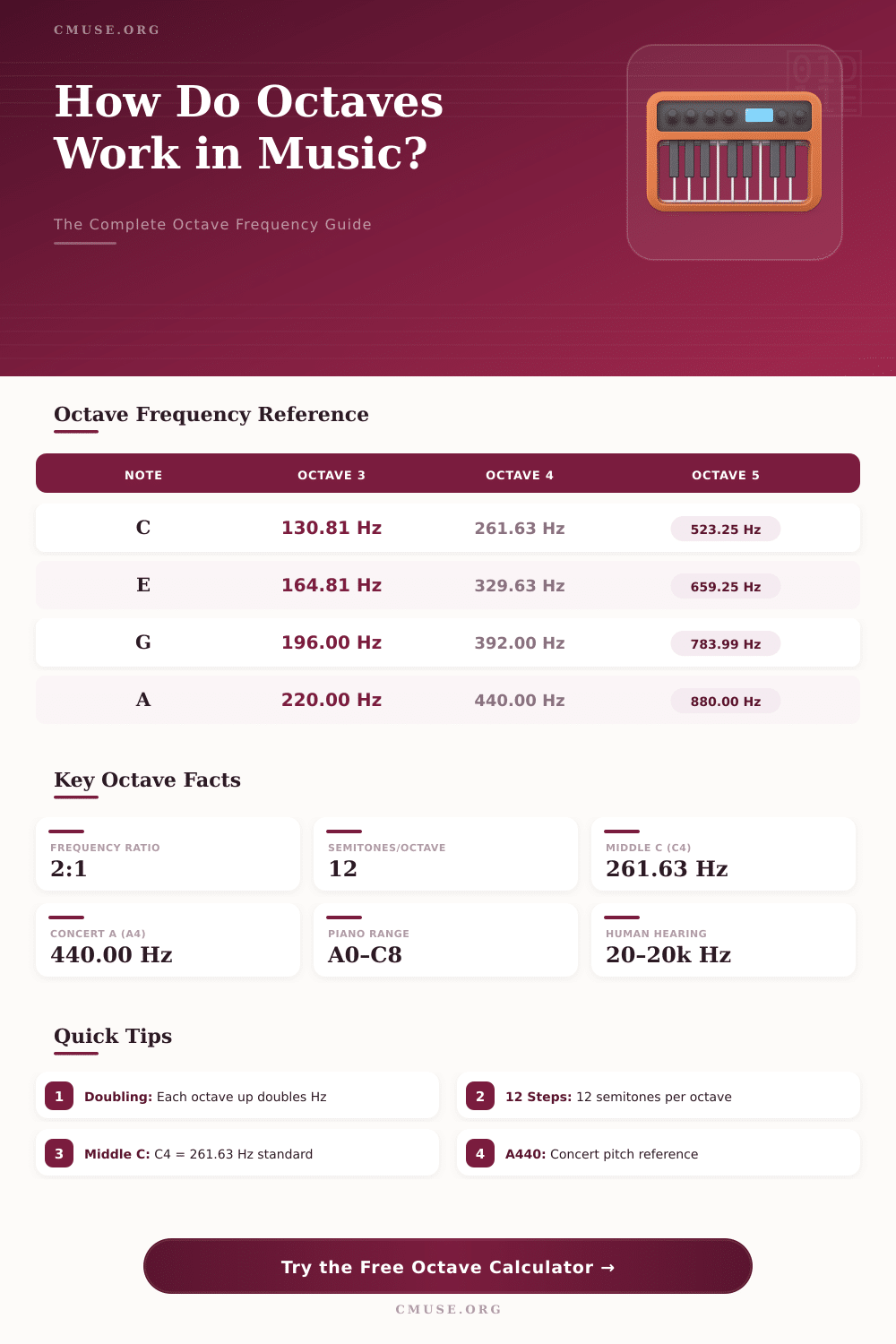
| C | 65.41 Hz | 130.81 Hz | 261.63 Hz | 523.25 Hz | 1046.50 Hz |
| D | 73.42 Hz | 146.83 Hz | 293.66 Hz | 587.33 Hz | 1174.66 Hz |
| E | 82.41 Hz | 164.81 Hz | 329.63 Hz | 659.25 Hz | 1318.51 Hz |
| F | 87.31 Hz | 174.61 Hz | 349.23 Hz | 698.46 Hz | 1396.91 Hz |
| G | 98.00 Hz | 196.00 Hz | 392.00 Hz | 783.99 Hz | 1567.98 Hz |
| A | 110.00 Hz | 220.00 Hz | 440.00 Hz | 880.00 Hz | 1760.00 Hz |
| B | 123.47 Hz | 246.94 Hz | 493.88 Hz | 987.77 Hz | 1975.53 Hz |
| Interval Name | Semitones | Frequency Ratio | Example (from C4) |
|---|---|---|---|
| Unison | 0 | 1.000 : 1 | C4 (261.63 Hz) |
| Minor Second | 1 | 1.059 : 1 | C#4 (277.18 Hz) |
| Major Second | 2 | 1.122 : 1 | D4 (293.66 Hz) |
| Minor Third | 3 | 1.189 : 1 | Eb4 (311.13 Hz) |
| Major Third | 4 | 1.260 : 1 | E4 (329.63 Hz) |
| Perfect Fourth | 5 | 1.335 : 1 | F4 (349.23 Hz) |
| Tritone | 6 | 1.414 : 1 | F#4 (369.99 Hz) |
| Perfect Fifth | 7 | 1.498 : 1 | G4 (392.00 Hz) |
| Minor Sixth | 8 | 1.587 : 1 | Ab4 (415.30 Hz) |
| Major Sixth | 9 | 1.682 : 1 | A4 (440.00 Hz) |
| Minor Seventh | 10 | 1.782 : 1 | Bb4 (466.16 Hz) |
| Major Seventh | 11 | 1.888 : 1 | B4 (493.88 Hz) |
| Octave | 12 | 2.000 : 1 | C5 (523.25 Hz) |
| Octaves Apart | Frequency Multiplier | Example: A (440 Hz) | Perceived Pitch |
|---|---|---|---|
| –3 Octaves (down) | ÷ 8 = × 0.125 | 55.00 Hz | Very Low |
| –2 Octaves (down) | ÷ 4 = × 0.25 | 110.00 Hz | Low |
| –1 Octave (down) | ÷ 2 = × 0.5 | 220.00 Hz | Below Reference |
| Same Octave | × 1 | 440.00 Hz | Reference |
| +1 Octave (up) | × 2 | 880.00 Hz | Above Reference |
| +2 Octaves (up) | × 4 | 1760.00 Hz | High |
| +3 Octaves (up) | × 8 | 3520.00 Hz | Very High |
f = A4_ref × 2^((n – 69) / 12) where n = MIDI note number (A4 = 69). Each octave up exactly doubles the frequency.
An octave occur when the frequency of one note is double the frequency of another notes. If a note goes up an octave, the frequency is multiplied by two. If the note goes down one octave, the frequency is divided by two.
For instance, if a note is 261 Hz, the note that goes up one octave will be 523 Hz, since 523 is double 261. While these two different frequency sound the same to a person’s ear, the high note will sound more brighter and the low note will sound deeper. The 2:1 ratio of an octave give octaves a sense of consonance within music.
What Is an Octave and How It Works
Consonance is the idea that certain frequencies of notes within a musical composition are pleasing to the ears of listener. One reason that musicians often utilize octaves within there music is that they provide a thick sounds with volume and depth. Listeners perceive each of these notes as the same pitch class.
Many musical instrument have specific ranges within which they produce best. Each instrument has a range of octaves within which it sound best. For instance, the piano covers many octaves from the lowest frequency to the highest frequency.
The guitar, however, range from the middle octaves of the piano. Furthermore, each of the guitar’s string must be tightened or loosened to play different octaves. If a musician select an incorrect note for an instrument, the instrument will not be able to produce that note.
For instance, a flute will not be able to produce a note that is too low in frequency for that instrument. The tuning of an instrument will determine the frequency of each note on that instrument. For example, A4 will be 440 Hz for most moddern musical composition.
However, the change in the tuning of the instrument will change the frequency of each note. For example, if A4 is tuned to 432 Hz instead of 440 Hz, then the same percentage will lower each note in frequency. The frequency of a note will impact how a person perceive the sound that that note make in the body and in the room.
Low frequencies will make a person feel as if the sound is rumbling in their chest. High frequencies will make a sound brightly and piercing in the room. Additionally, humans can only hear certain frequencies.
The range of hearing for human is between 20 Hz and 20,000 Hz. A human being will not hear any note outside of this range. MIDI numbers can be used to organize octaves within music software.
Every note have a MIDI number. To find the next octave, an individual simply adds 12 to the MIDI number of a given note. For instance, if a note have a MIDI number of 60, the note that is one octave higher will have a MIDI number of 72.
This relationship between notes with different MIDI number enables musicians to create music that transpose to different octaves. There are many way in which understanding octaves will help musicians. Musicians can use their understanding of octaves to improve their ability to mix music.
Additionally, understanding octaves will improve a musician’s ability to compose music. Furthermore, understanding octaves will also improve a musician’s ability to play their instrument. If a musician understand the rule of doubling the frequency of notes to create an octave, they will understand how melodies and harmonies works within music.