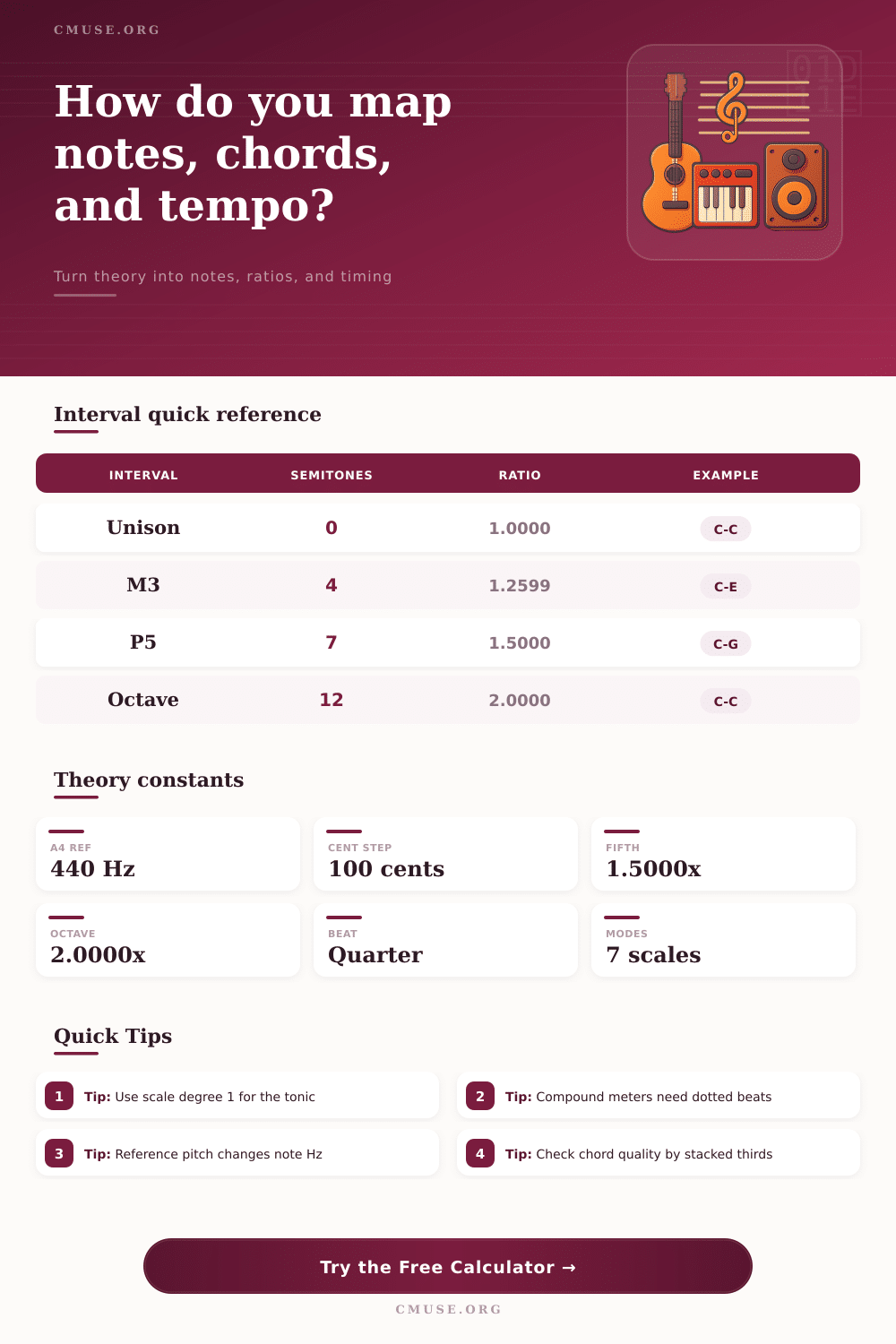
Music Theory Calculator
Map notes, scale degrees, chord quality, interval ratios, and beat timing from any tonic with a fast theory-first workflow.
Semitone Step
Frequency ratio per semitone
Perfect Fifth
Seven semitones above root
Octave
Twelve semitones above root
Cents
Equal temperament cents per step
| Mode | Steps | I Chord | Color |
|---|---|---|---|
| Major | 0 2 4 5 7 9 11 | Maj | Bright |
| Natural minor | 0 2 3 5 7 8 10 | Min | Dark |
| Harmonic minor | 0 2 3 5 7 8 11 | Min | Tense |
| Dorian | 0 2 3 5 7 9 10 | Min | Cool |
| Check | Formula | Result | Use |
|---|---|---|---|
| Octave | 2:1 ratio | 12 st | Same note |
| Fifth | 3:2 ratio | 7 st | Open sound |
| Third | 5:4 ratio | 4 st | Major color |
| Tempo bar | 240/bpm x sig | Bar ms | Rhythm math |
Music theory studies how music works. It helps to understand the bases of musical practices and possibilities. The word commonly shows the basic elements for reading notes, for instance key signatures.
Theory explains elements like harmony, melody and rhythm Moreover it describes song form, tempo, notes, chords, intervals, scales and other things.
Basics of Music Theory
The origin of music theory you can trace to old civilizations. The Greeks created systems of scales and modes. Pythagoras was the first known person that discovered that harmonious intervals appear when simultaneous notes have frequencies in ratios of small integers.
During the Middle Ages you refined theory by means of introduction of notation.
Music theory is not a simple textbook. It studies the evolution of usual practices. The reasons and ways of music.
Various cultures made rules from their own customs, which gave many coherent systems, like Greek, Indian, Chinese and Arabic. Theory shows relations between notes in various musical traditions, which are many world wide.
Theory deals with musical notions, not with instruments. It is knowledge of the mind, not of the fingers. Every learning about scales, instruments, note names, chord names, any method for describing musical phenomenon, belongs to music theory.
You do not require formal classical theory to play well, but the things that you learn for goodness, stay real theory.
Musicians use musical elements and performance elements. Theory mostly engages with what a composer writes on paper. Exploration of scales, keys, intervals and their feelings help to create better music.
Especially the major scale matters. West theory bases on it. All other scales originate from that, at least in West music.
From major scale you can make any scale by means of change of the right notes.
No need to know theory to create or play music. Even so theory ranks among the most useful things for producing music best according to your skills. It will be compulsory when you plan to talk and work with other expert musicians.
Theory simplifies communication of notions and information, gives more opportunities for creating new music or improvising. It divides just playing from insight why the sounds operate like this.
Theory is best learned in little pieces. Even fifteen minutes daily will lead to progress. Good start gives major and minor scales, pentatonics and basic chords as triads and seventh chords.