Lesson Plan Time Split Calculator
Balance warmup, review, new concept, repertoire, theory, feedback, and homework time for a focused music lesson.
Lesson split results
| Student level | Warmup | Review | New concept | Repertoire | Homework handoff |
|---|---|---|---|---|---|
| Young beginner | 3-5 min | 4-6 min | 5-8 min | 8-12 min | 3-4 min with parent notes |
| Beginner | 4-7 min | 5-8 min | 7-10 min | 10-16 min | 3-5 min with clear tasks |
| Early intermediate | 5-8 min | 6-10 min | 8-14 min | 14-24 min | 4-6 min with priorities |
| Intermediate | 6-10 min | 8-12 min | 10-18 min | 18-30 min | 4-7 min with practice order |
| Advanced | 8-14 min | 8-15 min | 12-25 min | 25-45 min | 5-8 min with targets |
| Adult learner | 5-9 min | 6-12 min | 10-18 min | 15-30 min | 4-7 min with flexible pacing |
| Lesson length | Best use | Recommended blocks | Suggested split | Planning note |
|---|---|---|---|---|
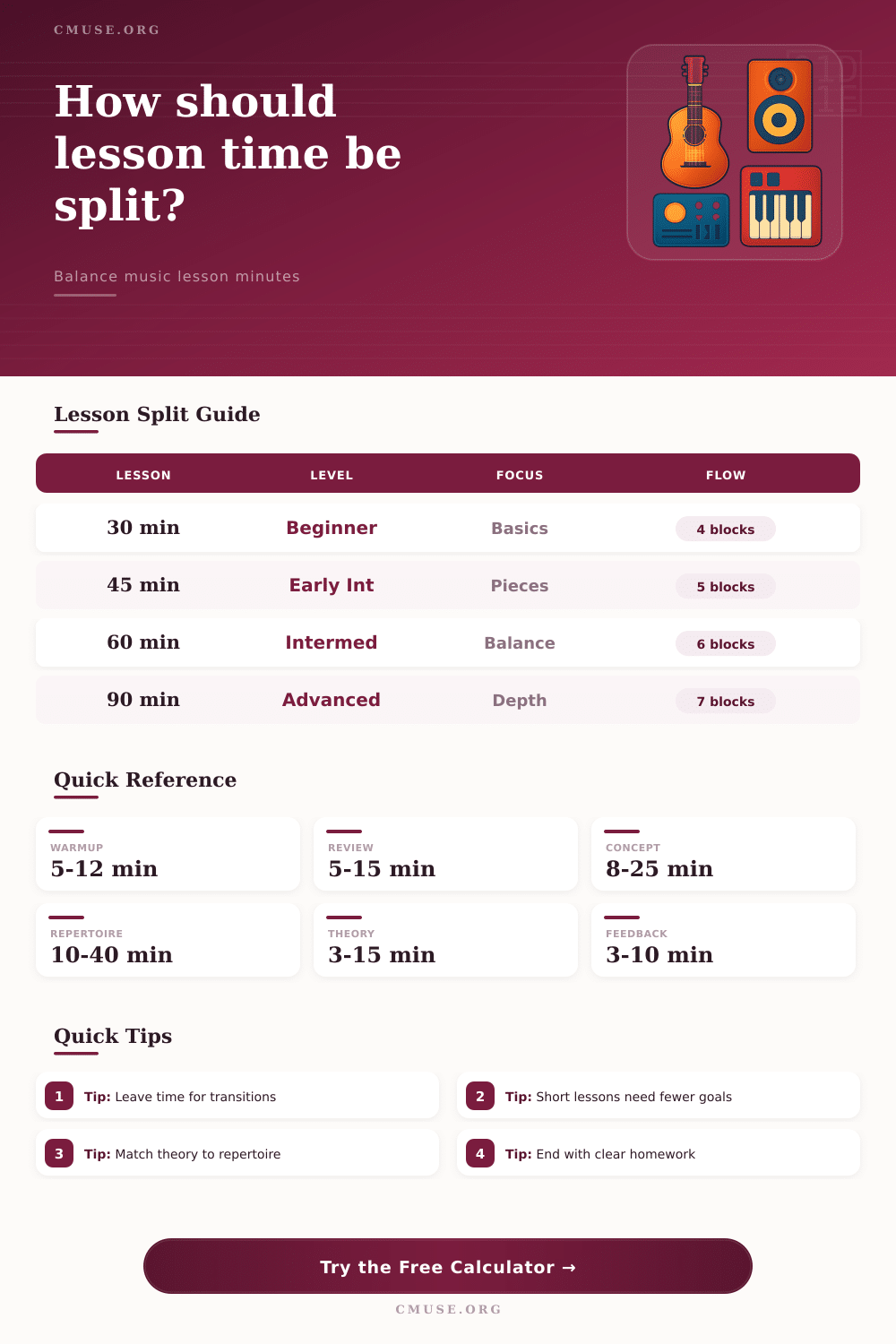
| 25 minutes | Young students or focused check-ins | 4 blocks | Warmup, review, one skill, homework | Keep theory embedded in the piece. |
| 30 minutes | Weekly beginner lessons | 5 blocks | Warmup 15%, review 20%, concept 25%, repertoire 30%, homework 10% | Choose one new idea only. |
| 45 minutes | Balanced private lessons | 6 blocks | Warmup 12%, review 15%, concept 25%, repertoire 35%, feedback 13% | Reserve a small transition buffer. |
| 60 minutes | Intermediate or exam preparation | 6-7 blocks | Technique 15%, review 15%, concept 25%, repertoire 35%, homework 10% | Use theory to explain repertoire decisions. |
| 75 minutes | Advanced repertoire coaching | 7 blocks | Warmup 12%, review 15%, deep work 50%, theory 10%, feedback 13% | Plan one major interpretation target. |
| 90 minutes | Ensemble, recital, or masterclass work | 7-8 blocks | Warmup 10%, review 15%, sectional work 45%, full run 20%, feedback 10% | Add breaks for listening and reset time. |
| Segment | Purpose | Good signs | Too short when | Too long when |
|---|---|---|---|---|
| Warmup | Prepare body, tone, rhythm, and attention | Student starts with ease | Technique problems appear immediately | It becomes unrelated drill work |
| Review | Check last assignment and retrieve prior learning | Corrections connect to practice notes | Homework quality is unclear | New work never begins |
| New concept | Teach one skill, sound, rhythm, or reading idea | Student can explain or demonstrate it | Concept feels rushed | Student loses active playing time |
| Repertoire | Apply skills to pieces, excerpts, or songs | Musical decisions improve | Lesson stays theoretical | Technique issues go untreated |
| Theory or reading | Name patterns and support independent practice | Student uses terms in the piece | Notation errors repeat | It disconnects from music making |
| Feedback and homework | Summarize wins, set next actions, assign practice | Student leaves knowing what to do | Assignments are vague | It repeats the whole lesson |
| Preset | Length | Level | Main emphasis | Typical split |
|---|---|---|---|---|
| Beginner Piano 30 | 30 min | Beginner | Reading, rhythm, short repertoire | 5 warmup, 5 review, 7 concept, 8 piece, 5 close |
| Beginner Guitar 45 | 45 min | Beginner | Chord changes and strumming | 6 warmup, 7 review, 10 concept, 15 songs, 7 close |
| Intermediate Violin 60 | 60 min | Intermediate | Technique, intonation, repertoire | 8 warmup, 10 review, 13 concept, 22 repertoire, 7 close |
| Voice Audition 60 | 60 min | Intermediate | Vocalises, text, audition cuts | 10 warmup, 8 review, 12 concept, 22 repertoire, 8 close |
| Ensemble Coaching 90 | 90 min | Advanced | Sections, balance, run-through feedback | 10 warmup, 15 review, 20 concept, 35 repertoire, 10 close |
Maybe the warmup lasts too long, or your review take up too much time and leaves no room to introduce new concept. At some point, every private teacher has felt that moment when a student packs up their instrument with three major points still left to explore. The single greatest limitation to teaching privates is time, and yet it seems to evaporate once the lesson begins. Taking a structured approach to how you divide your minutes can transform confusion more then clarity.
Once you input the student’s level and length of each lesson, the page’s calculator will work out the remainder for you. You won’t have to guess how long to allow for changing activities. Transitions are harder than many teachers think. Simply switching from scales to a sonata is more than just a physical transition. It asks the student to think different too. Without allowing time for this changeover, your lesson plan may look fine on paper, but fall apart when you put it into practice. Seeing this gap ahead of time are where the calculator helps.
How to Plan Your Lesson Time Better
A novice has shorter attention span, and it will take more time for their basic skills to develop. This is why it can be better to start with smaller blocks of time. Instead of six or seven distinct sections in a thirty-minute lesson, there may only be four. Complicated structures forced on early learners result in rushed explanation and frustration during home-practice. As you see from the table of references, the longer the lesson the more blocks, but also it becomes clearer that you wish to include just sufficient structure to guide them without having to provides such complete support that they give up any sense of control over their performance.
What about advanced students? Their technical issues is more profound; they’ve got plenty of repertoire to learn. You may find yourself in a 90 minute masterclass or ensemble. There might be detailed feedback, full run-throughs, and maybe even some sectionals. How do you know when it’s truly being measured? Is it measured by minutes of activity, or minutes of instruction? Not the same at all. Ten minutes of well-guided discovery might last them for years, while twenty minutes of lecture may be nothing.
The homework task at the end of the lesson is often rushed which results in ineffectiveness. The student rushes at the last minute to complete assignments, leaving them unclear on what to work on during their practice time. Poor practice habits result from vague instructions and you have to spend extra review time with them next week. This creates a vicious cycle that halts progress. Save those last few minutes for clear tasks. It changes period of time in between lessons from a blank void into an extension of the class.
Clock-time isn’t everything: energy patterns is important too. For some learners, ten minutes on scales will get them warmed-up and prepared to work on more demanding material. For others, they’re straight into action but then stall around half way because there’s too much in mind. By changing the pacing of lessons to suit your learner, you avoid mid-lesson lull where both of you feel stuck. It may be you slide a new concept ahead to help a flagging concentration, or delay it if they prefer a physical warmup first. And this is a little thing but important if you want to make progress each and every minute.
I’m not suggesting that it’s just about filling up time. It’s about lining up the minutes spent based off your learning objectives. If you have a clear idea of where minutes will be allocated between technique and theory then you’re not responding in the heat of the moment but making decisions as a result of planning. You spend five minutes less on review and more time on that tricky section in the piece. This is no longer an act of desperation but one of strategy. It’s more about planning but without feeling like math.
Each step leads into the next until the last homework are assigned. The form supports the music; not the reverse. Lessons go smoother for both parties, the teacher and the student, when they begin to work with the clock instead of against it. Instead of feeling exhausted, you feel like you’ve completed something. That feeling of closure makes students want to return and helps them improve steadly over time.