Music Note Value Calculator
Convert BPM, note values, and meter into precise durations, bar lengths, and note counts for rhythm checks.
🎵 Real Presets
Each preset sets the tempo basis, meter, note value, note count, bars, and comparison note so the calculator is ready to read immediately.
⚙ Note Inputs
📊 Common Note Ratios
📋 Note Duration Reference
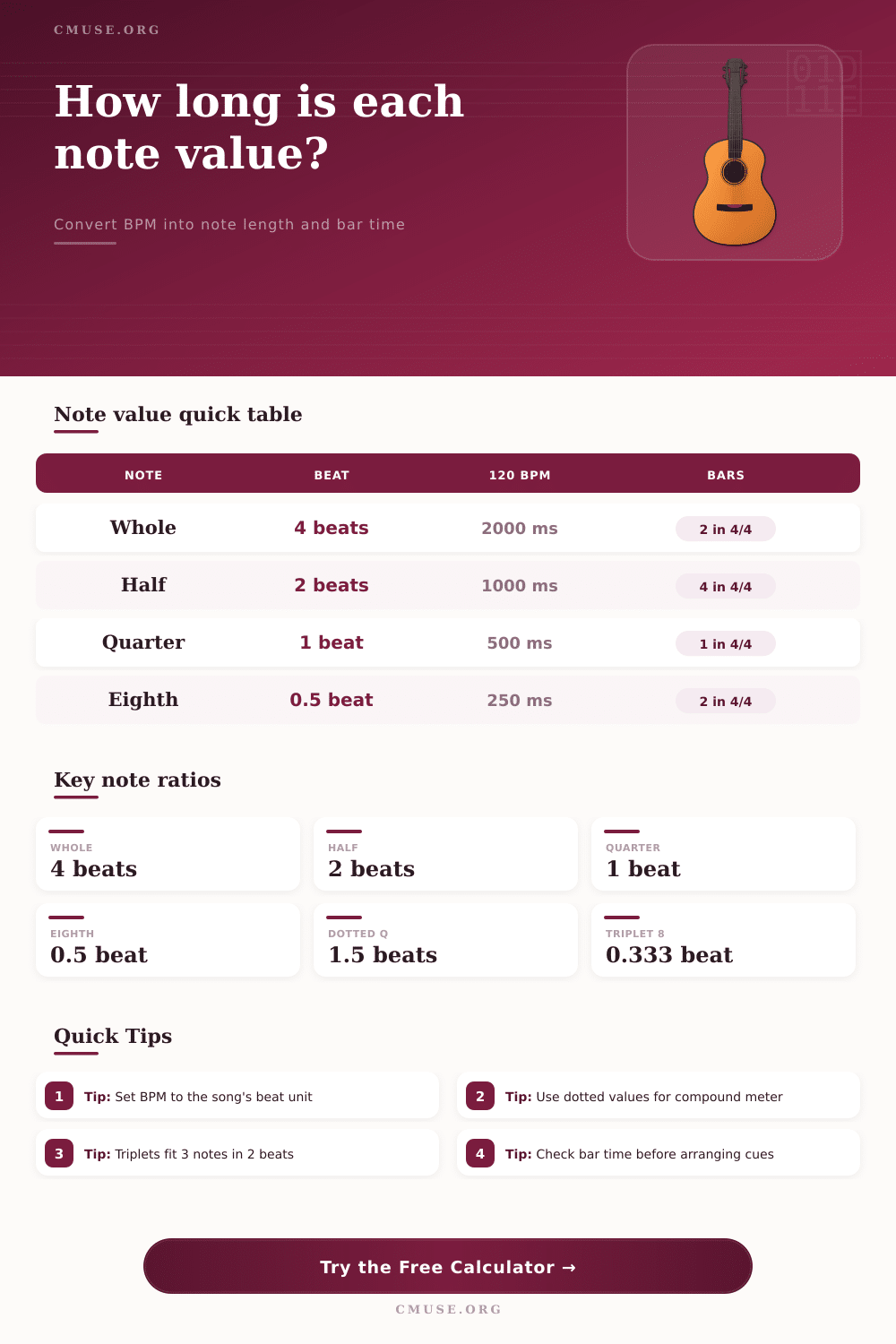
| Note Value | Quarter Eq | 120 BPM | 4/4 Notes |
|---|---|---|---|
| Whole note | 4.00 beats | 2000 ms | 1 per bar |
| Half note | 2.00 beats | 1000 ms | 2 per bar |
| Quarter note | 1.00 beat | 500 ms | 4 per bar |
| Eighth note | 0.50 beat | 250 ms | 8 per bar |
🎼 Meter Reference Table
| Meter | Beat Unit | Beats / Bar | Bar Time @120 |
|---|---|---|---|
| 4/4 | Quarter | 4 | 2000 ms |
| 3/4 | Quarter | 3 | 1500 ms |
| 6/8 | Dotted q | 2 | 2000 ms |
| 12/8 | Dotted q | 4 | 4000 ms |
📈 Preset Comparison Table
| Preset | Tempo | Note | Total Span |
|---|---|---|---|
| Pop Verse 96 | 96 BPM | Quarter x8 | 5.000 s |
| 6/8 Folk Pulse | 84 BPM | Dotted q x8 | 9.524 s |
| Funk Eighths | 112 BPM | Eighth x16 | 4.286 s |
| Drum Fill 16ths | 128 BPM | 16th x32 | 3.750 s |
Musical rhythm is measurement of time, but musical rhythm is also based off specific mathematical calculation. Each musical note have a duration, and the tempo and an meter of the music determine the duration of that musical note. The tempo of music is measured in beat per minute (BPM).
If a person set the tempo of the music to 60 BPM, then each quarter note will last for one second. This is because there are 60 seconds in one minute. If a person increase the tempo to 120 BPM, then the quarter note will last for 0.5 seconds, or half of a second, because the tempo has been doubled.
How Tempo, Time Signatures and Note Lengths Work
The basis note for music is another essential component of the tempo of the music. The basis note is the note that is used to determine which musical note represent the beat of the music. For most musical chart, the quarter note is the basis note.
However, some types of music use different basis note for their musical charts. For example, a chart that utilize a 6/8 time signature may use a dotted quarter note as its basis note. If a person incorrectly set the basis note for the tempo of the music, then the eighth notes for the music will land at the wrong time.
Using a musical tempo tool will allow the musician to set the basis note for the music, which will ensure the accuracy of the calculations of the tempo of the music. The time signatures for music will change the way time is measured within the music. Time signature for music dictate the number of beat in a bar.
For example, a time signature of 4/4 mean that there are four quarter note beat in a bar of music. In contrast, a time signature of 3/4 will mean that there are three quarter note beat in a bar of music. If a person change the time signature from 4/4 to 3/4, then the length of the bar change.
A music production application will allow a user to use presets for specific musical time signature, which will allow the musician to quickly set the basis note and the number of beat in a bar of music for a specific musical style. Musical dotted note and triplets can also change the duration of musical note within music. A dotted note will make the musical note last for 1.5 times the length of the original note.
For example, a dotted quarter note will last for 1.5 times the length of a quarter note. A musical triplet will group three notes together in the same amount of time as two note. Using these note calculation allows a musician or music producer to determine how many note will fit in a bar of music.
These calculation will also allow a musician to determine if a series of musical note will fit in a bar of music or will extend into the next bar of music. The concept of musical arrangement is dependent upon the use of these mathematical measurement of music. For instance, a musician can calculate how many second it will take to play eight notes in a pop verse at 96 BPM.
The same musician can use these calculation to determine if sixteenth-note hi-hat will be synchronized with the other note in the verse. Reference table will allow a musician or music producer to quickly determine these calculation. These table will display the relationship between whole note, quarter note, and sixteenth note.
Many people make mistake with musical tempo calculation when they dont account for the tempo basis and the bar count of the music. For example, if a musician count the BPM of a song but does not account for the basis note, the timing of the music will be incorrect. If a musician is timing a musical phrase for a film cue, the musician will have to account for the bar count for the musical phrase to land on the correct moment in the film dialogue.
Music tempo tool will allow the user and the music producer to verify the number for the song. Furthermore, the tempo tool will allow them to correct a musical riff that does not fit correctly within the bar line. Rhythm in music is a measured groove, and the best groove in music is one where the musician has accounted for the correct timing of the musical note through the use of moddern mathematical measurement.