🎵 Music Interval Calculator
Identify the interval between any two notes — semitones, interval name, quality & inversion
Numbers = semitones above root note
| Interval Name | Semitones | Abbreviation | Quality | Example (C Root) | Inversion |
|---|---|---|---|---|---|
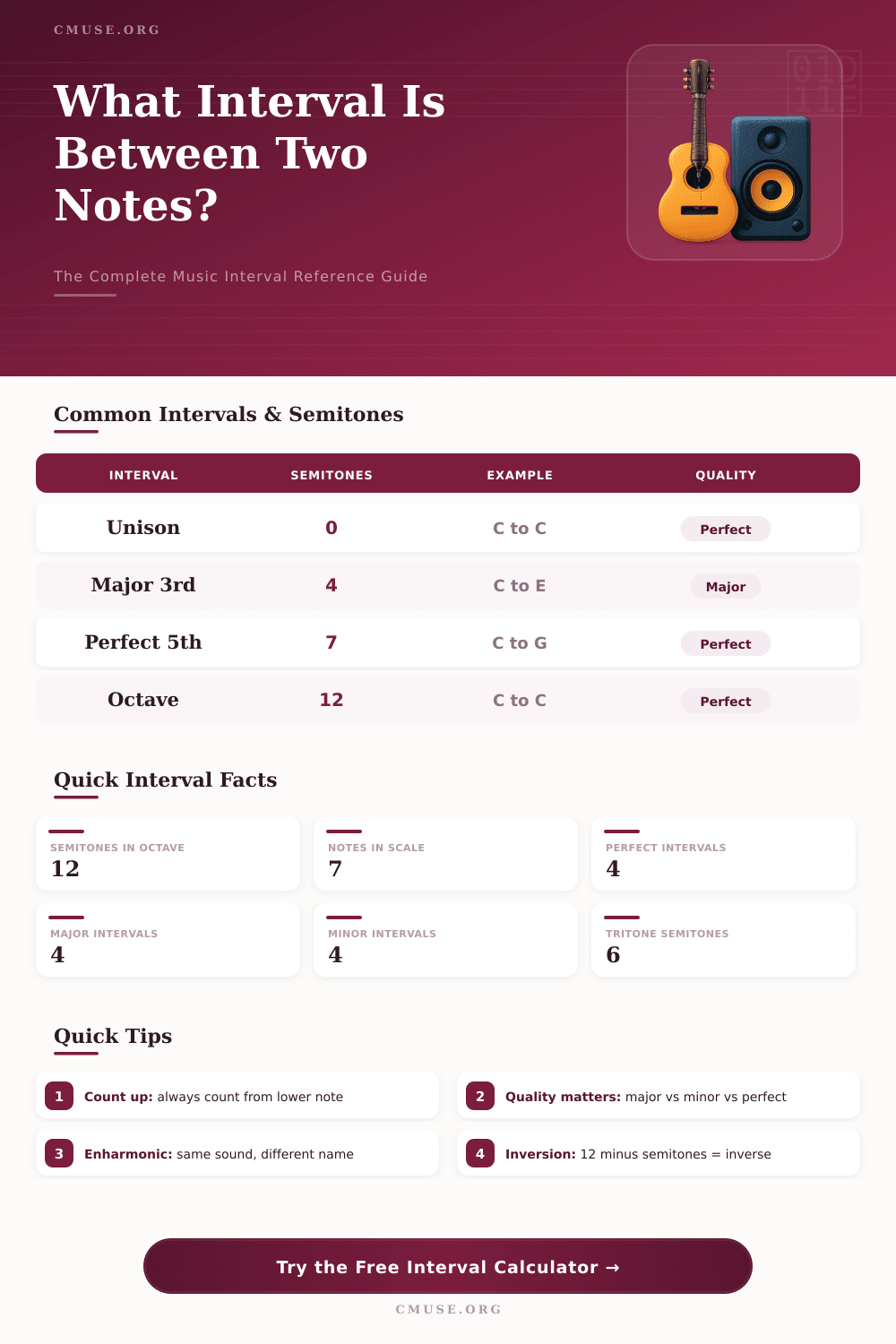
| Perfect Unison | 0 | P1 | Perfect | C → C | Perfect Octave |
| Minor 2nd | 1 | m2 | Minor | C → Db | Major 7th |
| Major 2nd | 2 | M2 | Major | C → D | Minor 7th |
| Minor 3rd | 3 | m3 | Minor | C → Eb | Major 6th |
| Major 3rd | 4 | M3 | Major | C → E | Minor 6th |
| Perfect 4th | 5 | P4 | Perfect | C → F | Perfect 5th |
| Tritone (Aug 4th) | 6 | A4/d5 | Aug/Dim | C → F# | Tritone |
| Perfect 5th | 7 | P5 | Perfect | C → G | Perfect 4th |
| Minor 6th | 8 | m6 | Minor | C → Ab | Major 3rd |
| Major 6th | 9 | M6 | Major | C → A | Minor 3rd |
| Minor 7th | 10 | m7 | Minor | C → Bb | Major 2nd |
| Major 7th | 11 | M7 | Major | C → B | Minor 2nd |
| Perfect Octave | 12 | P8 | Perfect | C → C | Perfect Unison |
| Chord Type | Intervals Used | Semitones from Root | Sound Character |
|---|---|---|---|
| Major Triad | M3 + P5 | 0, 4, 7 | Bright, happy |
| Minor Triad | m3 + P5 | 0, 3, 7 | Sad, dark |
| Diminished Triad | m3 + d5 | 0, 3, 6 | Tense, unstable |
| Augmented Triad | M3 + A5 | 0, 4, 8 | Dreamy, unresolved |
| Dominant 7th | M3 + P5 + m7 | 0, 4, 7, 10 | Bluesy, needs resolution |
| Major 7th | M3 + P5 + M7 | 0, 4, 7, 11 | Smooth, jazzy |
| Minor 7th | m3 + P5 + m7 | 0, 3, 7, 10 | Mellow, cool |
| Sus2 | M2 + P5 | 0, 2, 7 | Open, airy |
| Sus4 | P4 + P5 | 0, 5, 7 | Suspended, anticipating |
| Interval | Semitones | Just Ratio | Equal Temp. Ratio | Cents |
|---|---|---|---|---|
| Unison | 0 | 1:1 | 1.000 | 0 |
| Minor 2nd | 1 | 16:15 | 1.059 | 100 |
| Major 2nd | 2 | 9:8 | 1.122 | 200 |
| Minor 3rd | 3 | 6:5 | 1.189 | 300 |
| Major 3rd | 4 | 5:4 | 1.260 | 400 |
| Perfect 4th | 5 | 4:3 | 1.335 | 500 |
| Tritone | 6 | 45:32 | 1.414 | 600 |
| Perfect 5th | 7 | 3:2 | 1.498 | 700 |
| Minor 6th | 8 | 8:5 | 1.587 | 800 |
| Major 6th | 9 | 5:3 | 1.682 | 900 |
| Minor 7th | 10 | 16:9 | 1.782 | 1000 |
| Major 7th | 11 | 15:8 | 1.888 | 1100 |
| Octave | 12 | 2:1 | 2.000 | 1200 |
Music Intervals show the space between two notes. Almost every bit of music comes from the use of notes in various spaces, so with different measures for the Music Intervals. According to the theory of music a Music Interval is the difference of height between two sounds.
One can describe it as horizontal or melodic, when it binds notes, that sounds one after the other, for instance two pitches in sequence of melody. Sometimes one calls it vertical or harmonic, if two notes sound together.
What Are Music Intervals?
Music Intervals form the basic bit of scales, chords and lines of melody. They measure the distance between two heights, whether vertical or horizontal. If one measures vertically, the notes sound at the same time, and so one calls them harmonic Music Intervals.
Music Intervals work like the genetic code of the music. The step of note to the next notes taht move simply as a Music Interval.
Music Intervals in music form the main base for the western music theory. By means of them, one can create chords, scales, arpeggios and even more many elements. They help also as first step for study more difficult themes, as harmony and melodic lines.
Moreover, Music Intervals are useful a lot for talk between musicians and for sorting notions about music.
To find the number of a Music Interval, the cause is really easy. By means of counting lines and spaces one finds the grade, as second, third, fourth and down. Even so, to find the type of the Music Interval (whether perfect), diminished, big, augmented or little, requires more effort.
This requires to no the key, the signature of the key and some accidents before in the measure. It helps to also recall, that between B and C, likewise as between E and F, there is no half tone. There are a lot of causes for learning that, but knowledge about scales and reading music already settles some of them.
If the bottom note has a flat, the Music Interval grows in size. When both notes are sharps or both have flats, the Music Interval stays without change.
Some Music Intervals are recognized more well by hearing than others. The little second and the tritone stand out, because they sound especially harsh. The little second is that, that one hears in the theme music of the films about Jaws.
One can call the tritone also augmented fourth or diminished fifth. It sits fairly in the center of an octave and sounds discordant and bothering. In the Middle Ages, monks even called the tritone the “Music Interval of the devil”.
Music Intervals help to understand, why the same song one can play in various keys. The song sounds likewise the same, because the Music Intervals between notes stay identical. The grades of a scale are the notes in it, and each of those grades creates a Music Interval from the base.
For instance, in the scale of C major, C is the first grade, D the second, E the third, thus down. Even from C to C one counts as a Music Interval, which one callsa unison.