Cents Calculator Music
Convert frequency ratios, cents, detune in Hz, beat-rate estimates, and interval offsets for tuning, temperament, and pitch work.
🎼 Named Tuning Presets
🎚 Pitch and Ratio Inputs
Choose the active calculation mode. The calculator still displays equivalent frequency, ratio, cents, detune, beat-rate, and interval comparison values.
📊 Comparison and Formula Grid
🎹 Equal-Tempered Interval Table
| Interval | Semitones | Equal Cents | Equal Ratio |
|---|---|---|---|
| Unison | 0 | 0 | 1.000000 |
| Minor second | 1 | 100 | 1.059463 |
| Major second | 2 | 200 | 1.122462 |
| Minor third | 3 | 300 | 1.189207 |
| Major third | 4 | 400 | 1.259921 |
| Perfect fourth | 5 | 500 | 1.334840 |
| Tritone | 6 | 600 | 1.414214 |
| Perfect fifth | 7 | 700 | 1.498307 |
| Octave | 12 | 1200 | 2.000000 |
🎻 Just Ratio and Offset Table
| Interval Color | Just Ratio | Just Cents | Offset vs 12-TET |
|---|---|---|---|
| Minor second | 16:15 | 111.731 | +11.731 cents |
| Major second | 9:8 | 203.910 | +3.910 cents |
| Minor third | 6:5 | 315.641 | +15.641 cents |
| Major third | 5:4 | 386.314 | -13.686 cents |
| Perfect fourth | 4:3 | 498.045 | -1.955 cents |
| Perfect fifth | 3:2 | 701.955 | +1.955 cents |
| Major sixth | 5:3 | 884.359 | -15.641 cents |
| Minor seventh | 7:4 | 968.826 | -31.174 cents |
🎧 Detune Hz Reference Table
| Reference Pitch | +1 Cent | +5 Cents | +10 Cents |
|---|---|---|---|
| 82.407 Hz E2 | 0.048 Hz | 0.238 Hz | 0.477 Hz |
| 220.000 Hz A3 | 0.127 Hz | 0.636 Hz | 1.275 Hz |
| 440.000 Hz A4 | 0.254 Hz | 1.273 Hz | 2.548 Hz |
| 880.000 Hz A5 | 0.509 Hz | 2.545 Hz | 5.096 Hz |
📝 Use-Case Comparison Table
| Task | Best Input Mode | Primary Result | What to Watch |
|---|---|---|---|
| Compare tuner readings | Cents offset | Shifted frequency | Register affects Hz size |
| Analyze pure intervals | Ratio to cents | Temperament offset | Compare against 12-TET |
| Check piano unisons | Frequency pair | Beat rate in Hz | Use the same partial |
| Build microtonal steps | Cents offset | Ratio multiplier | Keep octave mapping clear |
| Measure A standard drift | Frequency pair | Cents from A440 | Small cents can be audible |
When two musical notes is played near each other, a person will hear a slow pulsing sensation in the auditory system. This pulsing sensation are referred to as beating. The beating phenomenon occur when two sound waves drift in and out of phase with one another, and the speed at which the beats occur indicates to the tuner how much the two notes differ in there pitch.
The difference in pitch between two notes can be measured in a unit call a cent. One octave contains exactly twelve hundred cents, which makes the cent a very small division of the octave. The use of the cent as a unit of measure allows for a comparison of interval between notes from different registers of pianos or between different musical instruments.
What a Cent Is and How It Helps Tune Instruments
The cent is a unit of measure that is equal to one twelve-hundredth of an octave. It is represented on a logarithmic scale, which matches the way that humans hears pitch relationships between two notes. For instance, a seven-cent difference between two notes that are played at a low pitch on the piano will feel the same as if the same difference in cent values were played at a high pitch on the same musical instrument.
Even though the shift in frequency in Hertz will be higher at the high pitch, the interval between the two pitches in cents will remain the same. Because of this unique quality of the cent, instrument technician, pianos tuners, and musical composer use this unit of measurement. A person often needs to calculate frequency (in Hertz), interval size (in cents), and the simple ratio between two different pitches.
For instance, a piano technician may use the concept of beats per second to evaluate the closeness of two pitches to each other when they are in a unison. A guitarist may need to know the number of Hertz that exist in a five-cent shift in frequency. A composer may need to know the cent value of a 5-to-4 major third to compare the interval to a major third that has been tempered.
Each of these scenarios start with a different measurement but each require the same type of mathematical conversion between the different units. The calculator that is provided here can calculate each of these different type of conversions if a person first select the type of quantity that they know. If a person enters two different frequencies, the calculator will provide the cent distance between the two notes, the ratio of the frequencies, and the number of beats per second.
If the mode is changed to cents, however, and if a person enters the number of cents of detuning from a given frequency, the calculator will provide the new frequency of the detuned note. In the mode that uses simple fraction as its input, the calculator will provide the cent equivalent of that fraction. A person can easily access each of these modes since each mode use the same underlying mathematical formulas to provide the answers.
It is possible for a person to be surprised at the different Hertz values that indicate the shift in frequency for the same shift in cents as the musical scale increases in frequency. For instance, shifting a pitch by one cent at the A note that is at 440 Hertz will result in a shift in frequency of only a quarter of a Hertz, but the same shift in cents at the A note that is at 880 Hertz will shift the frequency of the note by twice the amount. Such a relationship between these two types of measurement allows for a piano tuner to make certain adjustments to a piano and for a harpsichord technician to perform the same type of calculation.
Another important calculation that is used in the tuning of musical instruments is that of the rate at which beats will occur for two pitches. For instance, if two piano strings are supposed to be at the same pitch, then any difference in pitch between those two strings will manifest itself as a throb in the hearing of a tuner, and the speed of that throb will be equal to the difference in frequency between those two pitches. The calculator can calculate the frequency difference between two pitches, and it can also multiply that calculated difference by a chosen “partial” (such as the number of the harmonic) to provide an estimate of the rate at which the beats will sound.
Piano technicians can use this calculation to ensure that the higher harmonic of a piano are tuned accurately. In the Western musical scale, one of the most common tuning system is called equal temperament. In equal temperament, the comma that Pythagoras used is divided equally across the twelve tones of the octave.
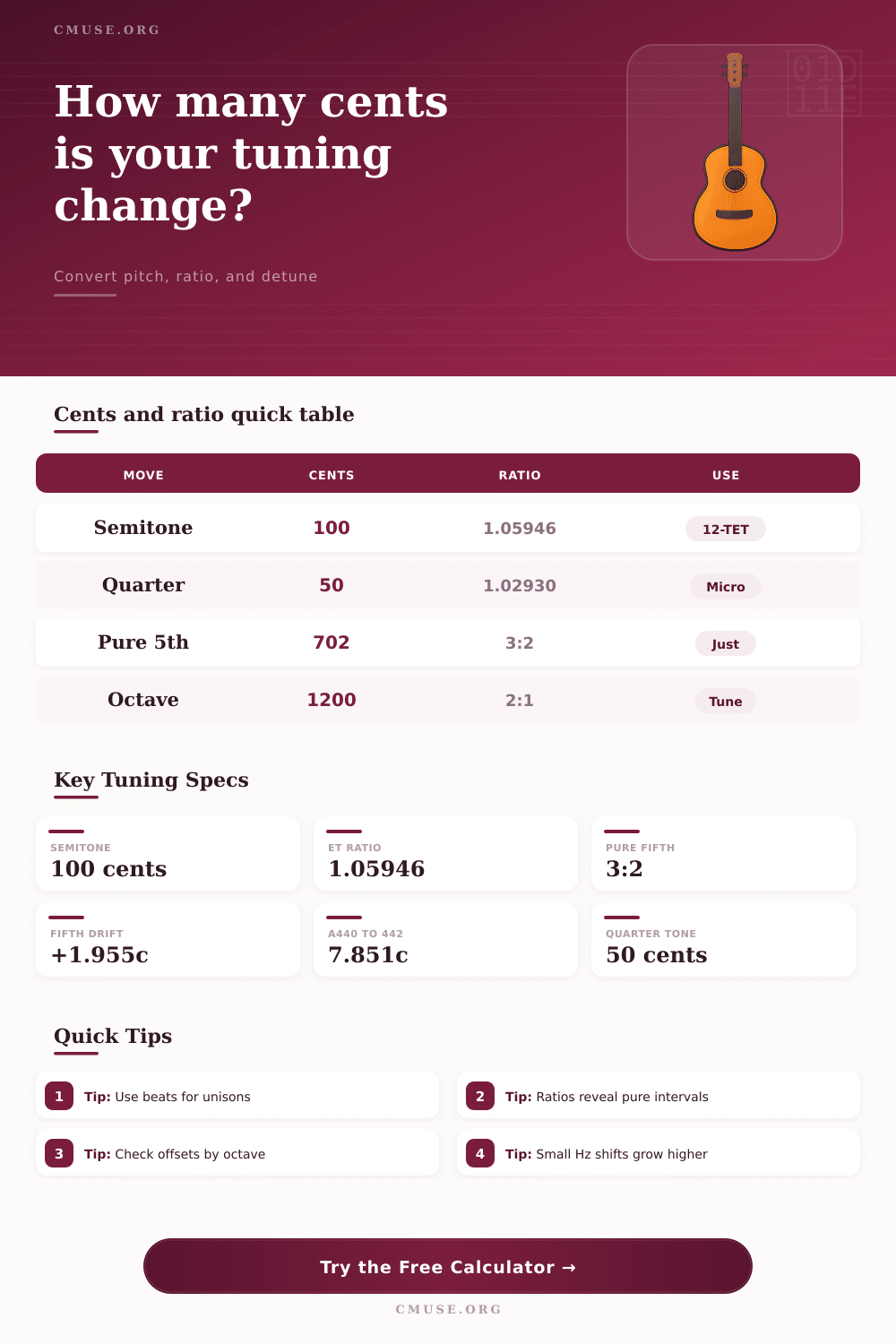
As a result, a perfect fifth that is tuned to 702 cents is reduced to 700 cents in equal temperament tuning. These two cents of difference accumulate over the course of twelve perfect fifths, creating what is heard as the sound of equal temperamented tuning systems. Seeing the difference between these two types of pitches in the unit of cents makes the adjustment between them concretely visible and understood.
Intervals that are tuned to just intonation are located at different distance from equal-tempered intervals. For instance, a pure major third is 14 cents lower than an equal-tempered major third, while a pure minor third is 16 cents higher than an equal-tempered minor third. These differences in cents create audible differences in the sound of just intonation versus equal temperamented tuning systems.
The calculator allows a person to enter a measured interval to compare it to both an equal-tempered interval and a just-ratio interval. Another use for the cent unit is to calculate the change in frequency of every musical note in an ensemble if that ensemble raises the pitch of A from 440 Hertz to 442 Hertz. Such a change in pitch will shift the pitch of every other note in the ensemble by approximately eight cents.
While such a shift is small, it do require wind musicians to lengthen their instruments and string musicians to shift their fingers along their instruments. Yet the fact that the shift is visible in cents allows for each musician to make the adjustment to their instruments. Many people find it difficult to understand that the cent is a logarithmic measurement.
For instance, if a person adds ten cents to a frequency, and then adds another ten cents to that new frequency, the result is not the same as adding twenty cents to the initial frequency. Yet the calculator automaticly shift the pitch back to its original frequency when making these calculations. Another concept of pitch that can be confusing for a person is the difference in the beat rate between two octaves of the same musical note.
For instance, a unison that has a beat rate of one Hertz for the note A will have a beat rate of two Hertz for the A note that is one octave higher. The number of cents between the two notes remains the same, but the rate at which the beats occur has changed. Yet the ability to view these two measurements allows a person to decide if the detected beat rate is within the standard for that instrument.
An understanding of the mathematical relationship between these different units of measurement allows for a person to use the cent as a measurement tool for tuning instruments to standard pitches. By knowing the number of cents between two pitches, a tuner can calculate the rate at which the two pitches will beat against one another, the change in frequency that is required to adjust an instrument to a standard pitch, and whether the interval between the two pitches is in equal temperament, just intonation, or some other tuning system. Thus, the cent is a useful unit for pianists, composers, and instrument maker.