Multi-Instrument Practice Time Allocator
Distribute weekly practice across several instruments using priority, upcoming gigs, maintenance decay, skill gap, and switching overhead.
Detailed Allocation Breakdown
| Instrument | Weekly Time | Daily Average | Weight Drivers | Practice Role |
|---|
| Priority Level | Use Case | Weekly Meaning | Allocation Effect |
|---|---|---|---|
| 1 | Maintenance only | Keep touch, tone, or fingerboard memory alive | Receives minimum plus a small skill share |
| 2 | Light development | Useful but not the center of the week | Receives modest growth time after reserve |
| 3 | Active rotation | Regular repertoire, lessons, or ensemble use | Competes strongly when skill gap is visible |
| 4 | Main working instrument | Core identity or frequent performance tool | Gets a high baseline share before gig boosts |
| 5 | Feature or deadline | Audition, exam, recording, paid lead, or exposed part | Dominates unless maintenance risk is severe elsewhere |
| Driver | Low Band | Medium Band | High Band |
|---|---|---|---|
| Skill gap | 0-15%: polish and retain | 16-35%: planned repair work | 36%+: focused technique blocks |
| Gig timing | 61-90 days: gentle pull | 22-60 days: active preparation | 1-21 days: urgent concentration |
| Deadline pressure | Casual reading or jam | Normal public set | Audition, exam, paid feature |
| Switching drag | 0-4 minutes per change | 5-9 minutes per change | 10+ minutes per change |
| Rotation Type | Best For | Switching Pattern | Planning Note |
|---|---|---|---|
| Batched blocks | Drums, recording, reeds, amplified rigs | Few changes, longer blocks | Good when setup overhead is above 8 minutes |
| Balanced rotation | Most multi-instrument weeks | One to three changes per day | Works when instruments have mixed priorities |
| Alternating rounds | Beginner sampling, ear training, short reviews | Frequent changes, short blocks | Use when overhead is low and goals are light |
| Deadline stack | Pit books, auditions, substitute calls | Main instrument first, support later | Protect minimum maintenance for every active instrument |
| Scenario | Weekly Hours | Instruments | Typical Split |
|---|---|---|---|
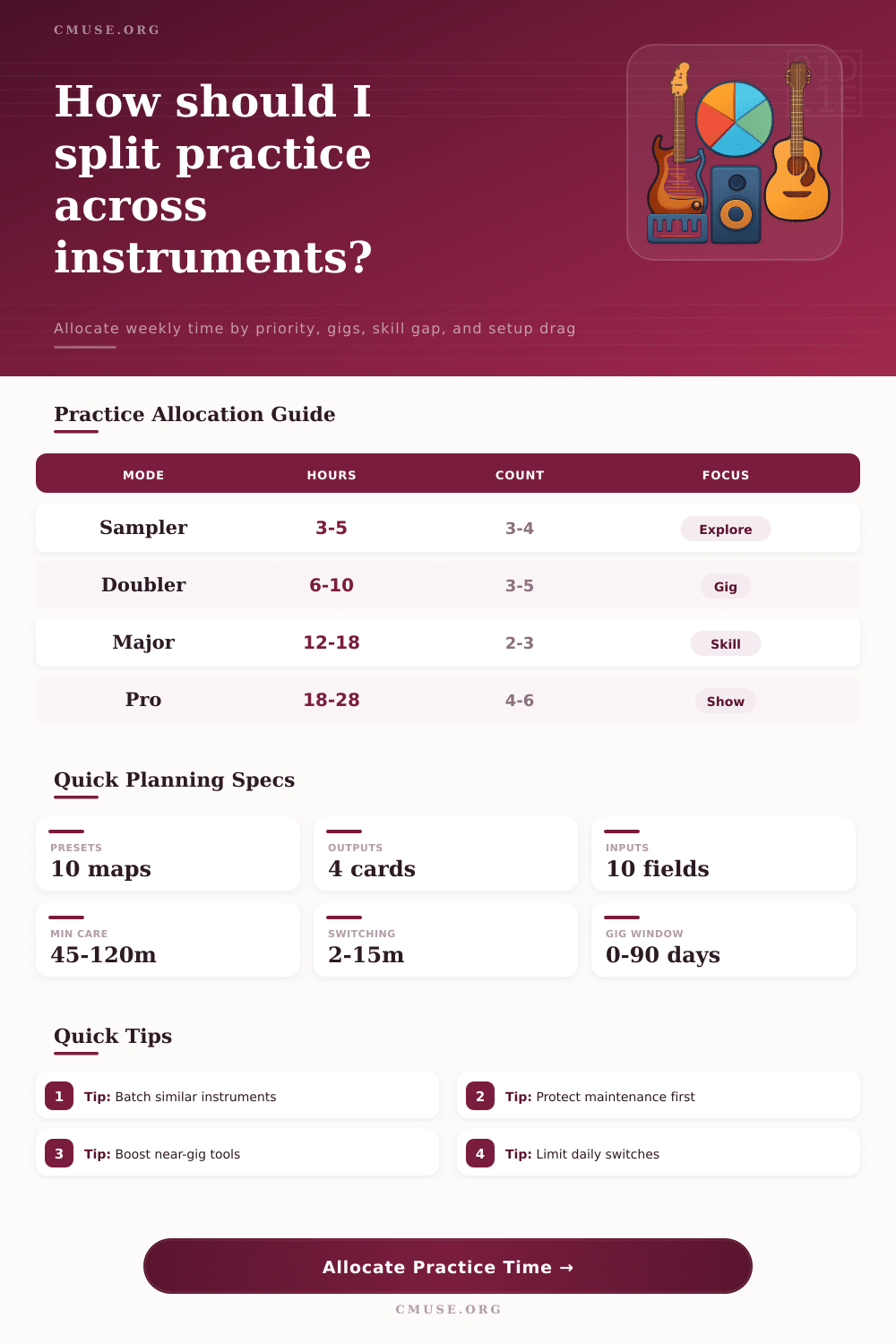
| Beginner sampler | 3-5 hours | 3-4 | Even review with light skill-gap bias |
| Working cover player | 6-10 hours | 3 | Primary 45-55%, others 20-30% |
| Theatre pit doubler | 10-16 hours | 4-6 | Book order and deadline pressure dominate |
| Conservatory double | 14-24 hours | 2-3 | Main study 50-65%, secondary deep work |
| Producer songwriter | 8-14 hours | 4-6 | Keys or DAW core with instrument upkeep |
After a week off from playing, you pick up your guitar and fight with it for a few minutes while trying to remember who you are. Then you do the same with the other three, four, or five instrument you rotate through. That’s the problem with most multi-instrumentalists, they’re not failures of talent but rather of time management.
Because they don’t manage practice as an energy budget but rather a pie chart, they end up slicing their hours evenly between all the tool. In the process, they doesn’t advance anywhere and maintain none. That’s where Multi-Instrument Practice Time Allocator change things and adds switching costs to the mix. Switching from guitar to voice, then piano to saxophone, take a chunk out of mental energy. Physical adjustment, mental reset, setup, it is what I call the silent killer of productivity.
Why Multi-Instrumentalists Waste Time
But you don’t need to guess how much time goes poof as you switch; that’s what the calculator accounts for. It make you realize that 30 minutes you put on the clock doesn’t mean 30 minutes of focus when you’re constantly changing up your rig. This is where the inputs matter more then the outputs. By choosing which method you’ll switch between instruments (alternating vs. Batched), you’re creating amount of friction cost in your workflow. For example, the difference between turning a page and setting up a kit are significant; there’s a lot more physical work involved based off the part of the drummer. That’s why the tool factor this into the equation and removes that drag prior to giving out your remaining minutes.
Decay is ruthless, and maintenance time come first. You will lose your embouchure memory quicker then you will your fingerboard calluses. So the system will ensure every instrument stay alive before it tries to help you become better at any individual one. The hierarchy is often overlooked and many musicians plunge directly into intensive study on their first instrument and let whatever doubles fall by the wayside. When gig day arrive, the simple exercises for these doubling instrument has vanished.
This is where the allocator can help because it creates a minimum amount of playtime according to your sensitivity settings for decay. So if you label something high maintenance, then the allocator will guarantee it recieve some airtime so that it doesn’t expire while you are focusing on deep practice for your main instrument. This is a defensive move that ultimately protects you from last minute panic rehearsals.
In addition, consider the effect of deadline pressure on the outcome. As a gig date gets closer, you focus more on being ready to perform right now instead of taking a slow and steady approach. This isn’t ideal in theory, but it is practical planning for a working musician. If your next show is next Saturday, you can’t spend time on slow technique, so the calculator will assign more practice time to instruments where you have urgent dates. That way, your effort aligns with your commitments.
On the page are reference tables to give you some guidelines for average situations like the cover band player on weekends vs the theatre pit doubler. What these illustrate is that there’s no one right ratio. If you’re a producer who might touch six sources during a session then it’ll be very different than conservatory student. It isn’t about perfection, but about making sure your musical work matches how you plan your time.
Who is going to be the musician you become this week? Are you defending territory or venturing into new ground? The tool won’t answer this question, but the numbers will give you enough information to be comfortabley with the choice you make. First, get real about your skill gap(s) and set-up time(s). Then, step aside and let the math work its magic. Your ears will appreciate it, as will your instruments; when you finally sit down to play.