MTM Crossover Calculator
Calculate passive crossover parts for midwoofer-tweeter-midwoofer speakers, including wiring impedance, tweeter padding, acoustic spacing, and baffle step allowance.
Ideal passive component values
| Crossover | Wavelength | Half-wave target | Use note |
|---|---|---|---|
| 1.4 kHz | 9.6 in / 24.5 cm | 4.8 in / 12.3 cm | Large waveguide or low tweeter Fs |
| 1.8 kHz | 7.5 in / 19.1 cm | 3.8 in / 9.5 cm | Common 5.25 to 6.5 in MTM target |
| 2.2 kHz | 6.1 in / 15.6 cm | 3.1 in / 7.8 cm | Tight baffle center-channel designs |
| 2.8 kHz | 4.8 in / 12.3 cm | 2.4 in / 6.1 cm | Best with small mids or close flanges |
| 3.5 kHz | 3.9 in / 9.8 cm | 1.9 in / 4.9 cm | Micro MTM only; lobing rises quickly |
| Topology | Electrical slope | At crossover | MTM comment |
|---|---|---|---|
| 1st order | 6 dB/oct | -3 dB electrical | Few parts, but high driver overlap |
| 2nd Bessel | 12 dB/oct | Softer knee | Useful when phase and transient shape matter |
| 2nd Butterworth | 12 dB/oct | -3 dB electrical | Common prototype value set |
| 2nd Linkwitz-Riley | 12 dB/oct | -6 dB electrical | Often needs one driver polarity inverted |
| 3rd Butterworth | 18 dB/oct | -3 dB electrical | Classic D'Appolito-style starting point |
| Project | Drivers | Typical Fc | Design watchpoint |
|---|---|---|---|
| Horizontal center | Dual 4 to 5.25 in mids | 1.8 to 2.4 kHz | Off-axis seats reveal lobing fastest |
| Stand bookshelf | Dual 5.25 in mids | 2.0 to 2.8 kHz | Keep tweeter flange small |
| Slim floor tower | Dual 6.5 in mids | 1.4 to 2.0 kHz | Tweeter must handle lower crossover |
| Stage monitor MTM | Dual high-sensitivity mids | 1.4 to 2.2 kHz | Pad compression driver carefully |
| Desktop or soundbar | Dual 2 to 3 in mids | 2.8 to 4.5 kHz | Excursion and thermal limits matter |
| Section | 1st order | 2nd order core | 3rd Butterworth core |
|---|---|---|---|
| Low-pass mids | L = Z / 2πf | L = Z / Q2πf, C = Q / Z2πf | L1, C2, L3 ladder from g = 1,2,1 |
| High-pass tweeter | C = 1 / Z2πf | C = Q / Z2πf, L = Z / Q2πf | C1, L2, C3 ladder from g = 1,2,1 |
| LR2 setting | Not used | Q = 0.50 | Not used |
| Butterworth setting | Q = 1.00 | Q = 0.707 | Prototype g values |
| Bessel setting | Not used | Q = 0.577 | Not used |
Passive crossover math assumes nominal resistive impedance. Real speaker drivers have rising impedance, resonance peaks, response rolloff, and acoustic offset, so final crossover parts normally need measurement-led adjustment.
An MTM array are a configuration that contains a midwoofer, a tweeter, and another midwoofer. This speaker configuration is often use for creating center channel speakers and slim tower speakers. An MTM array allow these speakers to have a narrow footprint and still provide sound output from two midwoofers.
However, you must take care when setting up the two midwoofers within the array, as the sound waves from each will interact with each other. The sound waves from the two midwoofers can either cancel each other out or sum together to create a jagged frequency response. In order to avoid these issues, the builder must take the physical distance between the tweeter and the two midwoofers into consideration when building the array.
How to Build and Tune an MTM Speaker Array
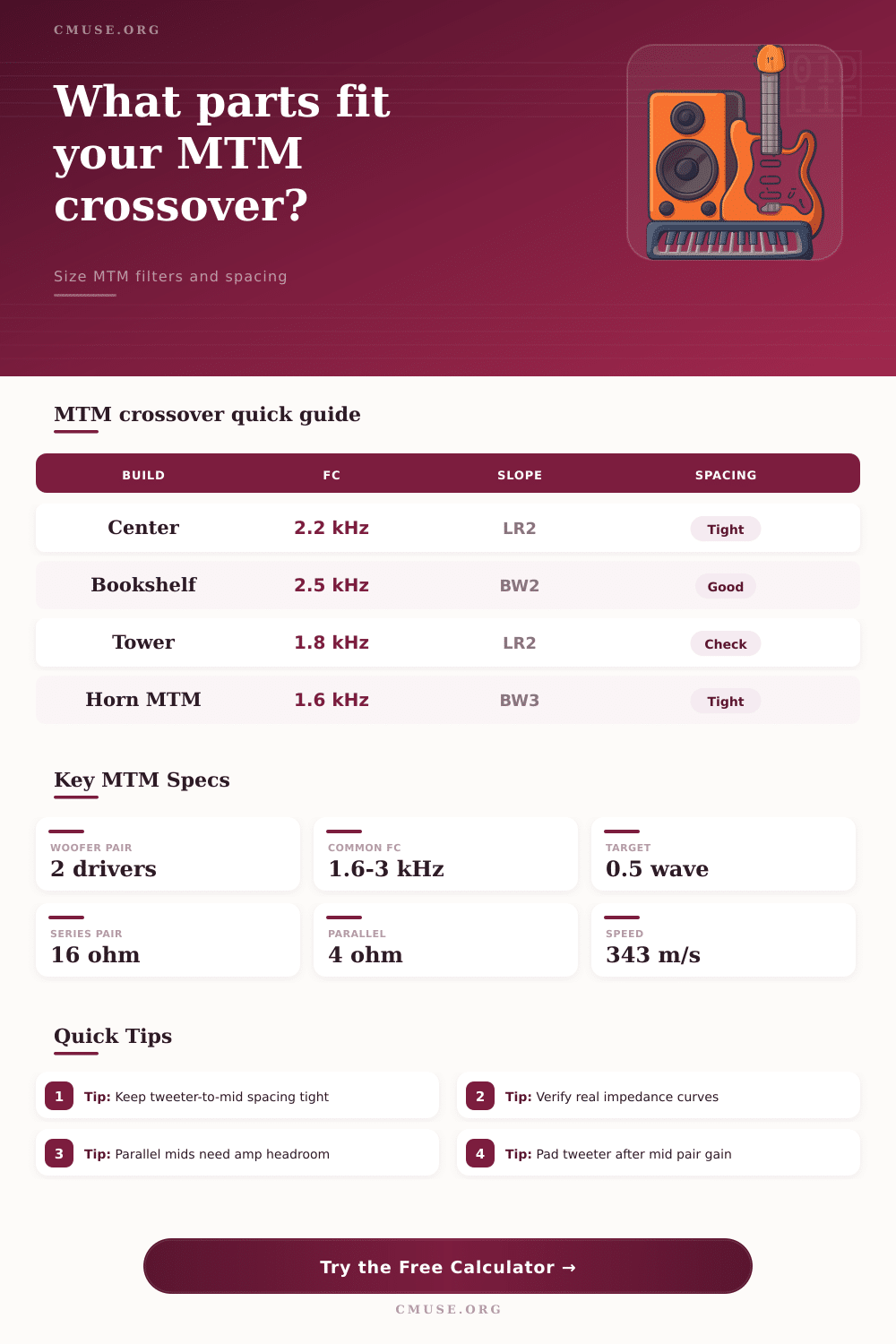
If the distance between the tweeter and the two midwoofers is too large, the sound waves will interact in a way that causes a massive dip in the frequency response of the speaker array. To avoid this problem, the distance between each component must be less than half of a wavelength of the crossover frequency of the tweeter. In order to determine the correct distance between each component, it is possible to use a calculator.
The calculator will mathematically determine the wavelength of the sound output of the tweeter and the distance between each component in the array. This will allow the user to ensure that the distance between the tweeter and the two midwoofers is less than half of the wavelength of the crossover frequency of the tweeter. An additional consideration with the distance between each component is the spacing ratio of the array.
The spacing ratio will indicate the distance between each component in relation to the half wave target. If the ratio indicate that the distance between each component is greater than the half-wave target, then the user must move the drivers closer together or the user must lower the crossover frequency of the tweeter. An issue with using two midwoofers in an array is that the speaker sensitivity will be increased.
With two midwoofers, there will be more output from that range of frequencies compared to if there was only a single midwoofer. As a result, the tweeter will often produce the quietest output from the speaker array. In order to address this issue, the user will need to padding the tweeter with an L-pad.
An L-pad will use resistor to even out the output of each component so that the tweeter is not producing the quietest component of the array. In addition to deciding on the distance between each component of the array, the decision of how the two midwoofers are wired together will impact the array. If the two midwoofers are wired in parallel, the impedance of the speakers will drop, which can make the amplifier work more harder to power the speakers.
However, the advantage of using a parallel configuration is that the crossover components will be smaller. If the two midwoofers are wired in series, the impedance of the speakers will increase, which is safer for the amplifier. However, the disadvantage is that the crossover components will be much larger.
The choice between these two configurations will depend upon the capability of the amplifier that you use with the array. Another issue to consider when building an MTM array is the issue of baffle step compensation. Because the baffle of the speaker array is narrow, there will be a roll-off of the low-mid frequency range of the speakers.
In order to counteract this, the crossover can be altered to include baffle step compensation. This compensation will prevent the speaker from sounding thin. The third last consideration of the MTM array is the type of filter that is used within the array.
First-order filters are the simplest form of filter. However, they allow too much energy to pass through the speakers. Linkwitz-Riley filters are a common choice for array configurations because they create a flat summation of the sound from the different components of the array.
If a Linkwitz-Riley filter is used, the polarity of the tweeter must be flipped. Flipping the polarity of the tweeter is one of the steps that will ensure that the sound is smooth at the crossover point of the tweeter. Finally, it is important to remember that the numbers that the calculator determines are estimates of the parameters that will allow for the best performance of the MTM array.
The calculations of the components of the array are based off the assumption that each speaker behave as a perfect resistor. In reality, speakers have internal resistance. Instead of using the numbers that are calculated to select components for the array, you should of build a prototype of the array.
Finally, after building the array and prototype, use that speaker to perform final tuning of the array parameters. With these considerations of each aspect of the MTM array, the array will produce focused and powerfull sound from the speakers.