MS Decoder Calculator
Decode mid-side audio into left/right estimates, width, mono fold-down, balance, and headroom risk.
🎧Mid-Side Presets
🎛Decoder Inputs
Decoded Stereo Result
📊Current Decode Formula Grid
📐Mid-Side Reference Tables
| Decode Convention | Left Output | Right Output | Normalization | Best Use |
|---|---|---|---|---|
| Standard matrix | M + S | M - S | 0 dB | DAW aux routing, simple decoder plugins |
| Equal-power matrix | (M + S) × 0.7071 | (M - S) × 0.7071 | -3.01 dB | Safer stereo reconstruction with less peak build-up |
| Matrix print preserve | (M + S) × 0.5 | (M - S) × 0.5 | -6.02 dB | Round-trip stems that must preserve encode gain |
| Side muted | M | M | 0 dB | Mono compatibility and center-only reference |
| Width Amount | Side Gain | Typical Result | Mono Effect | Headroom Note |
|---|---|---|---|---|
| 0% | Muted side | Dual-mono center | No side content remains | Lowest decode peak risk |
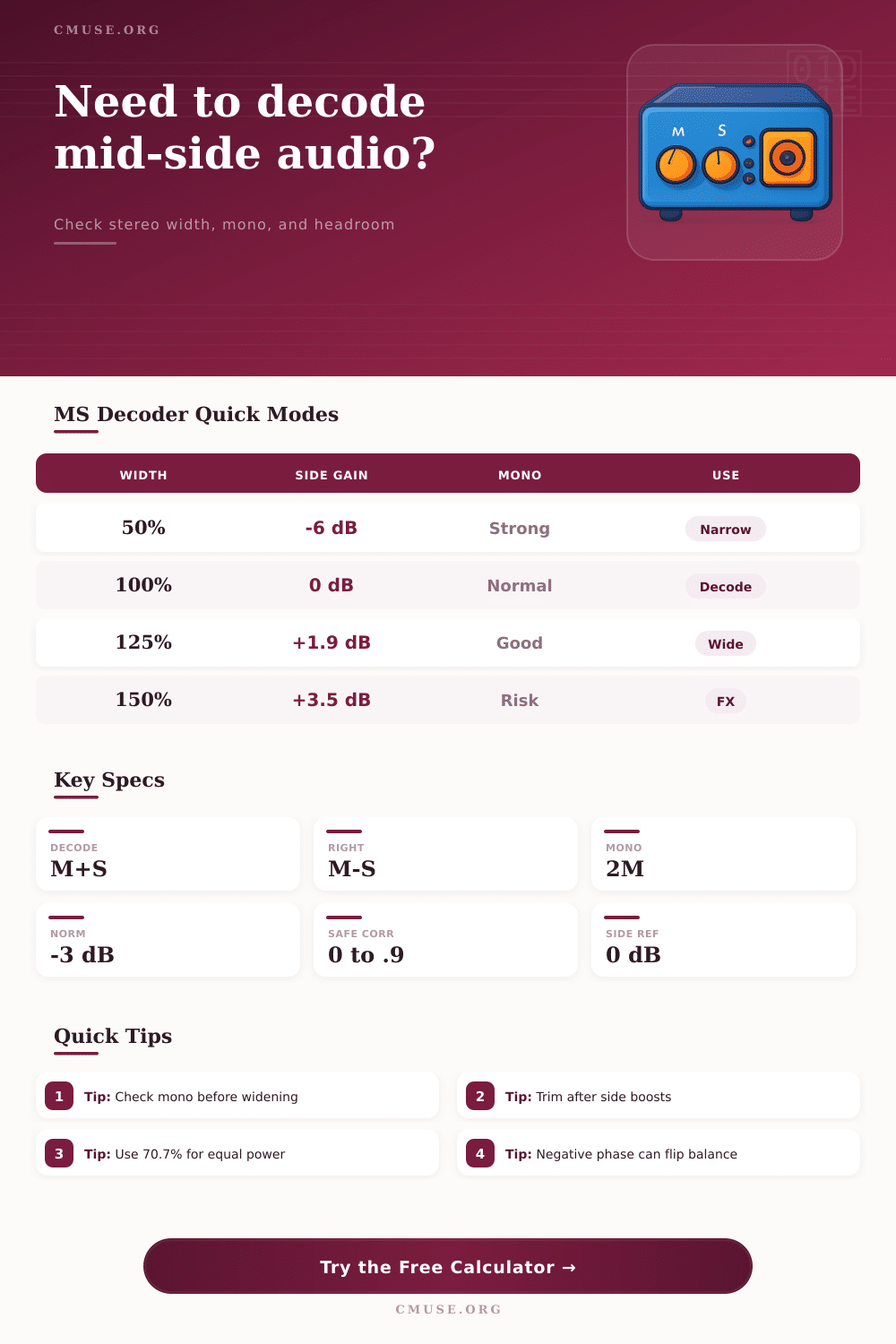
| 50% | -6.02 dB | Narrow stereo image | Very stable fold-down | Usually safe on buses |
| 100% | 0 dB | Original MS width | Side cancels in mono | Check peaks after decode |
| 125% | +1.94 dB | Enhanced width | More mono loss possible | Trim 1 to 3 dB when needed |
| 150% | +3.52 dB | Special-effect spread | Center can feel recessed | High peak and phase risk |
| Scenario | Mid RMS | Side RMS | Width | Suggested Check |
|---|---|---|---|---|
| Lead vocal MS mic | -18 dBFS | -27 dBFS | 75% | Keep lyric centered in mono |
| Acoustic guitar pair | -20 dBFS | -24 dBFS | 115% | Watch left/right imbalance |
| Drum room capture | -16 dBFS | -18 dBFS | 100% | Allow transient peak margin |
| Master bus width | -14 dBFS | -20 dBFS | 110% | Compare before and after trim |
💡Mid-Side Calculation Tips
Mid-side processing involve splitting a stereo signal into two different component. The first component is the mid channel, which contain the information that is centered within the stereo field. The second component is the side channel, which contains the difference between the left and right audio channel.
By using mid-side processing, a person can adjust the width of the stereo image by adjusting only the level of the side channel while leaving the level of the mid channel unchanged. Decoding are the process of turning a mid and side channel signal back into a standard left and right stereo signal. Decoding involves the mathematical addition and subtraction of the mid and side channel signals.
How Mid and Side Audio Works
Adding the mid and side channel signals calculates the left channel signal, and subtracting the side channel signal from the mid channel signal calculates the right channel signal. Because the left channel signal is the sum of the mid and side channel signals, it may have higher peak level within the signal than the original mid channel signal. Additionally, because the right channel signal is the difference between the mid and side channel signals, that signal may have a different peak level then the other channels.
By increasing the level of the side channel signal, the width of the stereo image will increase. However, increasing the side channel signal will also increase the risk of clipping within the left and right channel. The phase relationship of the signal is another critical factor in mid-side processing.
One measurement of the phase relationship is the phase angle. If the phase angle are 90 degrees, the mid and side signal are uncorrelated, and the resulting left and right stereo channel will be balanced. If the phase angle is less than 90 degrees, the signals are correlated to one another, which can make the stereo image lopsided.
Additionally, it is important to be aware of the polarity of the channels. If the polarity is flipped for either the mid or side channel signal, the left and right stereo channels will swap. Width percentage is used to adjust the gain of the side channel signal.
The width percentage are a multiplier for the side channel signal. For example, using a width percentage of 100 percent will allow the side channel signal to remain at its original level. Setting the width percentage to 50 percent will reduce the level of the side signal to produce a narrow stereo image.
Conversely, using a width percentage of 125 percent will increase the level of the side signal to produce a wider stereo image. However, increasing the width percentage will reduce the headroom within the left and right channel. Headroom is the difference between the peak level of the signal and the maximum level that the audio system plays.
There are different method for decoding a mid and side channel signal. One method is standard decoding, which does not reduce the volume of the signal. The second method is equal-power decoding, which applies approximately 3 dB of attenuation to the signal to reduce the summation peak that can occur during standard decoding.
The third method is matrix mode, which halves the signal. Matrix mode is often used to ensure that the level of the original sound stem are preserved. In all instances, though, an output trim should of be use after decoding to adjust for the changes to the level of the signal.
Because different audio applications may require different setting for the mid and side channel signal, there is some flexibility in how the signal is processed. For example, acoustic guitar signal often require a width of 115 percent. Additionally, the drum room microphones may require the side channel signal to be nearly as loud as the mid channel signal to create a wide sound from the stereo speaker.
However, the headroom must be increased in the drum room to handle the high peak level created by the musical instrument. Additionally, vinyl records require the side channel signal to be 8 dB lower than the mid channel signal to avoid damaging the record players needle. Finally, for podcasts, the side channel signal is often removed entirely since the podcasts are played in mono.
Another essential function of any audio mixing application is to ensure that the signals have appropriate mono compatibility. Mono compatibility is the quality of the signal when the left and right channels are combined into a single mono channel. If the mid and side channel signals are highly correlated, the side signal will not cancel out when the signal is converted to a mono signal.
By monitoring the correlation meter, a sound engineer can determine the relationship between the different audio channels. The correlation should be below 0.9 to avoid phase issue. Additionally, if the engineer increases the width of the signal without reviewing the phase relationship and headroom of each signal, there is a potential for the center of the audio signal to sound hollow or for the left and right channels to clip.
Its important to recieve teh right results with a moddern setup.