Modal Spacing Calculator
Estimate axial room modes, modal gaps, Schroeder frequency, and low-frequency spacing risk for control rooms, booths, and studio spaces.
🎵 Real Room Presets
📏 Room Mode Inputs
📊 Modal Spec Grid
📝 Spacing Risk Reference
| Spacing Metric | Good Target | Caution Range | High Risk Pattern |
|---|---|---|---|
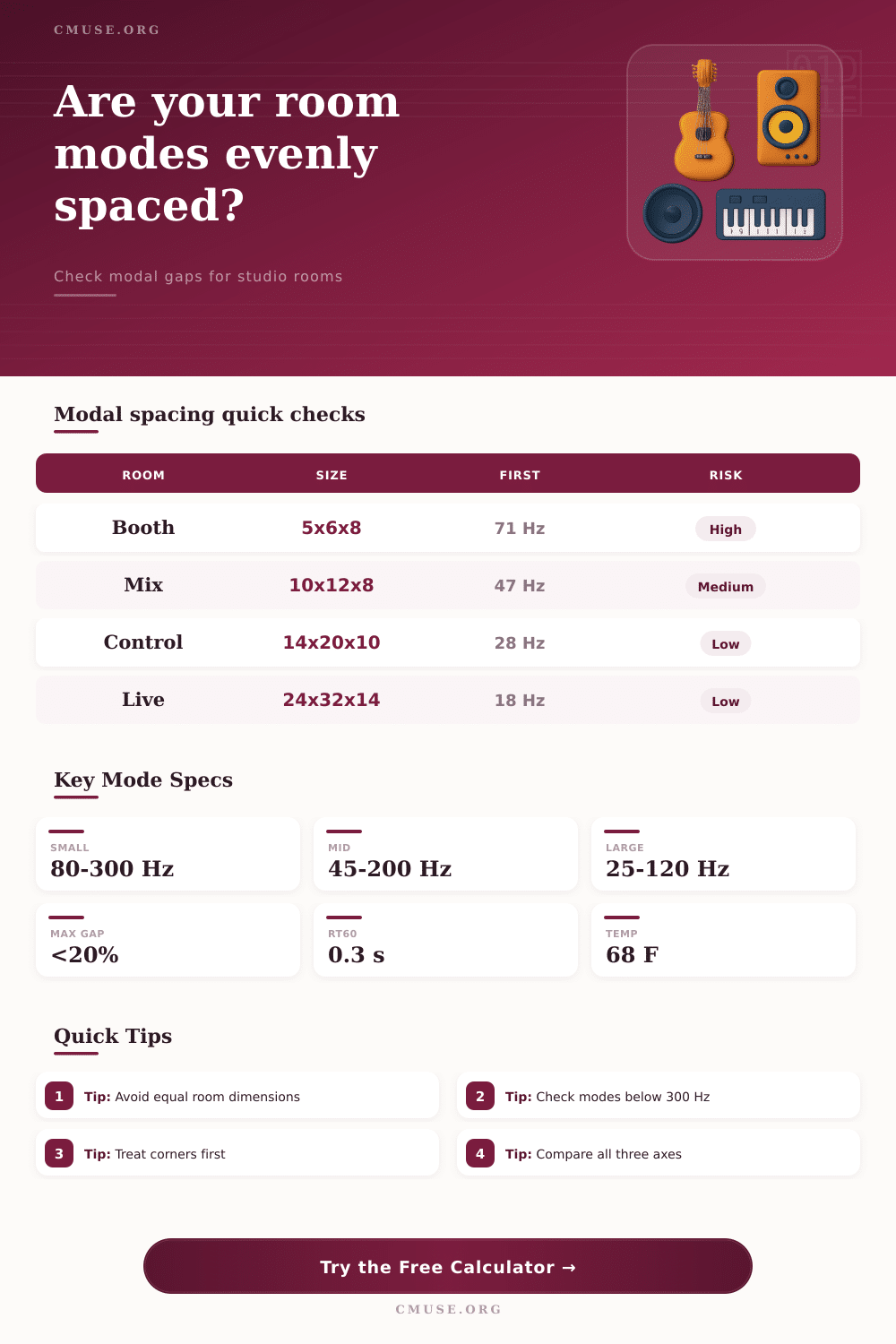
| Worst adjacent gap | Under 15% | 15% to 25% | Over 25% between modes |
| Repeated axial modes | No exact overlaps | One close overlap | Cube or near-square footprint |
| Lowest mode | Below 45 Hz in larger rooms | 45 to 70 Hz | Above 70 Hz for mix work |
| Modal density | Over 0.14 modes per Hz | 0.08 to 0.14 | Below 0.08 modes per Hz |
🎚 Common Room Comparison
| Room Type | Typical Size | First Axial Mode | Modal Character |
|---|---|---|---|
| Vocal booth | 5×6×8 ft | About 71 Hz | Sparse and clustered; treatment matters most below 250 Hz. |
| Bedroom mix room | 10×12×8 ft | About 47 Hz | Usable if width and height modes avoid hard overlaps. |
| Project studio | 11×16×9 ft | About 35 Hz | Better spread with enough volume for smoother bass decay. |
| Control room | 14×20×10 ft | About 28 Hz | Denser low modes and fewer audible spacing holes. |
📐 Ratio And Spec Grid
| Ratio Family | Normalized Dimensions | Spacing Behavior | Use Case |
|---|---|---|---|
| Bolt area style | 1 : 1.4 : 1.9 range | Usually even axial distribution | Purpose-built rooms |
| Sepmeyer A | 1 : 1.14 : 1.39 | Compact but balanced | Small control rooms |
| Sepmeyer B | 1 : 1.28 : 1.54 | Good practical spread | Project studios |
| Square footprint | 1 : 1 : 1.2 | Overlaps length and width modes | Avoid when possible |
🌡 Temperature And Speed Reference
| Air Temperature | Speed of Sound | Mode Shift | Note |
|---|---|---|---|
| 50°F / 10°C | 1106 ft/s | Lower modes | Cool rehearsal spaces read slightly lower. |
| 68°F / 20°C | 1125 ft/s | Reference | Common room-acoustics baseline. |
| 77°F / 25°C | 1135 ft/s | Slightly higher | Warm rooms move modes upward. |
| 86°F / 30°C | 1145 ft/s | Higher modes | Useful for hot live-room checks. |
Room modes are standing wave that exist within rooms due to reflections between the parallel surfaces of the room. The standing waves cause certain frequencies within the room to sound louder or quiet than others. Thus, a listener may hear a sound mix differently depending on where the listener is sitting within the room.
In general, the goal is to ensure that the modes are even enough in their spacing within the frequency spectrum to avoid having any gap within the frequency response of the room. The dimensions of the room will determine the spacing of the modes that exists within that room. The first axial mode can be calculated as the speed of sound divided by twice the length of the dimension of the room.
Room Modes and How to Fix Them
Each following mode will have a wavelength that is a multiple of that calculated first axial mode. Modes will tend to land near each other within dimensions of room that is similar in size. Furthermore, the longer the dimensions of the room, the lower the frequency of the first mode that exists within the room.
Additionally, the longer the dimensions of the room, the more mode that exist within the room prior to the midrange frequency. The higher the density of modes that exist within the room, the more even the frequency response will be. The temperature of the room will affect the placement of the modes within the soundfield.
When the temperature is cooler within the room, the mode frequencies will shift downward in the frequency spectrum. Additionally, higher temperatures will shift the modes to higher frequencies within the spectrum. While it is possible to ignore the temperature of a room, shifts in temperature will shift the lowest modes in the room by several hertz.
These lowest modes tend to be the most problematic in terms of correcting their frequency issue. An engineer can use a calculator to calculate the frequencies of each mode in the room. Furthermore, using such a calculator allow for the engineer to remove the guesswork involved in calculating these frequencies.
Within the room, there is a frequency known as the Schroeder frequency. Below the Schroeder frequency are the modes that exist within the room. Above the Schroeder frequency are frequencies referred to as statistical reverberation.
The Schroeder frequency allows one to determine the necessary treatment in regard to the bass trap in the room. Rooms with short decay time will have higher Schroeder frequencies. Thus, a higher Schroeder frequency will require more treatment for the modes within the room.
The frequency of the modes within the room can be judged by observing the gaps between the modes. The largest gap in percentage between each mode below a target frequency will indicate the risk of each mode. If the gap in any direction is greater than 20%, it will cause a noticeable hole in the frequency response.
Furthermore, repeated modes indicate that the frequencies from two different dimensions of the room is similar in frequency. Thus, it will cause problems for the room. One can reference tables to determine how even the modes should be within the frequency spectrum.
These tables dont require an engineer to memorize the exact number of modes that each dimension should have. Using equal dimensions for the dimensions of a room is a mistake. If each dimension of a room is of equal size, the modes will land in the same frequency on each axis of the room.
Furthermore, any room that are nearly cubes will experience the same problems as those that are true cubes. An exception to this problem involves using certain ratio for the dimensions of a room. While there are several such ratios, none of them will eliminate the formation of modes within the room.
However, they will ensure that the gaps between modes are not extreme in their difference in frequency. The treatment of modes within the room should follow the calculated number of each mode. For instance, if the lowest mode is 70 hz, attempting to treat 70 hz and below with broadband absorption will waste that treatment for those frequency.
Instead, one should use corner bass trap or membrane absorbers. Membrane absorbers should be tuned to the same frequencies as the first few mode within the room. A similar rule applies to the positioning of the speakers within the room.
By moving the listening ear to a different position within the room, it is possible to shift the listener from a loud spot to a quiet spot. Real rooms are not ideal in their construction. Real rooms will have doors, windows, and sloped ceiling.
Additionally, the standing in a room will also impact its response due to the addition of absorption of sound by those individual. Thus, a calculator will provide an idea of the modes that will be present in the room, but sound measurement will provide the final decision on treatment for the room. While it is impossible to provide an even frequency response to sound at every seat within a room, one goal of acoustic treatment is to ensure that the frequency response does not interfere with the level and EQ setting for the room.
Ensuring that the modes are even in their distribution within the first 200 Hz will remove the most obvious obstacle in regard to an even frequency response to sound. Afterwards, the budget for acoustic treatment can be focused on the frequencies that need treatment the most.