Mixing Calculator
Estimate bus gain, headroom, and limiter margin for stacked stems and dense arrangements.
🎧 Inputs
📋 Presets
📈 Reference Grid
Podcast
Pop
Rock
EDM
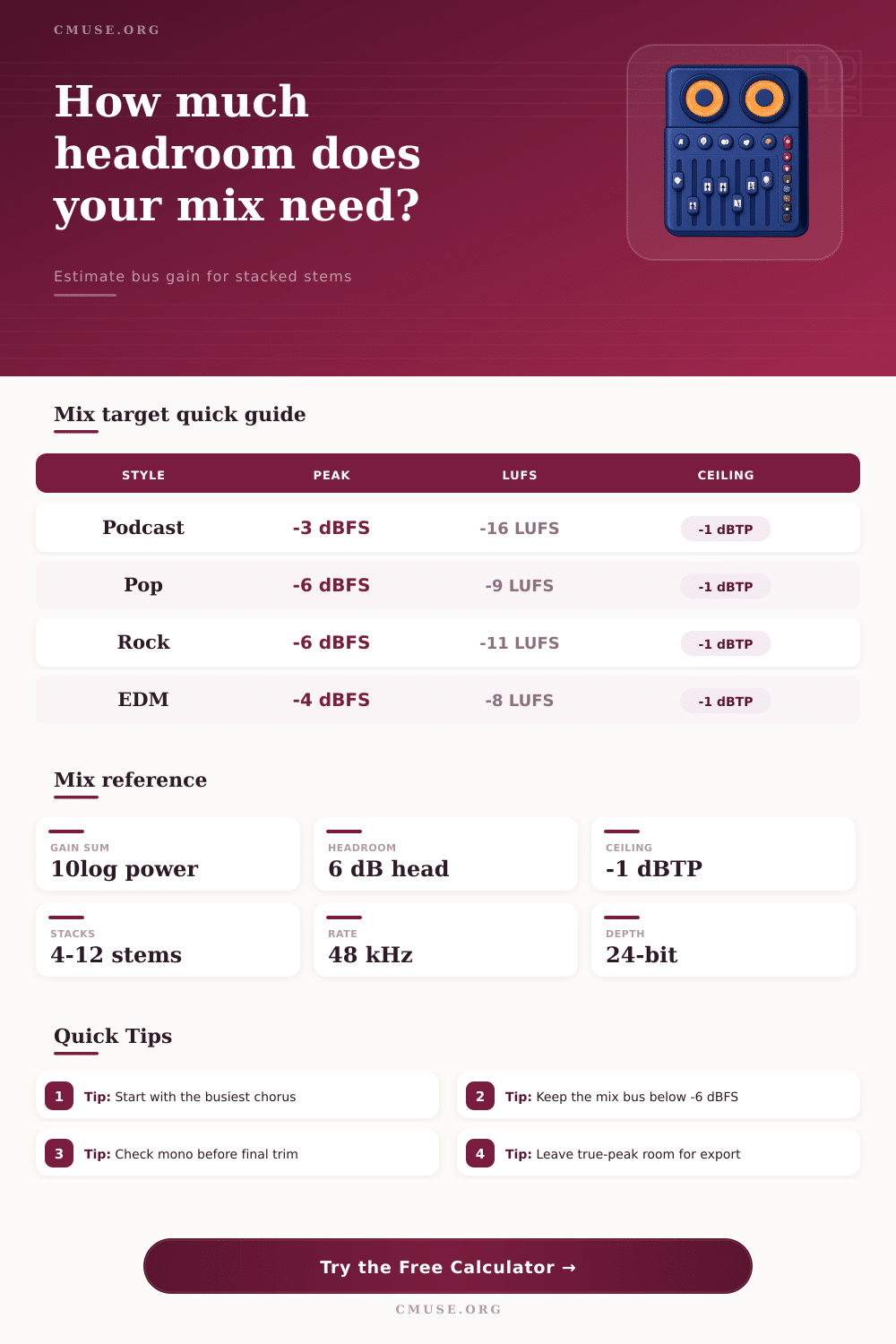
📊 Target Table
| Style | Peak | LUFS | Ceiling |
|---|---|---|---|
| Podcast | -3 dBFS | -16 LUFS | -1 dBTP |
| Pop | -6 dBFS | -9 LUFS | -1 dBTP |
| Rock | -6 dBFS | -11 LUFS | -1 dBTP |
| EDM | -4 dBFS | -8 LUFS | -1 dBTP |
📝 Comparison Table
| Mix type | Overlap | Headroom | Notes |
|---|---|---|---|
| Sparse dialogue | Low | 9 dB | Gentle bus chain |
| Pop stack | Medium | 6 dB | Watch chorus density |
| EDM build | High | 4 dB | Limiter sees more peaks |
| Orchestral cue | Low | 12 dB | Preserve transients |
📅 Common Sessions
| Project | Tracks | Peak | Bus trim |
|---|---|---|---|
| Podcast edit | 4-8 | -12 dBFS | -2 to -4 dB |
| Pop chorus | 24-48 | -12 dBFS | -4 to -8 dB |
| Rock session | 16-32 | -11 dBFS | -3 to -6 dB |
| Film cue | 40-80 | -18 dBFS | -1 to -3 dB |
💡 Tips
Audio mixing is the process of combining several tracks in one. It is made up of altering levels, panning and adding effects for balance and cohesion in the sound The mixing helps to layer and process several tracks to create a well balanced song. Elements like volume, equalization and reverb belong to it.
After the piece is written, arranged and recorded, comes the mixing. When voices, instruments and sounds are recorded, you must mix them. The mix engineer listens carefully to the song and ties the separate tracks, as vocals, synths and drums, so that everything sounds as well as possible.
How to Mix a Song
Sound mixing is a mix of art and technique, with the main target to form a new sonic reality. Technical parts alone do not suffice for a good mix. It must also show the message of the song and strengthen its emotions.
The mixing is the art itself, while the mastering later is the icing on top, that makes the audio more pleasant for the publc.
Take for instance that you record a friend with a guitar. He plays a home-made song finger-picking. During the recording he hits the strings in various speeds, which results in a recording with too loud parts and other quiet ones.
Here mixing steps in for balance.
Using headphones is a good approach. A good pair of studio headphones transmit the nuances of volume, dynamics and other audio attributes directly to the ears. That helps you more easily note subtle differences in the programs.
Recording tracks in around -18 until -12 decibels give space. Pushing almost until 0 dB in digital format will not make the sound warmer. Automation of volume and balance in a DAW are key for a good mix.
Reference tracks, playing mixes on various speakers and insight of the effect of programs in the chain help all.
Reverb puts the track backwards in the mix. It is the sound of the room. That is the difference between playing in a bathroom, bedroom or in a field.
Everything recorded by means of a microphone gets the reverb of that space.
Cut excessive bass is a good start. High pass in 40 hertz. A middle sound like a P-bass always takes a good place in a mix.
Something under 50 hertz for bass and kick or 100-120 hertz for guitar does not add value and only wastes power of the speakers. Gain staging in mixing is to keep gain consistent. Set the levels between -18 and 0, best near -18 for space.
Later you can start the mixingpractice.