Missing Fundamental Calculator
Estimate the pitch your ear may infer when the true fundamental is absent, then inspect harmonic spacing, audible partial count, pitch class, and confidence.
Preset use: Load a real musical or playback situation where the lowest tone is reduced, filtered, or absent, then adjust the harmonic set and masking conditions.
Calculation Breakdown
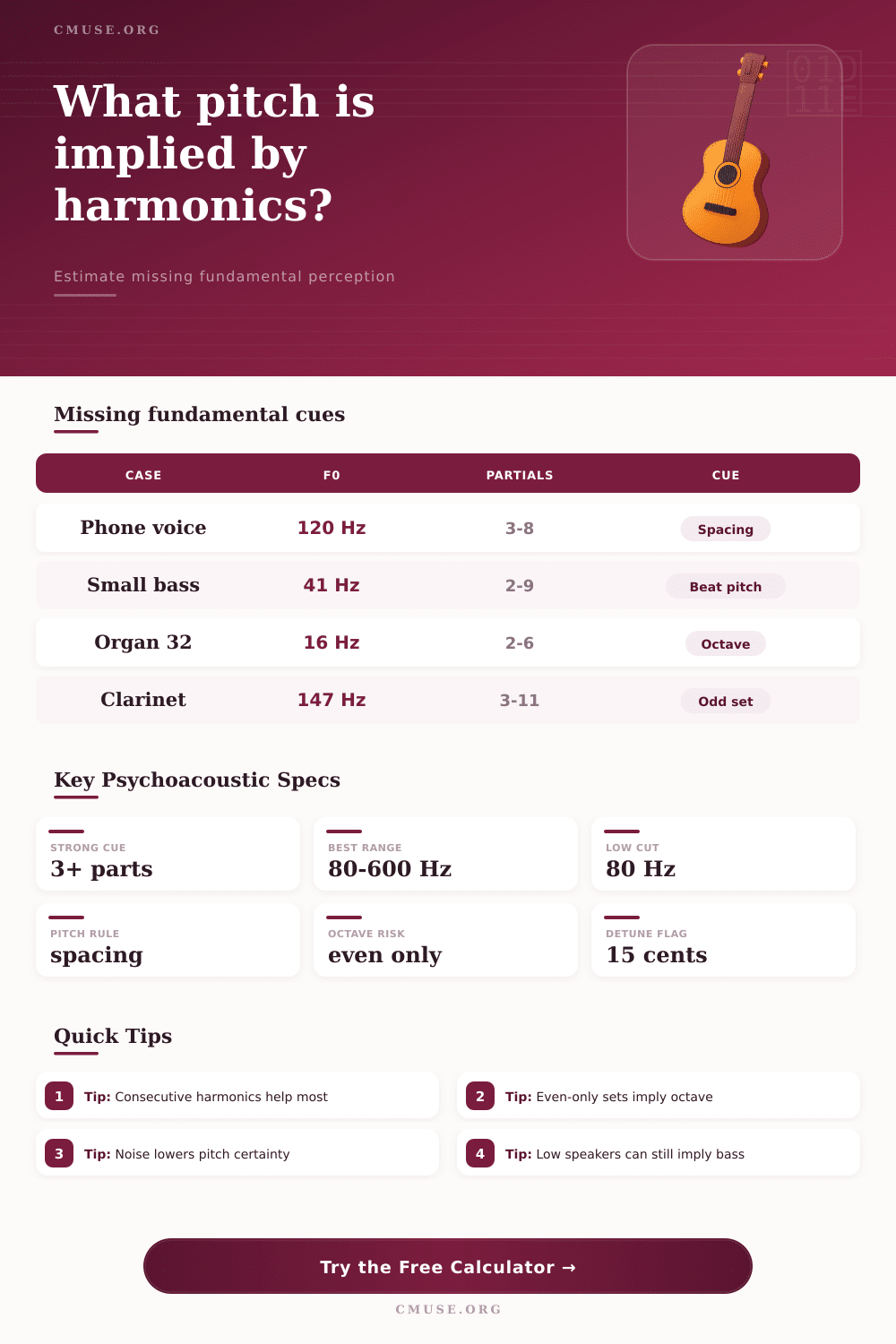
| Harmonic Set | Likely Perceived Pitch | Why It Works | Common Example |
|---|---|---|---|
| 2nd through 6th | Original fundamental | Adjacent spacing still equals the absent root frequency | Small speaker reproducing bass overtones |
| 3rd through 8th | Original fundamental | Several consecutive upper partials define a regular period | Telephone voice and filtered vocal formants |
| Odd harmonics only | Root or hollow timbre | Spacing is two fundamentals, but the auditory system can infer the full period | Clarinet-like and square-wave tones |
| Even harmonics only | Often octave above | All components align with a pitch class one octave higher | Octave-doubled bass or filtered organ tone |
| Octave-spaced components | Ambiguous octave | Wide spacing gives pitch class but weak register information | Sparse synth layers and organ mixtures |
| Source | Absent Root | Present Harmonics | Typical Result |
|---|---|---|---|
| Bass guitar on phone speaker | 41 Hz E1 | 2nd to 9th above 82 Hz | Listener still hears low E identity |
| Pipe organ 32 foot stop | 16 Hz C0 | Upper pipe components above the room cutoff | Deep pitch is implied more than directly heard |
| Male speech fundamental | 100 to 160 Hz | Higher voice harmonics through a narrow channel | Voice pitch remains recognizable |
| Cello low C through small monitors | 65.4 Hz C2 | 2nd through 7th harmonic dominate | Pitch center remains stable if overtones are clear |
| Barbershop tuned chord | Virtual low root | Aligned upper chord partials | Extra bass-like resultant tone may appear |
| Pattern | Pitch Strength | Octave Risk | Best Use In Calculator |
|---|---|---|---|
| Consecutive harmonics | Strong with 3 or more audible partials | Low | Most acoustic instruments, voice, and filtered bass |
| Odd harmonics only | Medium to strong when many partials remain | Medium | Clarinet, square waves, hollow synth tones |
| Even harmonics only | Can favor the octave above | High | Testing octave confusion in filtered sounds |
| Octave-spaced components | Weak register, clear pitch class | High | Organ mixtures, layered synths, sparse spectral tests |
| Condition | Calculator Signal | Listening Meaning | Practical Interpretation |
|---|---|---|---|
| Strong | 4 or more audible regular partials | Pitch should be easy to name | Missing root is probably perceived clearly |
| Moderate | 3 audible partials or mild detune | Pitch exists but timbre affects certainty | Check with another octave or speaker |
| Weak | 2 audible partials, heavy masking, or high stretch | Listener may hear interval color instead of root | Add lower harmonic support if needed |
| Ambiguous octave | Even-only or octave-spaced pattern | Pitch class can survive while register shifts | Compare root and octave interpretations |
The missing fundamental is a phenomenon that often occurs when someone play a low note with a small speaker. Speakers are typicaly not strong enough to play the fundamental frequency of the note, yet the ear is still able to identify that note being played. The ear fills in the missing fundamental with information from the overtones that is being played.
This phenomenon can be seen in a variety of different situations, such as telephones, pipe organs, small speakers, and even barbershop chord. Thus, the ear’s ability to fill in the gaps of the missing fundamental allows sounds to seem deeply even when the lowest frequencies of that sound never leave the speaker. The calculator included above allow for testing of the phenomenon of the missing fundamental.
Why we hear low notes with small speakers
The user can enter the root of the chord that is to be played into the calculator. Additionally, the user can describe each of the harmonics that are to be present in the calculator. The way in which each of the harmonics are spaced in relation to one another and how much of the low frequencies are to be filtered by the playback system can be described by the user.
Based off these descriptions, the calculator can estimate both the pitch that the ear will recognize from those harmonics and the confidence that the ear will have in relation to that recognized pitch. Thus, the user can alter the lowest present harmonic to test in what ways the confidence in the recognized pitch will increase or decrease. Additionally, the calculator can alter the total number of components within the chord.
Lastly, the low cutoff frequency can be altered in the calculator to test in what ways the ear may lose access to some of its higher partial. Within the calculator, a number of different factors that relate to the phenomenon of the missing fundamental is included. For instance, if only consecutive harmonics are present, the ear is able to recognize the pitch of the chord.
However, if only even harmonics are present, the ear tends to shift the pitch of the chord up an octave. If only odd harmonics are present, such as with a clarinet tone, the ear is still able to recognize the root of the chord, but with a different timbre than the original chord. Additionally, the ear may experience a stretch in relation to each of the harmonics, most likely as a result of stiff strings or mistuned oscillators.
In this case, the ear can become less certain of the true pitch of the chord. Other factors that the calculator accounts for include the masking of any upper partials by other noises in the environment, and the rolloff of each harmonic in terms of it level in the sound. Any partial that has a level that is below the cutoff or masking level will be discarded by the calculator.
Following the discarding of any low-level partials, the calculator will recalculate the spacing between the remaining partials. This process by the calculator mimics what happens to the voices on a telephone call, or to bass notes played through small speakers. Listening to sounds in the real world is rarely as ideal as suggested by the calculator.
For instance, room modes may boost the bass frequencies that are played in a listening environment or cancel them. Headphones may remove the listener from the physical environment of the sound yet introduce another set of resonances into the sound. Distorted guitars may contain additional harmonics beyond those that were contained within the original string vibrations.
Each of these factors can potentially change from sound to sound, depending upon the physical location of the listener of the sound. Thus, the calculator does not present a final answer to the phenomenon of the missing fundamental yet does provide a starting point for understanding the phenomenon. For example, each of the same chords can be tested with different low cutoff frequencies to determine the impact that speaker size may have upon the phenomenon.
Depending upon the situation in which a listener is making a decision regarding a sound, such as decisions about microphone placement or mixing, the calculator can be helpful. For example, if only two of the harmonics of a chord are audible, it is likely that any decision to filter any of that low-end energy of the sound will have a negative impact upon the listener’s understanding of the pitch of that sound. Thus, the addition of a low shelf filter or the movement of the sound source to a boundary may help to create one more audible harmonic of that chord.
Bringing one more harmonic above the threshold will help to provide the listener with a more certain understanding of the pitch of the sound. Thus, by testing the strength of the missing fundamental with the calculator, decisions can be made regarding the removal of low end energy. Such a decision could of only be made when the calculator shows high confidence in the ear’s recognition of the pitch of the sound.
The phenomenon of the missing fundamental can help to explain one of the main reasons that organ builders uses stops for 16 hertz sounds yet build the pipes for those stops an octave higher. Listeners will not hear the fundamental for those stops, instead the ears can recognize the spacing between the audible stops for that organ pipe. Thus, the calculator helps to explain the spacing between those audible stops and the reliability of that spacing with the introduction of real-world filtering.
Thus, an understanding of the phenomenon of the missing fundamental allows the listener to gain an understanding of the characteristics of the sound that is being created by the playback system. The phenomenon is not a trick played on the ear by the auditory system; instead, it is the auditory system that is recognizing the most probable period of the sound from each of the audible partials of that sound.