MIDI Note Number Calculator
Convert note names, octave numbers, frequencies, cents, tuning reference, transposition, and pitch bend into MIDI-ready pitch values.
🎹MIDI pitch presets
🎚Pitch inputs
📊MIDI pitch spec grid
🎼Reference tables
| Pitch | MIDI number | Frequency at 440 Hz | Common use |
|---|---|---|---|
| C-1 | 0 | 8.18 Hz | Lowest MIDI note |
| C1 | 24 | 32.70 Hz | Kick and sub trigger zone |
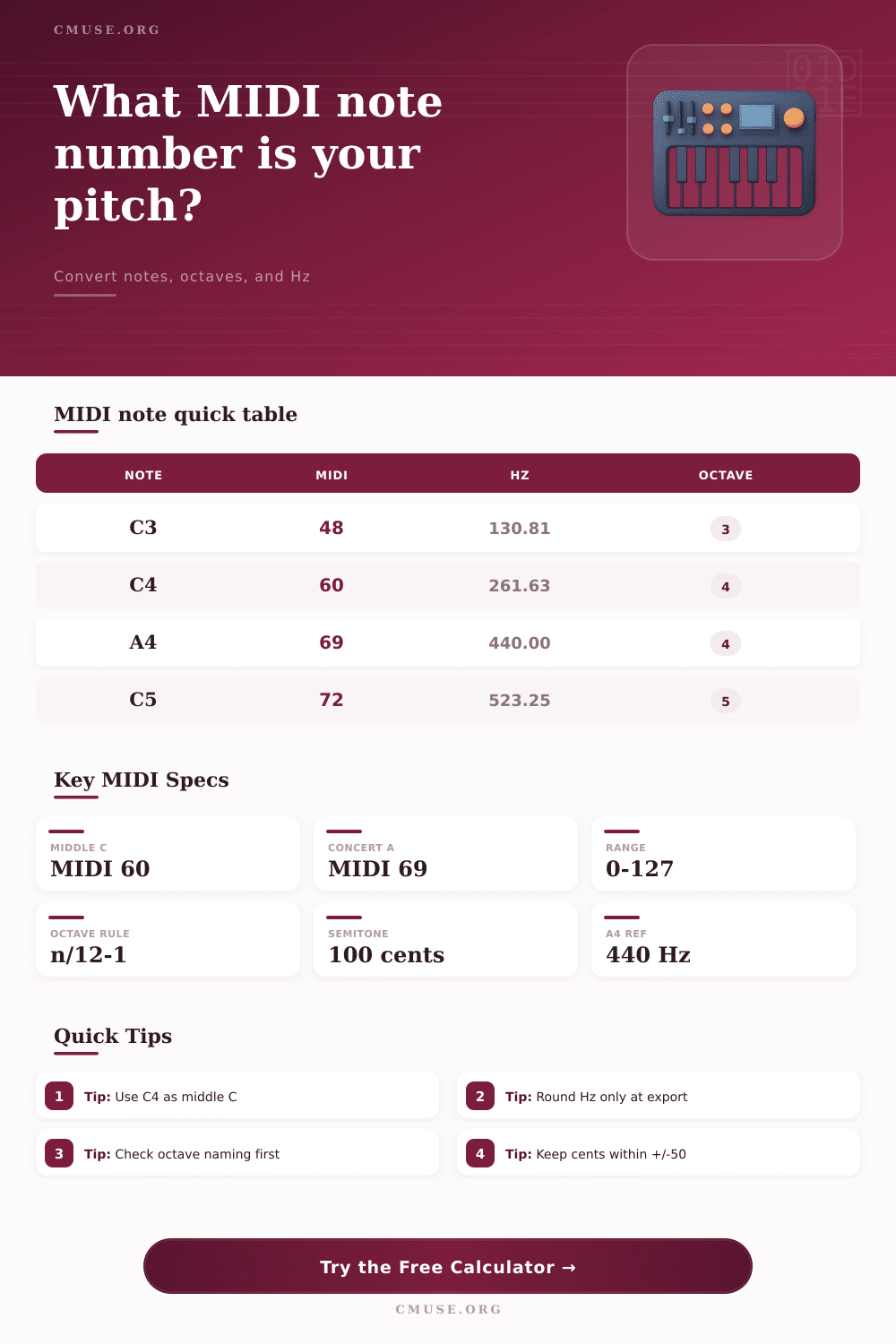
| C4 | 60 | 261.63 Hz | Middle C in scientific pitch |
| A4 | 69 | 440.00 Hz | Concert tuning reference |
| C8 | 108 | 4186.01 Hz | Very high piano C |
| Formula | Use it for | Expression | Example |
|---|---|---|---|
| Note to MIDI | Name and octave | 12 x (octave + 1) + pitch class | C4 = 60 |
| MIDI to Hz | Synth frequency | A4 x 2^((n - 69) / 12) | 69 = 440 Hz |
| Hz to MIDI | Audio pitch detect | 69 + 12 x log2(Hz / A4) | 261.63 Hz = 60 |
| Cents error | Tuning offset | 1200 x log2(Hz / target Hz) | +10 cents |
| Pitch bend | MPE or MIDI bend | 8192 + cents / range cents x 8192 | +50 cents |
| Octave system | Middle C label | Octave offset | Where seen |
|---|---|---|---|
| Scientific pitch | C4 | 0 | Notation and general reference |
| Yamaha style | C3 | -1 | Some keyboards and modules |
| Ableton style | C3 | -1 | Many DAW MIDI editors |
| Legacy style | C5 | +1 | Some older sequencers |
| Scenario | Pitch | MIDI | Frequency |
|---|---|---|---|
| Kick drum trigger | C1 | 24 | 32.70 Hz |
| Bass guitar low E | E1 | 28 | 41.20 Hz |
| Guitar low E | E2 | 40 | 82.41 Hz |
| Vocal tuning guide | A3 | 57 | 220.00 Hz |
| Synth lead center | C6 | 84 | 1046.50 Hz |
MIDI note numbers is the numbers that represents each musical pitch. Furthermore, MIDI note number are used in almost every element of digital music creation. People typicaly only become aware of the MIDI note numbers when they encounter a problem in the digital music creation process.
For example, suppose a person want to move a bass line from one digital audio workstation to another digital audio workstation. In that situation, the person may find that the line dont sound the same in the second program as it did in the first. However, since the MIDI note numbers have not changed, it is likely that the issue is due to the difference in the system that read those MIDI note numbers.
How to Use a MIDI Note Number Calculator
As such, creating a way to reliably convert musical elements into MIDI note numbers is essential for digital music production. The MIDI system create a logic system that assigns every musical pitch an integer value. These integers range from 0 to 127, and one of these integer represents every pitch within the MIDI system.
Furthermore, each integer represent a semitone within that musical scale. Twelve of these integers represent one musical octave. The MIDI system utilizes a standard value of the note A located above middle C being MIDI note number 69.
With this standard value, the MIDI system can perform mathematical operation to find other notes. For instance, if a person subtracts 12 from 69, the result will be the MIDI note number for the A note that is below middle C. Similarly, if a person adds 12 to 69, the result will be the MIDI note number for an A note that is above middle C. A MIDI note number calculator can automate these computations for a person. Additionally, the MIDI note number calculator can shift the results to account for different tuning system.
People often get confuse by the concept of octaves in music. This type of confusion is not related to the MIDI note numbers. Each music software application has a different system regarding which octaves are represented by which numbers.
For instance, one program may show that middle C is C4 while another program may label that same key as C3. Due to these differing octave labels, each key will have a different name in each software program. Furthermore, if one octave is used instead of the other, that will shift every musical note by twelve semitones. Therefore, if a person moves a music clip from one music software program to another without changing the octave label of the musical notes, the music clip will jump up a full octave or drop down a full octave.
The MIDI note number calculator allows people to choose a labeling system for the octaves so that they can view the different labels for each key. Another factor in the calculation of MIDI note numbers is the frequency of the notes. Although most instruments will play in the proper frequency for each note, rare instance may occur in which a singer will be sharp or a guitarist will play a flat note.
Additionally, in certain situations, a musician may wish to change the frequency from the standard 440 Hz to 432 Hz. In these instances, a MIDI note number calculator allow a person to enter the desired frequency and cent-offset for the note. The calculator will use this information to calculate the proper MIDI note number.
Additionally, the tool will also provide the pitch-bend information for that calculated MIDI note number. This information is essential for those who use musical hardware that utilize pitch-bend controls. Another concept that relates to the MIDI note number system is the concept of transposition.
Transposition is the action of moving a musical part a certain number of semitones. However, the resulting MIDI note numbers must still fall within the range of 0 to 127. A MIDI note number calculator allows a musician to perform a transposition on a musical part.
The MIDI note number calculator will also ensure that the resulting MIDI note numbers stays within the 0 to 127 range. Additionally, the MIDI note number calculator will also recalculate the frequency so that it matches the newly calculated MIDI note numbers. Finally, reference tables for MIDI note numbers are provided for ease of use.
These tables allow a person to quickly and accurately determine that the note C4 have a MIDI note number of 60. Additionally, these tables also allow for a person to determine that the note C1 has a MIDI note number of 24. These tables are useful in that they allow for a person to not second guess the MIDI note numbers for a given musical note.
Prior to beginning work on any musical project, a person should ensure that the octave labeling convention is selected and understood. If the convention matches that of the destination program for which the music is being created, then most problems with transpositions will be eliminated. After ensuring that the octave labeling convention is set up and understood, the remaining functions of the MIDI note number calculator can be used to fine-tune the music project.
Thus, by following these steps with the MIDI note number calculator, a person can ensure that the musical idea created in one place is maintained in another location, and all of the MIDI note numbers will accurately carry that musical idea from one piece of musical gear to another piece of musical gear without creating any form of distortion.