Mid Side Ratio Calculator
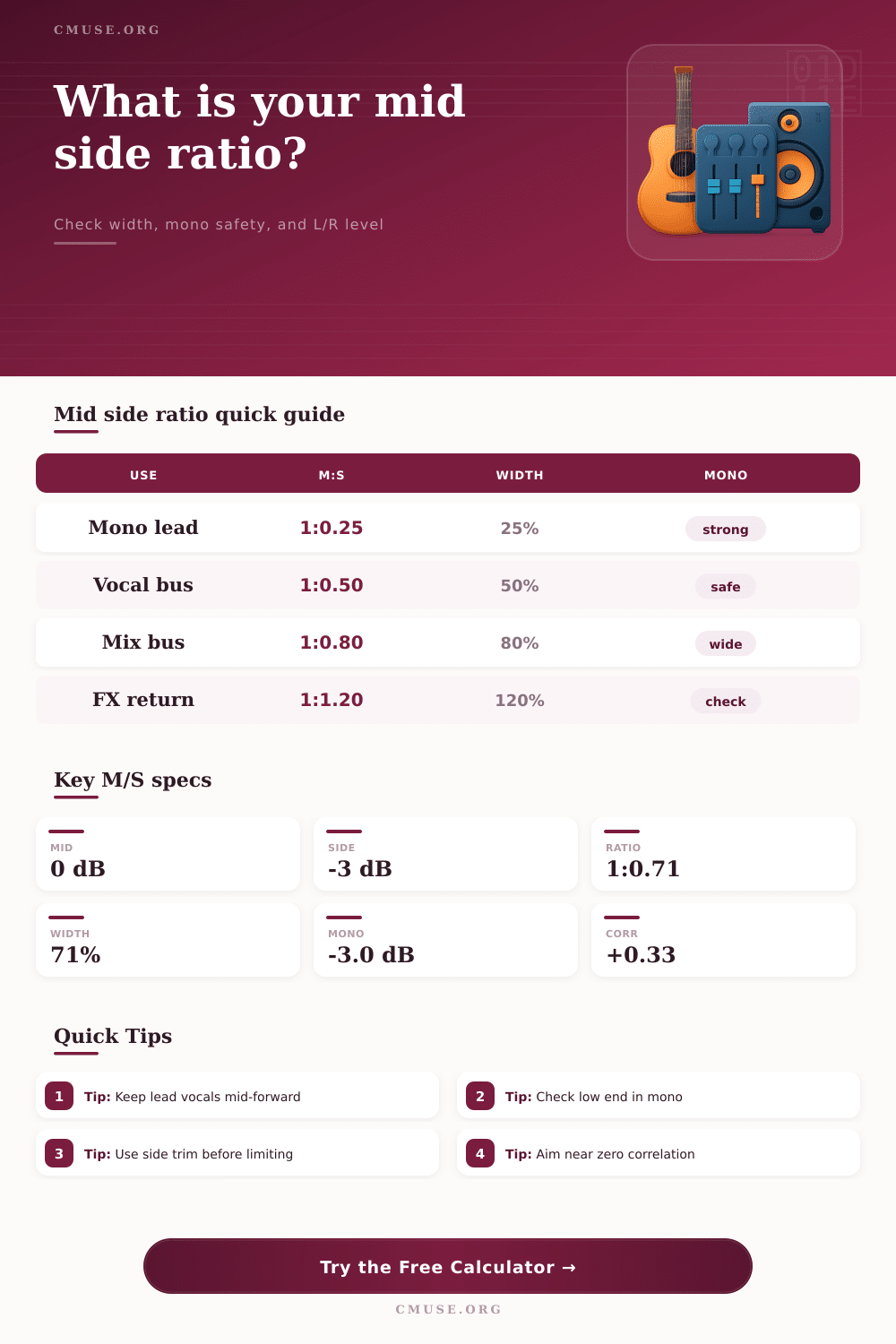
Compare mid and side gain, width percentage, estimated correlation, mono fold-down, and decoded left/right level before you commit a stereo master or bus setting.
| Side vs Mid | Side Gain | Width Index | Typical Use |
|---|---|---|---|
| 1:0.25 | -12.0 dB | 25% | Mono-focused vocal, bass, or dialogue stem |
| 1:0.50 | -6.0 dB | 50% | Safe vocal bus, piano support, or centered mix |
| 1:0.71 | -3.0 dB | 71% | Moderate mix-bus width with strong mono center |
| 1:1.00 | 0.0 dB | 100% | Open stereo pair or wide arrangement bed |
| 1:1.41 | +3.0 dB | 141% | Special effect width; mono check required |
| Source | Useful Range | Correlation Goal | Mono Note |
|---|---|---|---|
| Lead vocal bus | 25%-55% | +0.45 to +0.85 | Keep consonants and lead energy in the mid channel. |
| Full mix bus | 60%-100% | 0.00 to +0.60 | Check chorus width against verse and intro sections. |
| Guitar or keys pair | 80%-130% | -0.10 to +0.45 | Watch cancellation if doubled parts are nearly identical. |
| Drum rooms | 70%-120% | -0.05 to +0.55 | Confirm snare and kick do not hollow out in mono. |
| Low frequency bus | 0%-35% | +0.70 to +1.00 | Keep sub energy centered for translation and cutting. |
| Preset | Mid | Side | Expected Result |
|---|---|---|---|
| Mono Lead Vocal | 0.0 dB | -14.0 dB | Very stable center with light ambience width. |
| Balanced Mix Bus | 0.0 dB | -3.0 dB | Strong center and open edges for modern masters. |
| Wide Keys Pad | -1.0 dB | +1.5 dB | Wide supporting bed that may need mono trim. |
| Vinyl Safe Low End | 0.0 dB | -18.0 dB | Mostly centered low end with minimal lateral energy. |
| Metric | Formula | Meaning | Range Cue |
|---|---|---|---|
| Linear gain | 10^(dB/20) | Converts mid or side dB into amplitude. | 0.25x to 2.00x |
| M/S ratio | Side amp / Mid amp | Shows how much side exists for each mid unit. | 1:0.50 to 1:1.00 |
| Decode | L=M+S, R=M-S | Approximates the left and right channel peaks. | Trim if peak rises |
| Correlation | (M2-S2)/(M2+S2) | Energy estimate where +1 is mono and 0 is wide. | Stay above -0.2 |
Mid side processing allows a person to treat the center signals and the side signal as separate signals. Furthermore, a person can control the ratio of the center signal to the side signal using mid side processing. This ratio are important to control because it will determine how the music sounds through a mono speaker or an phone speaker.
Should the side signal become too loudly relative to the center signal, the music will lose energy when folded into a mono signal. The balance between the center and side signal impact the loudness of the low end in a nightclub. The balance between the center and side signal impact how clear a lead vocal will sound on a laptop speaker system.
Why Mid and Side Balance Is Important
Furthermore, the balance between these two signals will impact the way a streaming service compressor react to the music. A slight change to the side level can change how far away a reverb tail in the music will sound. Finally, a slight change to the side level can impact whether or not doubled guitar part in a song work well together or if they fight with each other.
The calculator will provide the mathematics behind the levels of each signal (mid side levels, width trim, and center bias), the side relative to mid ratio, the estimated correlation between the left and right channels, and the mono fold down value. The mono fold down value will show how much energy are lost in folded music. Furthermore, the estimated correlation value is a critical number for understanding the relationship between the left and right channels.
A correlation that is near one means that the music is essentially mono. A correlation that is near zero means that the side signal contains almost as much energy as the center signal. Correlation values that is negative indicates the phase relationship between the left and right channels.
Different types of musical sources will contain different amounts of side energy. For example, the lead vocal in a song may have seventy percent of its energy within the side channel while still remaining stable. However, the energy of the sub bass in a song should not be seventy percent of the signal within the side channel because the low frequencies needs to have a phase relationship between each speaker in order to sound like bass.
If the side channel has too much energy relative to the center channel for sub bass signals, the sub bass may sound like separate clicks from each speaker rather than bass. The source type selector in the calculator will remind a person of these different suggestions for each type of musical material. Stereo balance offset allow a person to fix problems with a lopsided mix.
By tilting the signal to the mid side matrix to the left or right a person can fix those problems. The calculator will display the calculated level of the left and right channels after applying this balance offset to provide a person with insight as to whether or not the application of the stereo balance offset was appropriate. By increasing the width of a signal, the combined peak of that signal will increase when the signal is decoded to left and right channels.
Therefore, before applying any compression or limiting, a person will need to lower the level of the signal. The headroom target and the trim suggestions will help a person to determine how much to lower the level of a track. If the level of the signal is not lowered prior to applying any limiting, the limiters will have to work harder to attenuate the signal.
The reference tables will provide examples of the level of each type of musical element in various types of music projects. Furthermore, the tables will include the correlation values that is targeted for each element. These target correlations can help a person to decide if the use of a wide pad in a mix is worth the risk of folding into mono.
A person should check the ratio of the side channel to the center channel at several points within a song. For example, a person should check that ratio beyond the loudest portion of a song. It is possible that a chorus within a song may have a wide ratio of side to center relative to the verse within that same song.
Furthermore, if the music within a song becomes thick in certain portions, it is possible that the side channel has too much energy relative to the center channel. Checking the ratio in both the verse and chorus will help a person to decide if the ratio of the side and center channel needs to be automate. A person can listen to a tracks mono signal with the side channel muted.
Furthermore, after determining the level of the side channel in the mix, a person can listen to the mono signal with the side channel restored. If the track sounds smaller without the side channel but is otherwise intact, the ratio of the side to the center channel is healthy. However, if the track becomes unrecognizable with the side channel muted, then the side channel has too much energy and the ratio needs to be changed to that of the center channel.
The width trim and mono blend channels allow a person to model changes that are specific to those two channels. Width trim allows a person to scale the side channel energy after the gain stage. Mono blend allow a person to fold part of the side channel into the center channel.
For example, mono blend can be used to restore focus to a vocal while leaving some “air” around the vocal. Both of these functions will impact the final ratio and the estimated correlation. A person must remember the variables that is introduced into a mix by the listening environment.
For example, each monitoring system is different and may introduce variables into the mix that is different than those introduced by another monitoring system. Furthermore, any translation system that is used to transform a mix from digital to analog will roll off the high frequencies. Therefore, any calculations will provide a reliable map of a music mix but a person will still have to perform a final listen on the speakers that the audience will use to listen to the music.
Many of the most effective ratios for the side channel relative to the center channel will be narrower than a person might expect. For example, a person might become accustomed to a very wide stereo image while recording music in the studio but that same image may not work well for other playback systems. By understanding the correlation between the left and right channels a person can check the fold down value and ensure that the ratio is not too wide for the listening system and audience.
Overall, a person needs to become familiar with the calculations and variables that the calculator presents to ensure that the music has the proper ratio between the side and center channel. Furthermore, they should be able to understand the relationship between each of the channels and the final mix. This will allow a person to create mixes that sound good on the speakers that the audience will use and that will maintain energy when folded into mono.