Microtonal Calculator
Convert EDO scale degrees into frequency, cents position, 12-EDO deviation, and MIDI pitch-bend planning values for synths and notation.
🎹 Named Tuning Presets
⚙ Tuning Inputs
📊 EDO Specification Grid
Current Degree Map
| Degree | Cents | Frequency | Nearest MIDI Plan |
|---|---|---|---|
| -- | -- | -- | -- |
🎼 EDO Comparison Table
| System | Step Size | Approx Fifth | Best Use |
|---|---|---|---|
| 12 EDO | 100.00 cents | 700.00 cents | Standard piano, guitar, DAW piano roll, quick comparison baseline. |
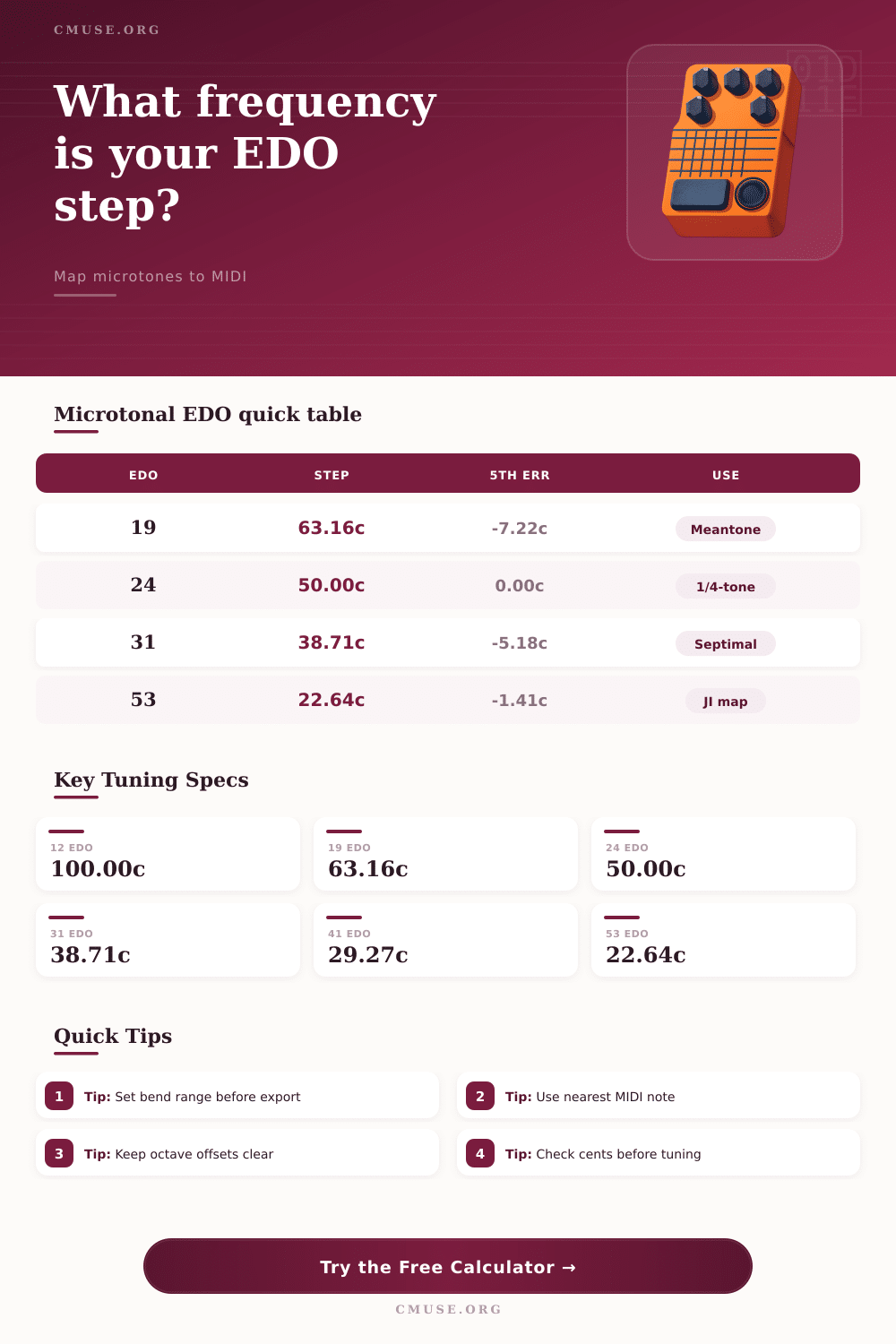
| 19 EDO | 63.16 cents | 694.74 cents | Meantone-like thirds, clean diatonic spelling, altered common-practice colors. |
| 22 EDO | 54.55 cents | 709.09 cents | Neutral thirds, bluesy inflections, small-step melodic systems. |
| 24 EDO | 50.00 cents | 700.00 cents | Quarter-tone notation, Arabic maqam approximations, orchestral microtonal sketches. |
| 31 EDO | 38.71 cents | 696.77 cents | Septimal harmony, meantone keyboards, rich chord lattices. |
| 41 EDO | 29.27 cents | 702.44 cents | Fine melodic shade, xenharmonic harmony, bend-heavy synth setups. |
| 53 EDO | 22.64 cents | 701.89 cents | Close 3-limit mapping, just-intonation approximations, detailed tuning study. |
| 72 EDO | 16.67 cents | 700.00 cents | Film scoring, cents-grid automation, very fine pitch shading. |
🎚 MIDI Pitch-Bend Planning Table
| Bend Range | Cents Covered | Approx Resolution | Recommended Use |
|---|---|---|---|
| +/- 1 semitone | +/- 100 cents | 0.012 cents per unit | Precise microtonal correction when notes stay near the chromatic grid. |
| +/- 2 semitones | +/- 200 cents | 0.024 cents per unit | Default synth setting, good for 19, 24, 31, and 53 EDO single notes. |
| +/- 12 semitones | +/- 1200 cents | 0.146 cents per unit | One-octave glide plans and coarse MPE zones. |
| +/- 24 semitones | +/- 2400 cents | 0.293 cents per unit | Wide pitch maps where every MIDI note may need a large bend. |
📋 Preset Reference Table
| Preset | EDO | Degree Target | Why It Matters |
|---|---|---|---|
| 12 EDO fifth | 12 | Degree 7 | Confirms the normal 700-cent fifth and center pitch-bend value. |
| 19 EDO meantone | 19 | Degree 11 | Shows a narrow fifth and strong meantone-style interval placement. |
| 24 EDO 1/4-tone | 24 | Degree 13 | Places a 650-cent interval between tritone and fifth targets. |
| 31 EDO septimal | 31 | Degree 18 | Maps a 696.77-cent fifth and usable seventh-harmonic colors. |
| 53 EDO fifth | 53 | Degree 31 | Demonstrates a close fifth at 701.89 cents for JI-style planning. |
📐 Interval Approximation Table
| Interval Goal | Pure Ratio Cents | 24 EDO Degree | 31 EDO Degree |
|---|---|---|---|
| Minor third 6:5 | 315.64 | 6 steps = 300.00 | 8 steps = 309.68 |
| Major third 5:4 | 386.31 | 8 steps = 400.00 | 10 steps = 387.10 |
| Perfect fifth 3:2 | 701.96 | 14 steps = 700.00 | 18 steps = 696.77 |
| Harmonic seventh 7:4 | 968.83 | 19 steps = 950.00 | 25 steps = 967.74 |
Microtonal music exist in the spaces between the keys of a piano. Microtonal music consists of pitches that isnt found in standard twelve-tone tuning. The calculator will convert those pitches into numbers that can be used to program a synthesizer or to write the note that will appear in a musical score.
These numbers will allow a composer to make choices about the width of intervals in a composition rather than guessing which notes should be used. EDO stands for “equal divisions of the octave,” and it ask the composer to divide the space between one pitch and the octave above that pitch into any number of steps. If the composer divides the number of steps into twelve, then the result is standard piano tuning.
How to Use the Microtonal Music Calculator
If the number of steps is divided into nineteen, third will be closer to the natural harmonic series. Thirty-one steps will allow for the use of harmonic sevenths without retuning the instrument. Any number of steps will determine the size of all intervals in a composition.
The reference note will become the standard from which all other pitches will be measured. Using A4 at 440 Hz will align the music to most recording studio. However, 432 Hz or 442 Hz can also be used as the reference note.
Shifting the reference note will shift all pitches in a composition. However, shifting the reference note will not change the relationship between pitch. The degree field asks for the number of steps that should be taken up or down from the reference note.
Positive degrees will shift the note up on the piano keyboard. Negative degrees will shift the note down on the piano keyboard. Most synthesizers can only play the twelve standard notes.
To play any note other than those twelve standard notes, the pitch must be bent. The bend range allow the composer to adjust how far the synthesizer can play from the standard chromatic notes. A narrow bend range will allow for greater precision when playing pitches close to standard notes.
A wide bend range will allow for playing additional pitches but sacrifice the precision with which they can be played. The deviation determines the difference between the chosen interval and the note in twelve-tone tuning. A small deviation will indicate the pitch can easily be played on the synthesizer using pitch bends.
A high deviation will require each interval to have its own MIDI channel on a synthesizer. Knowing the deviation will save time when determining whether a passage can be played in one hand or if it require two instruments. Musical composition will often move from one EDO system to another.
For instance, a composition may use 24 EDO for melodic lines but move to 31 EDO for a chord that contains a harmonic seventh. These shifts can be tested using this calculator. Testing these shifts will ensure that the composition sound intentional when played rather than accidental.
In addition, the calculator can be used to determine where a fifth will land in a specific EDO system. For some EDO systems, a fifth will land on the just intonation value. For other EDO systems, the fifth will not land on that just intonation value.
Notation is another aspect of microtonal music that many composer tend to underestimate. Beyond determining the cents offset from standard tuning, the composer also has to choose a means of writing the note in a score for a performer. Some composers use arrows to show pitch bends.
Others use entirely new clef or a color coding system to indicate where pitch bends should take place. The bend value calculated will not eliminate the need for notating a composition but will tell the composer if the performer will have to practice playing the obtained pitch bend. A composer should follow a specific order when using this calculator.
The composer should set the bend range first on the synthesizer. After that, the calculation should be performed. If the bend value is near the limit of the synthesizers bend range, then the bend range should be raised and the calculation perform again.
The composer should leave the octave offset in a separate field from the degree field so that the passage can be transposed. Following this order will avoid the mistake of discovering that a passage cannot be performed on the synthesizer with current settings. While the reference tables will provide context for the types of intervals that can be found in various EDO systems, the tables cannot replace the composer’s ear.
The tables will provide information about what intervals exist in various tuning systems. However, the composers ear is necessary for determining whether a chord will sound tense or relaxed when played. The numbers from the calculator is valuable in narrowing the composers compositional choices.
The composer’s ear will make the final decision on which options will be used in the composition. The same logic can be used to discuss the difference between musical projects. For instance, a film cue may use a 72 EDO system so that a held note can drift in pitch over time.
However, for a string quartet in the same film score, 19 EDO may be used so that the thirds sound bright and clear. This calculator does not make a decision for the composer about which EDO system best fit which part of a score. However, it does allow the composer to focus on the musical decisions rather than on the arithmetical calculations.
When exporting files from a digital music composition program, the calculator’s mathematical calculations have done their job if the intervals within the composition sound correct and if the pitch bends do not draw attention to themself.