Microphone Sensitivity Calculator
Convert sensitivity, capsule SPL, output voltage, and preamp gain from one mic setup.
🎤 Microphone Presets
📏 Distance and Signal Setup
📊 Mic Quick Spec
📖 Reference Tables
| Type | Sensitivity | Impedance | Common use |
|---|---|---|---|
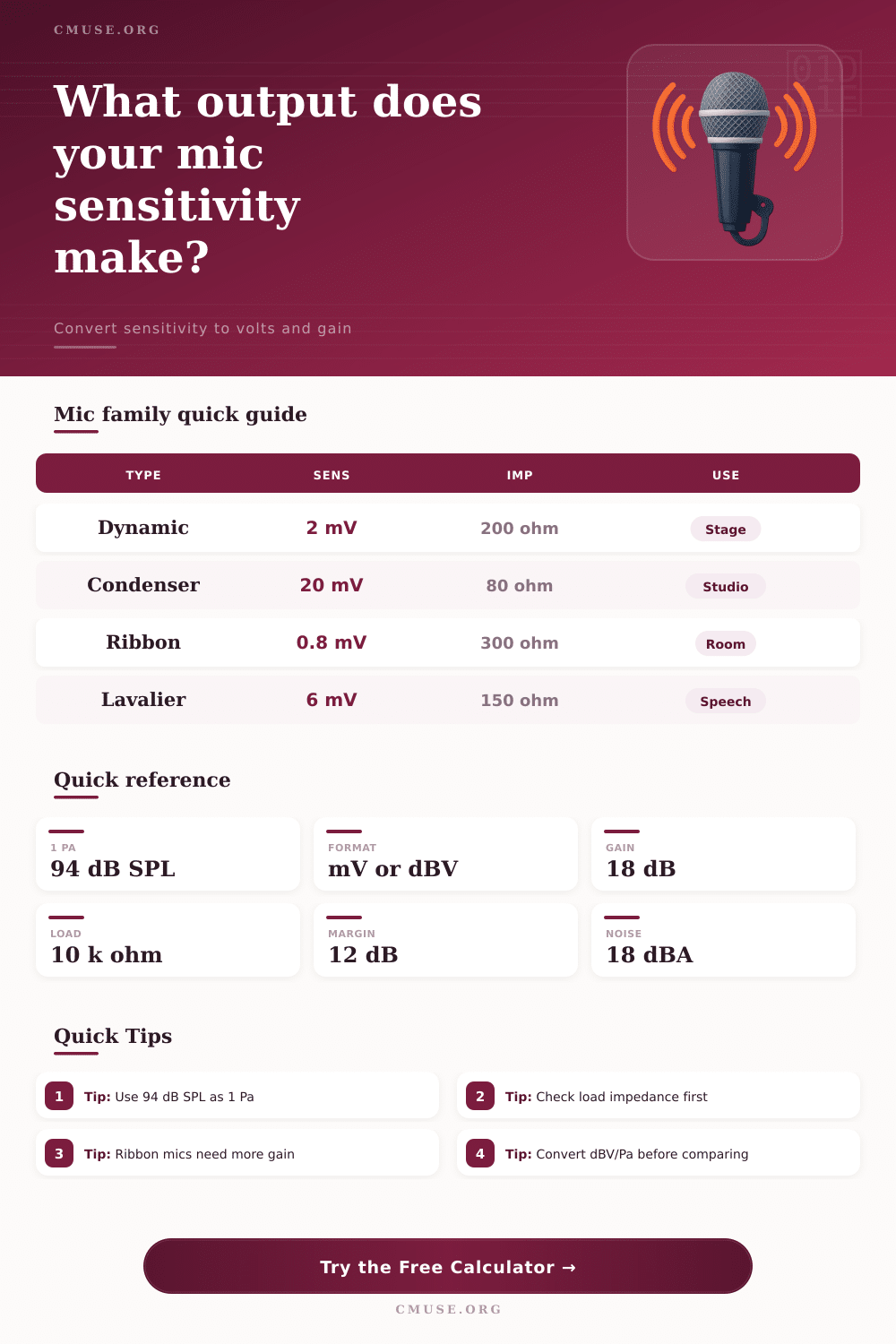
| Dynamic handheld | 1.5-3.5 mV/Pa | 150-600 ohms | Live vocal and speech |
| Large condenser | 10-30 mV/Pa | 50-200 ohms | Studio vocal and detail |
| Ribbon figure 8 | 0.2-2.0 mV/Pa | 150-300 ohms | Warm room and brass |
| Lavalier / headset | 3-10 mV/Pa | 150-600 ohms | Speech and broadcast |
| Shotgun / boom | 8-20 mV/Pa | 100-200 ohms | Dialogue capture |
| dB SPL | Pressure | Pa note | Use |
|---|---|---|---|
| 74 dB | 0.10 Pa | Very quiet | Soft speech |
| 84 dB | 0.32 Pa | Close voice | Speech booth |
| 94 dB | 1.00 Pa | Reference | Calibration point |
| 104 dB | 3.16 Pa | Loud source | Live vocals |
| 114 dB | 10.00 Pa | Peak hit | Drums and amps |
| Sensitivity | Open output | dBV | dBu |
|---|---|---|---|
| 1 mV/Pa | 1.00 mV | -60.0 dBV | -57.8 dBu |
| 2.5 mV/Pa | 2.50 mV | -52.0 dBV | -49.8 dBu |
| 10 mV/Pa | 10.00 mV | -40.0 dBV | -37.8 dBu |
| 20 mV/Pa | 20.00 mV | -34.0 dBV | -31.8 dBu |
| 30 mV/Pa | 30.00 mV | -30.5 dBV | -28.3 dBu |
| Source Z | Load Z | Ratio | Effect |
|---|---|---|---|
| 150 ohms | 10 k ohms | 98.5% | Very clean |
| 200 ohms | 2 k ohms | 90.9% | Still fine |
| 250 ohms | 1 k ohms | 80.0% | Some loss |
| 300 ohms | 600 ohms | 66.7% | Vintage load |
| 600 ohms | 600 ohms | 50.0% | Heavy loading |
💬 Practical Notes
Microphone sensitivity is a measurement of how much electrical voltage are produced by the capsule of a microphone given a specific amount of sound pressure. The sensitivity of a microphone is important in that the sensitivity of a microphone will determine the amount of gains that is required from a preamplifier to reach the target level of the signal. Microphones with low sensitivity requires a large amount of gain to amplify the signal to an appropriate level; the use of such a large amount of gain, however, can increase the amount of noise that is present in the signal.
Microphone sensitivity is typically expressed in either millivolts per Pascal (mV/Pa) or decibel relative to one volt per Pascal (dBV/Pa). Each of these units is a measure of the voltage produced by the microphone when exposed to a sound pressure level of 1 Pascal, which is equivalent to 94 decibels of sound pressure level (dB SPL). By using this standard unit of measurement for microphone sensitivity, it is possible to compare the sensitivity of different microphones.
How Microphone Sensitivity Affects Sound
For instance, dynamic microphones may have a sensitivity of 2 mV per Pascal, while condenser microphones may have a sensitivity of 20 mV per Pascal. Thus, because the condenser microphone produce more voltage than the dynamic microphone, the condenser microphone will require less gain to amplify its signal to an appropriate level. The distance between the sound source and the microphone can impact the amount of sound pressure that the microphone capsule receives.
As the distance between the sound source and the microphone increases, the amount of sound pressure that the microphone capsule receives decreases. Furthermore, as a singer, for example, moves further away from the microphone, the amount of sound pressure that the microphone receives will decrease, which will impact the amount of electrical voltage that that microphone produces. In addition to the distance between the sound source and the microphone that impacts the amount of sound pressure that is received, the placement of the microphone can also impact the amount of sound pressure that is received by the microphone.
Finally, because the amount of sound pressure that is received by the microphone changes based on its distance from the sound source, it is important to understand the sound pressure that will be emit from the sound source to calculate the voltage that will hit the microphones diaphragm. Impedance is another factor that can impact the voltage that is received from a microphone. Every microphone has a source impedance, and every preamplifier have a load impedance.
The preamplifier receives the voltage that is equal to the open-circuit voltage of the microphone multiplied by a loading ratio. The loading ratio is calculated by dividing the load impedance of the preamplifier by the sum of the source impedance of the microphone and the load impedance of the preamplifier. Thus, if the load impedance is much higher than the source impedance, the voltage of the signal will be high; however, if the load impedance is low relative to the source impedance, the voltage will be lower than the open-circuit voltage of the microphone.
For instance, if a ribbon microphone with an impedance of 300 ohms is connected to a load of 600 ohms, the voltage of the signal will be halved. Because most moddern preamplifiers has a high impedance relative to that of a microphone, most engineers dont have to worry about signal loss due to impedance mismatch; however, due to the presence of headroom in some vintage audio equipment or long audio cables, impedance mismatches can occur. Furthermore, because low-sensitivity microphones require high gain to amplify their signals to an appropriate level, the self-noise of the microphone preamplifier can become more audible in the signal.
Another specification regarding microphones is the maximum sound pressure level (SPL) at which the microphone capsule does not begin to distort the sound waves. Every microphone has a maximum SPL that it can handle; if the SPL of the sound that is received by the microphone reaches this maximum level, the capsule will begin to distort the sound. For instance, many condenser microphones used in recording studios have a maximum SPL of 140 dB, which is often sufficient for the microphone to capture quiet sounds; however, the SPL may be too low for loud sounds, such as those made by a snare drum.
Headroom is the amount of space between the SPL of the sound source that is used in the microphone and the maximum SPL of the microphone. Additionally, engineers typically aim for a target line level for the signal that is received by the microphone, which is around -18 dBu. Thus, headroom is used to make sure that the gain that is applied to the signal is not too high; otherwise, the signal will clip.
Ribbon microphones are a specific type of microphone that typically have very low sensitivity to sound pressure. Because ribbon microphones have low sensitivity, they require a large amount of gain to amplify the signal to an appropriate level. For instance, ribbon microphones can have a sensitivity as low as -60 dBV/Pa; thus, ribbon mics will produce very little voltage when exposed to SPLs of 94 dB.
Because ribbon microphones require so much gain to amplify the signal to an appropriate level, a preamplifier with a low noise floor is required to avoid the loudness of the noise of the preamplifier. Dynamic microphones, in contrast, have higher sensitivity than ribbon mics, and condenser mics have the highest sensitivity of all microphone types. For these reasons, engineers often use dynamic microphones in live sound for loud sounds that are made by performers on stage, while condenser mics are often used in recording studios to capture quieter sounds.
By considering each of these factors, such as impedance, distance between the source of the sound and the microphone capsule, and the maximum SPL that a microphone can take before distorting the sound, engineering technicians can avoid common mistakes when setting up a microphone for use. For instance, they will not assume that the sensitivity figure that is listed for the microphone is the voltage that the microphone will receive; the distance between the sound source and the microphone will change the voltage that is received by the microphone. Furthermore, they will take into consideration the maximum SPL of the microphone; otherwise, the sound may distort.
Additionally, if a low-sensitivity microphone is to be used, the gain and noise characteristics of the preamplifier must be considered to ensure that the signal is amplified to an appropriate level without adding too much noise. Thus, by calculating the loaded output of the microphone and comparing that value to the target line level that should be obtained from the microphone signal, engineering technicians can ensure that their microphone setup is working correct.