Metric Modulation Calculator
Convert a pivot rhythm into a new tempo and compare the beat lengths across both meters.
🎶 Presets
📏 Inputs
📊 Reference Table
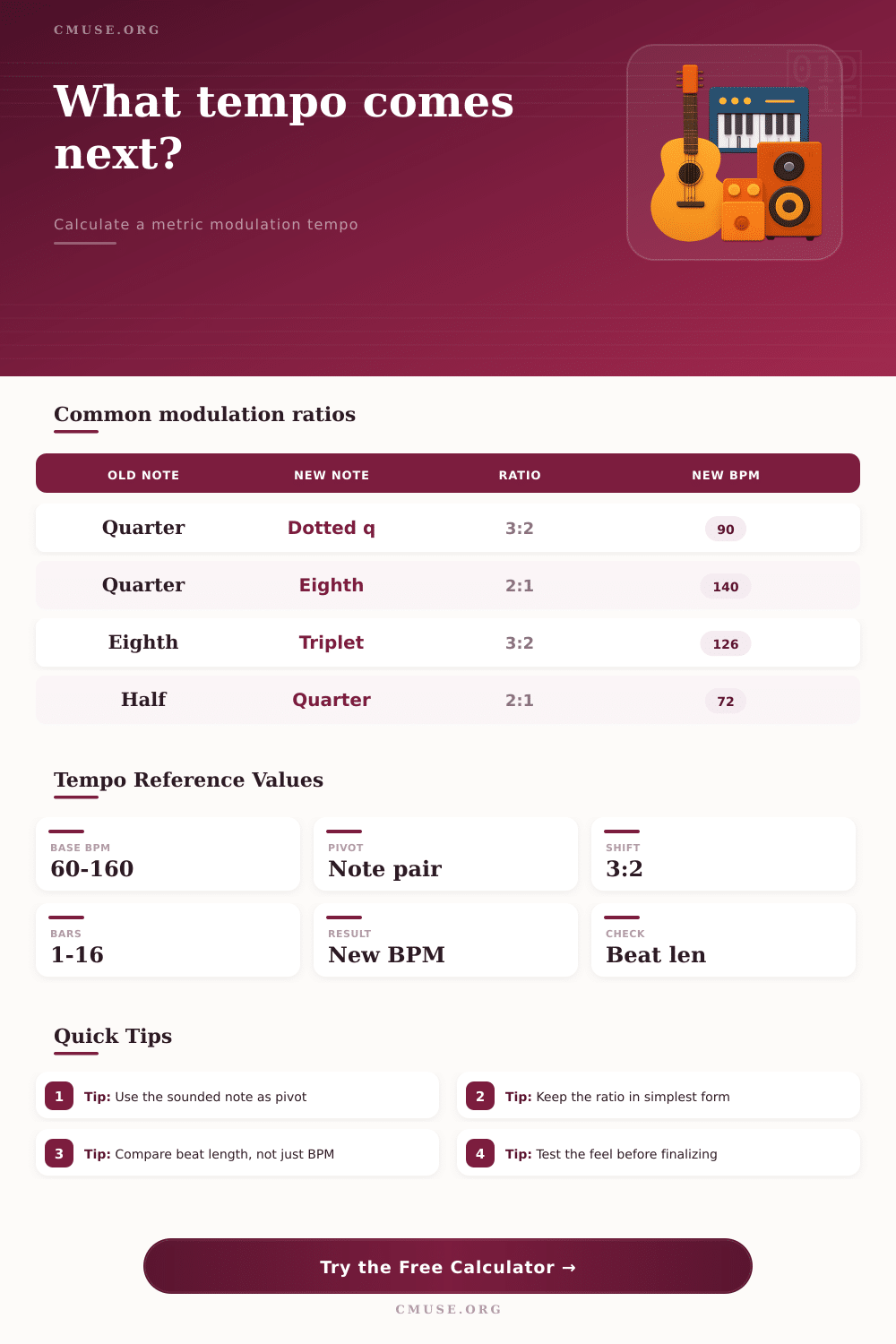
| Old note | New note | Ratio | Tempo effect |
|---|---|---|---|
| Quarter | Dotted q | 3:2 | Slows |
| Quarter | Eighth | 2:1 | Faster |
| Eighth | Triplet | 3:2 | Faster |
| Half | Quarter | 2:1 | Faster |
🎯 Common Modulations
Metric modulation is a method that alters the feeling of rhythm in music. It gives the impression of faster or slow rhythm although the real beat stays same. The word points to music where rhythms cross according to particular rhythmic values that have a different role in the new rhythm than in the old.
In metric modulation a note value from the first rhythm matches in pace to another note value in the next rhythm. That can happen during a change of time signature but without change of rhythm. Most commonly it relates to motion of one rhythm and signature to another where one note value from the first becomes equivalent to a value in the second.
How Metric Modulation Changes Rhythm
Metric modulation happens by means of regrouping of beat divisions. The new groups divide into more or fewer parts, which makes the rhythm faster or slow. For instance section A goes in 72 rhythms in a minute, later section B starts in 144 rhythms in a minute.
Rhythm is modulted also by means of ritardando or accelerando. You call that metric modulation because the rhythm adjusts during the flow of the music.
Elliott Carter first used metric modulation. It ensures that rhythm changes are precise. With instructions as “ritardando to Largo” or “accelerando to Allegro” it is impossible to reach an exact metronome.
Musicians should guess the new rhythm because they cannot use a metronome on stage. Metric modulation however ensures a clean rhythm if the performer stays in time. Parts of Carter as Eight Etudes and Fantasy use it to go to a faster rhythm.
The piece starts with a quarter note in 96 and during the change to 120 he writes sixteenth note in quintuplet that matches four sixteenth notes in the new rhythm.
Of quarter notes in 96 it ends in dotted quarter in 64, the eighth note stays same, but rhythm adjusts. Of quarter in 96 to dotted quarter in 96 the rhythm stays same, but subdivision adjusts. Occasionally you write that as L’istesso Rhythm.
For making the change more natural, identify the duration of a note from the current rhythm to a note in the future. A simple jump of 4/4 to 6/8 with same rhythms alters the feeling of accents. When the next cycle starts, the slow pulse of 6/8 reinterprets itself as a quarter pulse in 4/4, which slows the whole rhythm.
The ear catches a new notion, smooth transition and final solution in a fresh rhythm. Indian classical music has a similar tradition by means of proportionate cycles that alter without suspension of the basicrhythm.